

Contact forces: muscles and friction
Exploring Forces14 min readLesson 2 of 5
2.1 Forces that need contact
Many forces are applied only when two objects touch. The contact may be direct, as when a hand pushes a box, or indirect, as when a stick or a rope is used. Forces of this kind are called contact forces. Two important contact forces are muscular force and friction.
2.2 Muscular force
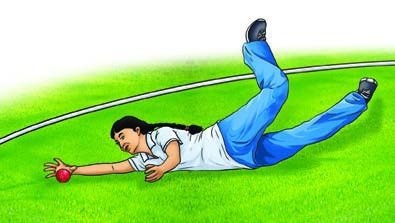
Whenever you walk, run, lift, push, jump or stretch, your muscles are doing the work. Muscles contract and elongate to produce a force, and the force that results from the action of muscles is called muscular force. Animals, birds, fish and insects also use muscular force to move and to survive.
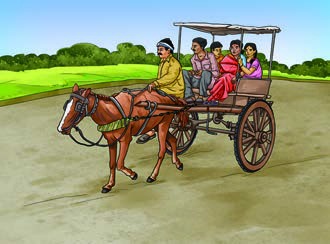
Human beings have used the muscular force of animals for centuries. Horses and bullocks pull carts, carry loads and plough fields. The same force works inside our own bodies. Muscles help us chew food and push it along the alimentary canal during digestion, and the contraction and relaxation of heart muscles keeps blood circulating.
2.3 Friction
A ball rolling over level ground gradually loses speed and stops. A bicycle left to coast on a flat road also slows and halts. On a rough road it stops sooner than on a smooth one. No one seems to be pushing against the ball or the bicycle, yet their speed decreases. A force must be responsible.
A simple activity shows the force at work. Place a flat-based object, such as a lunch box or a notebook, on a table and give it a gentle push. It slides some distance and stops. The surfaces of the object and the table are in contact while it slides, and the force between them acts opposite to the direction of motion. This force is called friction. Whenever one surface slides, or attempts to slide, across another, friction appears and pushes against the motion or the attempted motion.
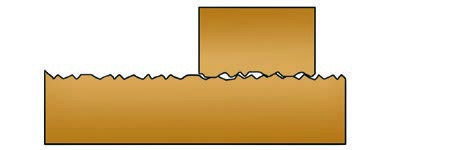
Friction arises because surfaces are not perfectly smooth. Every surface has minute irregularities, and where two surfaces touch, these irregularities lock into each other and oppose sliding. Even a surface that feels smooth has many tiny bumps and hollows.
2.4 Surfaces decide the friction
The chapter's next activity repeats the sliding test on glass, cloth, wood, a ceramic tile and sand. The object travels different distances on different surfaces, which shows that friction depends on the nature of the surfaces in contact. Rough surfaces produce more friction than smooth ones.
Friction is not limited to solids. Air, water and other fluids also exert friction on objects moving through them. That is why aeroplanes, ships, boats and fast trains get special shapes that reduce the friction caused by the air or water around them.
2.5 Muscular force inside the body
Muscular force also keeps the body working from the inside. Muscles help us chew food, and the muscles of the alimentary canal push the food along in waves during digestion. The heart is a muscular organ whose contraction and relaxation keep blood moving through the body. Even sitting upright and holding the head steady depends on muscles working against gravity.
Animals show the same principle in different ways. A horse pulls a carriage, a bird flaps its wings to fly, a fish swings its body to swim, and an insect moves its legs to walk. In each case, muscles contract and pull on bones or other body parts, and the force that results moves the animal or something it is carrying.
2.6 Why rough surfaces grip better
Friction begins at the tiny scale of the surfaces. Two apparently smooth surfaces are actually covered with minute bumps and hollows. When they are pressed together, the bumps of one surface settle into the hollows of the other, and sliding has to break these tiny interlockings. A rough surface has larger irregularities, so the locking is stronger and more force is needed to slide one surface over the other.
That is why a rough path makes pedalling harder but gives the tyres more grip, while a smooth floor lets a box slide further. A wet floor is slippery because the water fills the hollows and reduces the direct contact between the surfaces, so the friction becomes smaller. The same idea explains why a ball rolls further on a smooth floor than on a rough one.
2.7 Friction in air and water
Fluids also resist motion. A cyclist riding into the wind feels the air pushing back, and a swimmer feels the water resisting each stroke. Engineers shape aeroplanes, ships, boats and high-speed trains to reduce this fluid friction and save energy. The shapes do not remove friction completely; they reduce it enough to make motion efficient.
2.8 Friction can be useful
Friction also helps us move safely. The grip between our feet and the ground lets us walk without slipping. Friction between the tyres and the road lets a bicycle turn without skidding. Brakes work by pressing surfaces together so that friction slows the wheel. In these cases, a larger friction is helpful, and engineers design the surfaces accordingly.