

Non-contact forces: magnets, charges and gravity
Exploring Forces15 min readLesson 3 of 5
3.1 Forces that act without touching
Some forces still act when the objects are apart. These are called non-contact forces. The chapter studies three of them: magnetic force, electrostatic force and gravitational force.
3.2 Magnetic force
You already know that magnets pull on things made of magnetic materials. Bring two magnets close and the like poles (north and north, or south and south) push each other away, while unlike poles (north and south) pull each other closer. Attraction and repulsion are both forms of push and pull, so both are forces.
The chapter's activity uses two ring magnets on a vertical wooden stick. When the like poles face each other, the upper magnet floats above the lower one. Pushing it down gently feels like fighting a force. Reversing the poles changes what happens. A magnet, in short, can push or pull another magnet without touching it. That push or pull from a magnet on another magnet or on a magnetic material gets the name magnetic force, and it is a non-contact force.
3.3 Electrostatic force
Rub a plastic scale or a plastic straw vigorously with a piece of polythene, then bring the rubbed part near small pieces of paper without touching them. The paper pieces jump towards the scale and stick to it. Rubbing the two materials has built up electrical charges on their surfaces. Such charges do not move on their own, so they are called static charges, and the object that has them is a charged object.
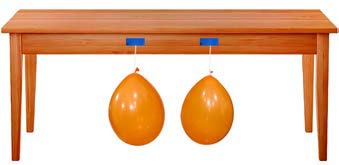
A second activity uses two inflated balloons hanging from threads. Rub both balloons with a woollen cloth and release them. They move apart, as if repelling each other. Bring the woollen cloth near one rubbed balloon and the two attract each other. Both balloons received the same kind of charge, so they carry similar charges; their repulsion shows that like charges repel. The cloth and the balloon carry opposite charges, and their attraction shows that unlike charges attract. There are two kinds of static charge, labelled positive and negative.
The force a charged object applies to another charged object, or to an uncharged one, is called electrostatic force. It can act across a gap, so it is a non-contact force. When charges move, they form an electric current, which is the same current that can light a lamp or produce heat and magnetism.
3.4 Gravitational force
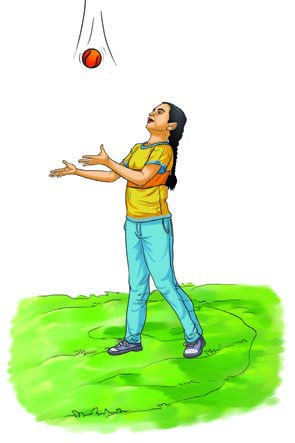
Throw a ball straight up and it eventually falls back to the ground. Throw it harder and it still comes back. Every object thrown up, in any direction, finally returns to the Earth or the floor. Since all these objects move towards the Earth, the Earth must be attracting them. The force with which the Earth pulls objects towards itself is called gravitational force, or the force of gravity.
Gravity acts without touching the object, so it is a non-contact force. It is always attractive, unlike magnetic and electrostatic forces, which can attract or repel. The chapter describes the vertical motion of an object. Dropped from a height, it moves straight down. Thrown vertically upwards, it moves up straight, slows down, stops for a moment at the top, and then moves straight down again, speeding up as it falls. While going up, the speed decreases; while coming down, the speed increases.
3.5 Testing a non-contact force
How do we know that a force is acting without contact? We look for its effects. Two ring magnets with like poles facing stay apart even when nothing holds them together. A rubbed plastic scale pulls paper pieces towards it before it touches them. A ball thrown upwards changes its speed and direction even though no hand is touching it. In each case, the effect appears across a gap, which is the signature of a non-contact force.
The tests also show that the effect depends on distance and on the objects involved. The magnetic float disappears if the poles are reversed. The paper pieces behave differently if the scale has not been rubbed. The ball always comes down under gravity. Comparing what happens when the conditions change is how an investigator decides which force is at work.
3.6 Comparing the three non-contact forces
| Force | Can it attract? | Can it repel? | What produces it? |
|---|---|---|---|
| Magnetic force | Yes | Yes, between like poles | Magnets and magnetic materials |
| Electrostatic force | Yes | Yes, between like charges | Charged or rubbed objects |
| Gravitational force | Yes | No, it is always attractive | Any two objects with mass, noticeable because of the Earth |
The table shows how the three forces differ. Magnetic and electrostatic forces can push objects apart as well as pull them together, while gravity only pulls. Gravity is also the one we feel all the time, because the Earth is so large.
3.7 Why vertical motion matters
The up-and-down motion of a thrown object is a clear example of a force acting throughout a journey. On the way up, gravity slows the object. At the top, the speed becomes zero for a moment as the direction reverses. On the way down, gravity speeds the object up again. The pattern is so regular that it can be used to predict how high a ball will go and how long it will stay in the air, which is useful in games and in engineering.