

Force: a push or a pull
Exploring Forces13 min readLesson 1 of 5
1.1 A windy ride
The chapter opens with two friends, Sonali and Ragini, setting off on their bicycles on a windy day. Riding against the wind, Ragini feels pushed hard and has to pedal with more effort. Some parts of the path are rough and hard to pedal on; other parts are smooth. At the top of the hill they turn back, and on the slope down they notice something strange: the bicycles pick up speed even when nobody is pedalling. Something seems to be pulling them downhill.
The chapter's opening questions come from the same sort of experience. Why is pedalling uphill harder than on level ground? Why is a wet surface easier to slip on? Why do we feel light just after a swing reaches its highest point and starts to come down? Each question is really a question about force.

1.2 Push and pull
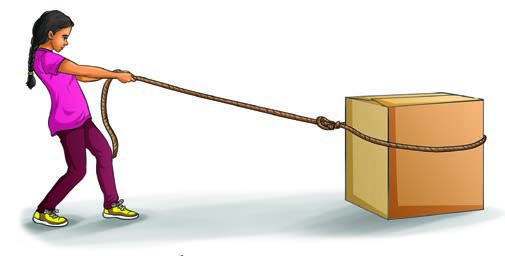
The first activity asks you to move a large cardboard box in as many ways as you can. You might push it, pull it, lift it or carry it. In every method, you apply a push or a pull to the box. Scientists give this push or pull a name: force. Push and pull are the two basic ways of describing a force.
1.3 Forces come from an interaction
Push a table and two things are involved: your hand and the table. The two are interacting, and the force belongs to that interaction. Whenever one object interacts with another, the push or pull that appears on either of them is a force. At least two objects must be involved. While you push the table, the table also pushes back on your hand; when you stop pushing, both forces disappear.
The SI unit of force is the newton, written with a small n and represented by the symbol N. The unit is named after Isaac Newton, whose work on motion you will meet again in higher classes.
1.4 What a force can do
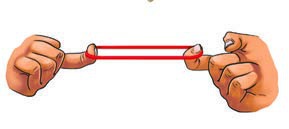
Everyday life is full of forces. A drawer is pulled open, a rubber band is stretched, a fielder stops a ball, a football is kicked, brakes are applied on a bicycle, a chapati is rolled, and the handle of an autorickshaw is turned. From such examples, the chapter lists the changes a force can produce.
| Action | Push or pull | Effect |
|---|---|---|
| A friend holds your moving bicycle from behind | Pull | Slows the bicycle and stops it |
| A bat hits a moving ball | Push | Changes the direction of the ball |
| An inflated balloon is pressed | Push | Changes the shape of the balloon |
A force can make an object move from rest, change the speed of a moving object, change its direction of motion, or change its shape. Sometimes one force causes several of these changes at once. A force is not always easy to see, but its effects can be seen.
1.5 Rest does not always mean no force
An object at rest may look as if no force is acting on it. In fact, it may have forces acting on it that balance one another; you will study balanced forces in higher classes. For this chapter, the useful rule is that a change in speed, direction or shape tells us that a force is at work.
1.6 Recognising forces in daily actions
The chapter's examples make a useful checklist. Opening a drawer is a pull; stretching a rubber band changes its shape; a fielder stopping a ball slows it; kicking a football starts it moving; applying brakes slows a moving bicycle; rolling a chapati changes its shape; turning the steering handle of an autorickshaw changes its direction. Each action can be named as a push or a pull, and each effect can be named as a change in motion or shape.
This habit of naming the action and the effect is the first step in analysing any force situation. Instead of saying "some force happened", a student can say what was pushed or pulled, in which direction, and what changed as a result.
1.7 When the wind pushes back
In the opening story, Ragini feels the wind pushing her hard as she cycles against it. The moving air is applying a force on her and her bicycle. She cannot see the wind, but she can feel the push and see its effect on her speed and effort. The same lesson applies to many invisible forces: their presence is known from what they do.
The opening questions point to other effects. Pedalling uphill is harder because the bicycle must also be pushed against the pull of gravity along the slope. A wet surface is easier to slip on because friction is reduced. The feeling of lightness near the top of a swing comes from the way speed and direction change during the up-and-down motion. None of these experiences can be explained without forces.
1.8 Forces come in pairs of interactions
When two objects interact, both feel a force. Your hand pushes the table, and the table pushes back on your hand. A bat hits a ball, and the ball pushes back on the bat. The two forces belong to the same interaction and appear together; when the interaction stops, both forces disappear. This is why the chapter describes a force as a push or pull that results from an interaction rather than as something an object owns.
The idea helps explain everyday situations. A swimmer pushes water backwards, and the water pushes the swimmer forwards. A walker pushes the ground backwards, and the ground pushes the walker forwards. In both cases, the motion comes from a pair of forces acting on two different objects.