

Density, floating and quick revision
The Amazing World of Solutes, Solvents, and Solutions16 min readLesson 4 of 5
4.1 Why objects float or sink
Husk particles float on water while rice sinks. Oil floats on water. A wooden stick and an iron rod of the same size feel very different, because iron is denser than wood. Floating and sinking are not decided by height or size alone; density is the property that matters most.
Density tells the mass in one unit of volume, written as density = mass ÷ volume. The SI unit is kilogram per cubic metre (kg/m³). For convenience, liquids and solids are also measured in grams per millilitre (g/mL) and grams per cubic centimetre (g/cm³). The conversion is 1 kg/m³ = 1 g/L = 0.001 g/cm³.

At room temperature, 1 mL of water has a mass of about 1 g, so water's density is roughly 1 g/cm³. An aluminium block of mass 27 g and volume 10 cm³ has a density of 27 ÷ 10 = 2.7 g/cm³. Aluminium is 2.7 times as dense as water, and this number, aluminium's relative density compared with water, has no units.
Density is independent of the shape or size of an object. A lump of modelling clay has the same density whether it is moulded into a cube or flattened into a sheet, because both its mass and its volume stay the same.
4.2 Heating, pressure and density
Heating a substance makes its particles move apart, so its volume increases while its mass stays the same. Since density is mass divided by volume, the density decreases on heating and increases on cooling. Warm air is less dense than the cooler air nearby, which is why it rises, and a hot air balloon floats for the same reason.
Pressure affects the density of gases strongly: pressing a gas into a smaller volume brings its particles closer, so its density rises. Liquids are nearly incompressible, so pressure changes their density only slightly, and solids are affected even less.
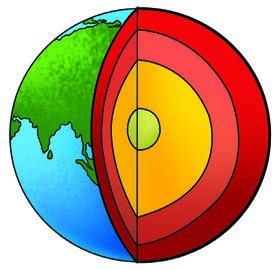
The Earth itself shows density layering. The crust is the lightest layer, and density increases towards the centre as pressure and temperature rise. This is a large-scale example of the same rule that particles packed more closely make a material denser.
4.3 Why ice floats
Ice floats on water because it is less dense than liquid water. Water has a special property: its density is highest at 4 °C. When water freezes at 0 °C, its particles arrange themselves so that the same mass takes up more space. The ice expands, its density falls below that of liquid water, and it floats.
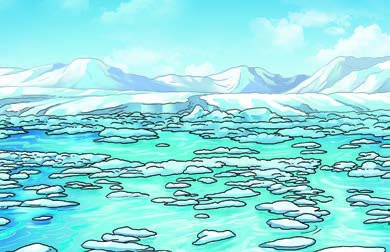
The floating layer of ice also matters for life. Because ice stays on top, the water below remains warmer than the air above, so fish and other organisms can survive extremely cold weather. Traditional bamboo rafts float for a related reason: bamboo is light and hollow, so its overall density is low.
4.4 Common mistakes to avoid
- Treating density as weight: density is mass divided by volume, and the two quantities have different units.
- Thinking heavy objects always sink: whether an object floats depends on its density rather than on its mass alone.
- Believing a saturated solution can always dissolve more solute: at that temperature it cannot.
- Assuming solubility always rises with temperature: this is true for most solids but not for gases, whose solubility in water falls as it warms.
- Thinking a solution must be a liquid: air is a solution of gases, and an alloy is a solid solution.
- Saying ice is denser than water: ice is less dense because its particles occupy more space.
- Reading a measuring cylinder from the top of the meniscus for colourless liquids: read the bottom, with the eye level.
- Believing density changes when a material is reshaped: density stays the same when only the shape changes.
Exam
For solution questions, name the solute and the solvent and check the rule: solid in liquid means the liquid is the solvent; two liquids means the larger amount is the solvent. For density questions, write density = mass ÷ volume, use g/cm³ or kg/m³ consistently, and compare with the density of water (about 1 g/cm³) to decide whether an object floats. Remember that gases dissolve less as water warms, while most solids dissolve more as water warms.
- Define solution, solute and solvent with one example of each.
- Explain how the solute and solvent are decided when two liquids are mixed.
- Differentiate saturated and unsaturated solutions at a given temperature.
- Explain concentration, dilute and concentrated solutions with an example.
- Describe how temperature affects the solubility of solids and of gases.
- Explain how mass and volume are measured, including taring and the meniscus.
- Define density and relative density and give the formula for each.
- Explain why ice floats and how density changes with heating and pressure.