

Measuring mass and volume
The Amazing World of Solutes, Solvents, and Solutions15 min readLesson 3 of 5
3.1 Mass and weight
The quantity of matter in an object is its mass, measured in grams and kilograms with a balance. The force with which the Earth attracts an object is its weight, measured in newtons. Most balances measure weight while displaying the result in mass units such as grams or kilograms.
A digital balance is easy to use, and a two-pan balance works by comparison. Shopkeepers often use either type, and both give the mass when they are in working order.
3.2 Using a digital balance
Switch the balance on and check that the display reads zero. If it does not, press the tare or reset button to bring it to zero. Put a clean, dry watch glass or a piece of butter paper on the pan and note the reading. Then press tare again so that the display returns to zero with the watch glass on the pan. Now place the object, such as a stone, on the watch glass, and read the mass shown, for example 16.400 g.
For a liquid, use a beaker instead of a watch glass and pour the required amount into it. Taring removes the mass of the container, so the reading gives the mass of the liquid alone.
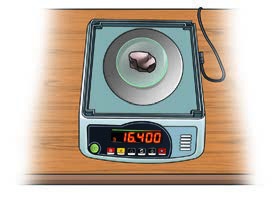
3.3 Units of volume
The space occupied by an object is its volume. The SI unit is the cubic metre, written m³. For smaller objects, the decimetre cube (dm³) and the centimetre cube (cm³) are used, and a centimetre cube is also called one cc. Liquids are measured in litres (L), where 1 L = 1 dm³, and the millilitre (mL) is 1 cm³. A 200 mL pack of buttermilk therefore contains 200 cm³ of liquid.
3.4 Measuring cylinders
A measuring cylinder is a narrow transparent cylindrical container, open at one end and closed at the other, with markings along the side. Measuring cylinders come in many sizes, from 5 mL and 10 mL up to 250 mL and 500 mL, with 25 mL, 50 mL and 100 mL in between, and they can measure a chosen volume much more accurately than a beaker.
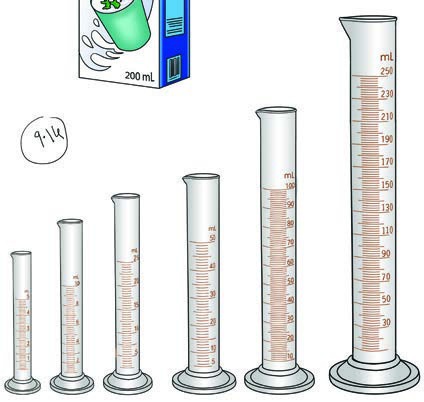
The smallest volume a cylinder can read depends on its capacity. Look at the gap between two large marks, count the small divisions between them, and divide. On the 100 mL cylinder shown in the chapter, the gap between 10 mL and 20 mL is covered by 10 divisions, so one division is 1 mL. Usually the smallest reading is 0.1 mL for small cylinders, 1 mL for a 100 mL cylinder, 2 mL for a 250 mL cylinder and 5 mL for a 500 mL cylinder.
Choosing the right cylinder matters. To measure 70 mL in one step, a 50 mL cylinder cannot do the job, while a 250 mL or 500 mL cylinder would give a less precise reading. A 100 mL cylinder can measure 70 mL in one step and is precise enough, so it is the best choice.
3.5 Reading the meniscus
Water and other colourless liquids form a curved surface in a glass cylinder, and this curve is called the meniscus. For colourless liquids, read the mark that lines up with the bottom of the meniscus, keeping the eye at the same level. For coloured liquids, read the top of the meniscus instead. Pour slowly, and use a dropper to adjust the level if needed.
3.6 Volume of regular solids
For a cuboid, volume is length × width × height. A notebook 25 cm long, 18 cm wide and 2 cm thick has a volume of 25 × 18 × 2 = 900 cm³. A die or a box can be measured in the same way.
3.7 Volume of irregular solids
For a stone or a key, no formula is available, so the displacement method is used. Fill a measuring cylinder with a known volume of water, say 50 mL, then lower the object in with a thread. The level rises to, say, 55 mL. The volume of the object is the rise in level, 5 mL, which equals 5 cm³. With a mass of 16.400 g, the density is mass divided by volume, or 16.400 g ÷ 5 cm³ = 3.28 g/cm³.
3.8 Choosing the right instrument
A beaker can hold a liquid but its wide shape makes the reading rough. A measuring cylinder is narrow and tall, so a small change in volume produces a clear change in height, and the scale can be read more precisely. That is why measuring cylinders are preferred when a specific volume is needed.
The capacity of the cylinder sets the trade-off. A small cylinder can read small volumes precisely but may be too small for the job. A large cylinder can take the full volume in one step but its smallest division is bigger, so the reading is less precise. Matching the cylinder to the volume being measured gives both convenience and accuracy.
3.9 From measurements to density
Mass and volume become useful together when they are used to calculate density. The mass comes from a balance, the volume from a formula or the displacement method, and density is mass divided by volume. A stone that displaces 5 mL of water and has a mass of 16.400 g has a density of 3.28 g/cm³.
Density belongs to the material, not to the particular piece. A small stone and a large stone of the same kind have the same density, because a larger piece has both more mass and more volume in the same proportion. This is why density is a useful way to identify a substance.