

Solute, solvent and solution
The Amazing World of Solutes, Solvents, and Solutions14 min readLesson 1 of 5
1.1 Every sip tastes the same
Oral rehydration solution, or ORS, helps treat dehydration by restoring the body's water. A homemade ORS is made by adding sugar and salt to water. Each sip tastes the same however much you drink, because the sugar and salt are spread evenly through the water and form a uniform mixture.
Not every mixture is uniform. Chalk powder, sand and sawdust mixed with water give non-uniform mixtures, where the solid does not spread evenly and may settle or float. Salt and sugar in water give uniform mixtures, where the components are evenly distributed throughout.
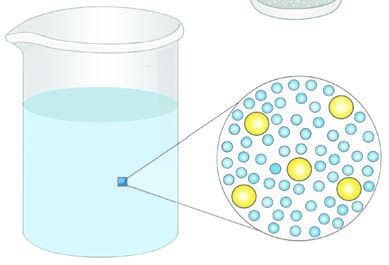
1.2 Solution, solute and solvent
A uniform mixture such as salt in water or sugar in water is called a solution. For a solution of a solid in a liquid, the solid is the solute and the liquid is the solvent. The solute passes into the solvent, and the result is the solution.
Solute + Solvent gives Solution
In salt water, salt is the solute and water is the solvent. In sugar water, sugar is the solute and water is the solvent. The solute is present in a smaller amount in these examples, but amount is not the deciding factor; the roles depend on the state and the way the mixture is described.
1.3 Solutions made from two liquids
For a solution made from two liquids, deciding which one dissolves the other can be tricky. Usually the liquid in the smaller quantity is called the solute, and the liquid in the larger quantity is called the solvent. This rule is used when both components are liquids.
1.4 Gases can form solutions too
Air is a mixture of several gases, and it is a uniform mixture. A mixture of gases that is uniform is also considered a solution, because the gases are evenly mixed and are not chemically combined. Oxygen dissolved in water is another example: the mixture is uniform even though oxygen dissolves only slightly.
1.5 The sugar syrup of gulab jamun
Gulab jamun is served in chashni, a sugar syrup made from a large amount of sugar dissolved in a small amount of water. Here the solid sugar is present in a larger amount and the water in a smaller amount, yet water is still called the solvent and sugar the solute. That is because this is a solid-liquid solution, and in such solutions the liquid is the solvent regardless of how much of each is present.
1.6 Examples around us
Seawater is a solution of salt in water, and soda water is a solution of carbon dioxide in water. Lemonade is a solution of sugar and flavourings in water, and vinegar is a solution of acetic acid in water. An alloy can be viewed as a solid solution of one metal in another. These examples show that solutions are not limited to liquids; the state of the mixture can be solid, liquid or gas.
1.7 Solutions in the kitchen
Tea and coffee are solutions made by extracting colour and flavour from leaves or beans into hot water. Salt and sugar disappear into curries and drinks. ORS combines two solutes, sugar and salt, in the same water. In each case the liquid is the solvent, and the dissolved substances are the solutes.
The solid-liquid rule holds even when a recipe uses a lot of solid. In chashni the sugar is the larger component by amount, yet water remains the solvent because the mixture is a solution of a solid in a liquid.
1.8 Why solutions look clear
The particles of a solute are far too small to be seen, and they are spread evenly through the solvent. Light passes through such a mixture without being scattered strongly, so a solution usually looks clear. This is why sugar water is transparent even though it contains sugar.
Clearness is not the same as colourlessness. A solution of ink or potassium permanganate can be strongly coloured and still be uniform, because the colour comes from dissolved particles that are evenly spread. The test of a solution is even distribution, not the absence of colour.
1.9 More than two components
Many solutions contain more than two substances. ORS contains sugar, salt and water; seawater contains several salts dissolved in water; air contains many gases. A solution can have several solutes in the same solvent, as long as all of them are evenly distributed and no chemical reaction turns them into new substances.
Alloys are solid solutions with several components. Brass contains copper and zinc, and stainless steel contains iron, nickel, chromium and carbon. The components are mixed at the level of particles, which is why the material behaves as one uniform solid.