

Lenses and the images they form
Light: Mirrors and Lenses15 min readLesson 3 of 5
3.1 Curved transparent surfaces
A flat transparent glass window pane does not change the size or shape of objects seen through it. Curved transparent surfaces behave differently. Spread a thin film of oil on a glass strip, place a drop of water on it, and look down through the drop at printed text below. The drop forms a curved surface and the letters under it appear enlarged. The water drop is acting like a simple lens.
A magnifying glass works the same way. It is a lens that makes small print appear bigger.
3.2 What is a lens
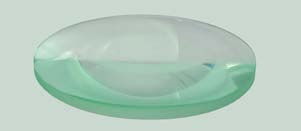
A lens is a transparent piece, most often glass or plastic, bounded by curved surfaces. Lenses can be convex or concave. A lens that is thicker at the middle than at the edges is a convex lens. A lens that is thicker at the edges than at the middle is a concave lens.
Light passes through a lens, unlike a mirror. Objects are viewed through a lens, not in it.
3.3 Images seen through lenses
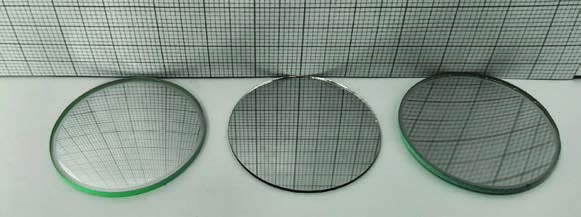
Place an object behind a convex lens and look at it from the other side. When the object is close to the lens, it appears erect and enlarged. As the object moves farther away, the image appears inverted; it is enlarged at first and then becomes smaller.
Repeat with a concave lens. Through a concave lens, the object always looks erect and smaller. Distance changes its size a little, but the image stays erect and diminished.
3.4 Converging and diverging
Parallel beams of light from a comb are passed through a thin glass plate, a convex lens and a concave lens, one by one. The thin glass plate lets the beams pass through as they are. The convex lens brings the beams together, so it is a converging lens. The concave lens spreads the beams apart, so it is a diverging lens.
The same property lets a convex lens concentrate sunlight. Used carefully under supervision, a convex lens can focus sunlight on paper until the paper scorches. The lens and the concave mirror both converge light, but the lens does it by bending light as it passes through, while the mirror does it by reflection.
3.5 Lenses in use
Lenses appear throughout daily life. Eyeglasses worn to see clearly are lenses. Cameras, telescopes and microscopes depend on lenses. Our own eye also contains a convex lens that changes shape. That change lets us read a book at close range and also see something far away.
The choice of lens depends on the job. A magnifying glass uses a convex lens, because it makes small print look larger. A camera also uses a convex lens to focus the light from a scene onto the film or sensor. A concave lens, by contrast, makes what is seen through it look smaller, and it is used where a reduced view is wanted. Each lens is chosen for the way it bends light.
3.6 A lens compared with a mirror
A mirror reflects light at its surface, and we see the image in the mirror. A lens lets light pass through, and we see the object through the lens. The image formed by a mirror is a reflection; the image seen through a lens is the result of light changing direction as it enters and leaves the transparent material.
Both devices can converge or diverge light, and both can form enlarged or diminished images. For a mirror, the shape of the reflecting surface decides the effect. For a lens, the shape of the two curved surfaces decides it. That is why a convex lens and a concave mirror are both converging, while a concave lens and a convex mirror are both diverging.
3.7 Looking again at the water drop
The water drop on the oiled glass is a small, simple lens. Its upper surface curves outward, and light passing through the drop changes direction. The letters under the drop look larger because the curved surface spreads the light from each point of the print over a wider angle as it reaches the eye.
The oil or wax is only there to make the water form a round drop instead of spreading out. The drop itself is the lens. This activity shows that a lens does not need to be made in a factory; any suitably curved transparent surface can act like one.
3.8 Image depends on distance
The table summarises what is seen through each lens at different distances.
| Lens | Object close | Object farther away |
|---|---|---|
| Convex lens | Erect and enlarged | Inverted, enlarged at first, then smaller |
| Concave lens | Erect and diminished | Still erect and diminished, size changes slightly |
The distance between the object and the lens is therefore part of the description of the image. Saying that a convex lens magnifies is only true for an object close to it. At a larger distance the same lens can produce an inverted image that is smaller than the object.
3.9 Choosing a lens
A convex lens is used when the aim is to magnify, focus or converge light: in a magnifying glass, a camera, a telescope or a microscope. A concave lens is used when the aim is to spread light or reduce the apparent size of an object. The choice depends on the job, not on which lens is better in general.
The human eye uses a convex lens that can change shape. That change allows the eye to focus on a nearby book and then on a distant tree without replacing the lens. Lenses in instruments do the same job with fixed or adjustable shapes.