

Uses of curved mirrors and the laws of reflection
Light: Mirrors and Lenses15 min readLesson 2 of 5
2.1 Concave mirrors at work
The reflectors of torches and the headlights of cars and scooters are concave. Their curved shape spreads the light from the bulb into a beam that travels forward. A dentist uses a small concave mirror to get an enlarged view of teeth when the mirror is held close. Most modern telescopes are reflecting telescopes, and their main mirror is a large concave mirror.
2.2 Convex mirrors at work
Vehicles carry convex side-view mirrors. These show the traffic behind as an erect image smaller than the real vehicles. Because the mirror curves outward, it covers a much wider area behind the vehicle than a plane mirror would. The warning on these mirrors reminds the driver that what is seen in them is nearer than it looks, since the smaller image makes vehicles seem farther away.
Convex mirrors are also installed at road intersections and sharp bends so that drivers from both sides can see the other side and avoid collisions. Big stores use them to monitor a large area and deter theft.

2.3 Representing light as rays
Light is often represented by straight lines with arrows, called rays. A ray shows the path along which light travels. Light travels along a straight line, so a ray is a useful model.
In a mirror experiment, the ray that falls on the mirror is the incident ray, and the ray that comes back is the reflected ray. The point at which the incident ray strikes the mirror is the point of incidence. A line drawn at 90° to the mirror at that point is the normal.
The angle marked i, called the angle of incidence, lies between the normal and the incident ray. The angle marked r, called the angle of reflection, lies between the normal and the reflected ray.
2.4 The two laws of reflection
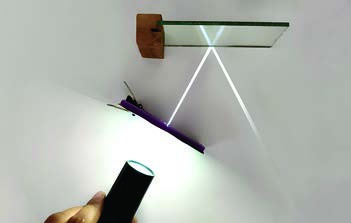
A narrow beam of light from a torch is aimed at a mirror through a slit in a black paper. The reflected beam shifts when the incident beam is moved. When the angles are measured carefully, the angle of incidence is found to be equal to the angle of reflection.
That gives the first law of reflection: the angle of incidence equals the angle of reflection, so i = r.
When the incident beam falls along the normal, both angles are zero, and the light returns along its own path.
The second law comes from bending a chart paper on which the incident and reflected beams are seen. The reflected beam disappears from the bent portion and reappears when the paper is flattened. That tells us the incident ray, the reflected ray and the normal at the point of incidence share one plane.
All three kinds of mirror, plane, concave and convex, obey these laws.
2.5 Parallel beams and curved mirrors
When many parallel beams of light fall on a plane mirror, the reflected beams remain parallel. When they fall on a concave mirror, the reflected beams get closer and converge. When they fall on a convex mirror, the reflected beams spread apart and diverge.
Each ray still obeys the laws of reflection. The difference comes from the curved surface, which changes the direction of the normal from point to point. The collective effect is convergence or divergence of the whole beam.
2.6 Concentrating sunlight
Because a concave mirror converges a beam, it can concentrate sunlight into a small bright spot. A concave mirror held facing the Sun can make a spot on paper that becomes hot enough to scorch or burn the paper after a few minutes.
A device that uses mirrors or lenses to gather sunlight into a small area is called a solar concentrator. The concentrated light can heat a liquid to make steam for generating electricity, for large-scale cooking, or for a solar furnace that can even melt steel. This activity must be done only under adult supervision, with the mirror kept away from faces and eyes.
2.7 Reading the warning on a side-view mirror
The smaller image of a convex mirror makes a vehicle behind look farther away than it actually is. A driver who judges distance from the apparent size could therefore think there is more space than there really is. The warning on the mirror reminds the driver to check carefully rather than rely on the size of the image alone.
This is a good example of how a device's useful property and its limitation come from the same cause. The convex shape gives the wide field of view that makes the mirror useful, and it also produces the diminished image that requires the warning.
2.8 Doing the reflection activity
The setup needs a plane mirror on a stand, a torch, a comb with one slit open, white paper and black paper. The comb is held upright with a paper clip and most of its openings are covered with black paper, leaving one thin slit. Light through the slit gives a thin beam.
The positions of the incident and reflected beams are marked, the mirror is removed, and a normal is drawn at the point of incidence. Measuring the angles with a protractor gives i and r. Repeating for several angles builds confidence that i = r is a law, not an accident. Turning the beam so that it falls along the normal shows the special case where both angles are zero.
2.9 Why the normal matters
The angle of incidence is measured from the normal, not from the surface of the mirror. A ray that grazes the mirror has a large angle of incidence, close to 90°, while a ray that falls along the normal has an angle of incidence of zero.
The normal is drawn perpendicular to the mirror at the point where the ray strikes. Keeping the normal as the reference makes the law i = r simple and consistent for every angle.