

Mirrors, lenses and quick revision
Light: Mirrors and Lenses16 min readLesson 4 of 5
4.1 Mirrors and lenses side by side
Plane mirrors always form erect images of the same size. Concave mirrors can form enlarged, diminished or same-size images, and the image may be erect or inverted depending on the distance. Convex mirrors always form erect, diminished images and give a wider field of view.
Convex lenses can form enlarged, diminished or same-size images, erect or inverted, depending on the distance. Concave lenses always form erect, diminished images. Convex lenses and concave mirrors converge light; concave lenses and convex mirrors diverge it.
| Device | Kind | Image |
|---|---|---|
| Plane mirror | Flat reflecting surface | Erect, same size, laterally inverted |
| Concave mirror | Reflecting surface curves inward | Close: erect and enlarged; far: inverted, then smaller |
| Convex mirror | Reflecting surface curves outward | Always erect and diminished |
| Convex lens | Thicker in the middle | Close: erect and enlarged; far: inverted, then smaller |
| Concave lens | Thicker at the edges | Always erect and diminished |
4.2 A heritage of reflection
More than eight centuries ago, during the time of the Indian mathematician Bhaskara II, astronomers observed the stars and planets through shallow bowls of water. They looked at the reflected images through tubes placed at suitable angles and measured the positions of the stars and planets in the sky. The laws of reflection are not written in their surviving texts, but their instruments and methods show that they understood reflection in practice.
4.3 The bent pencil
Put a pencil behind a clear glass tumbler and observe it. Then fill the tumbler halfway with water and look again. The pencil appears bent or broken at the surface of the water. The water and the glass change the direction of light as it passes through them, so the part of the pencil under water does not appear in line with the part above.
This bending is what lenses use. A lens is shaped so that light passing through it changes direction in a controlled way, which lets the lens form an image. Mirrors work by reflection at a surface; lenses work by changing the path of light as it passes through.
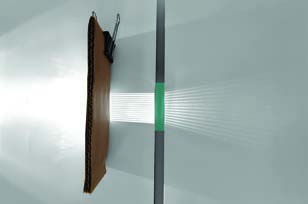
A light beam crossing a glass strip changes direction at each surface in the same way, as the next picture shows. The beam is not a pencil, but the cause is the same: light bends when it moves between materials.
4.4 Solar cookers
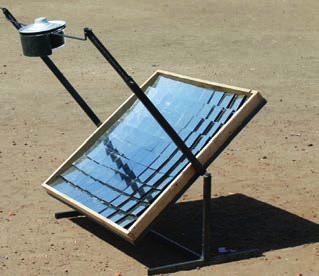
In India, solar cookers are used in villages to cook food with sunlight, reducing the use of electricity and fossil fuels. A solar cooker uses mirrors to converge sunlight onto a cooking pot or a small area. Designing a solar cooker for a home or school requires thinking about the mirror arrangement, the position of the pot, the angle of the Sun and the budget. Such projects connect the physics of mirrors with real energy needs.
4.5 Common mistakes to avoid
- Mixing up concave and convex: a concave mirror curves inward like a cave, while a convex mirror bulges outward.
- Thinking a convex mirror enlarges: it always forms a diminished image.
- Saying a plane mirror forms an inverted image: the image is erect but laterally inverted.
- Measuring the angle of incidence from the mirror surface: measure it from the normal.
- Thinking the angle of reflection can differ from the angle of incidence: they are equal.
- Believing a lens forms an image only on its surface: light passes through and the image depends on the distance.
- Assuming a convex lens always magnifies: at a larger distance it can form an inverted and diminished image.
- Expecting a concave lens to converge light: it diverges light and always forms an erect, diminished image.
Exam
For mirror questions, name the mirror and describe the image: plane gives erect, same-size, laterally inverted; concave depends on distance; convex is always erect and diminished. For reflection, draw the normal, mark i and r, and write i = r; remember both rays and the normal lie in one plane. For lens questions, identify convex (thicker middle) or concave (thicker edges), say whether it converges or diverges, and describe the image in the same way as for mirrors.
- Define spherical mirror and distinguish concave and convex mirrors.
- Describe the images formed by concave and convex mirrors at different distances.
- Give two uses each of concave and convex mirrors.
- State the two laws of reflection and apply i = r to simple angles.
- Explain what happens to parallel beams on plane, concave and convex mirrors.
- Define convex and concave lenses and describe the images seen through them.
- Explain convergence and divergence of light by lenses.
- List four uses of lenses and explain why the bent pencil appears broken.