Concepts: Floral whorls, aestivation and placentation
Morphology of Flowering Plants20 min readLesson 4 of 7
4.1 Calyx and corolla
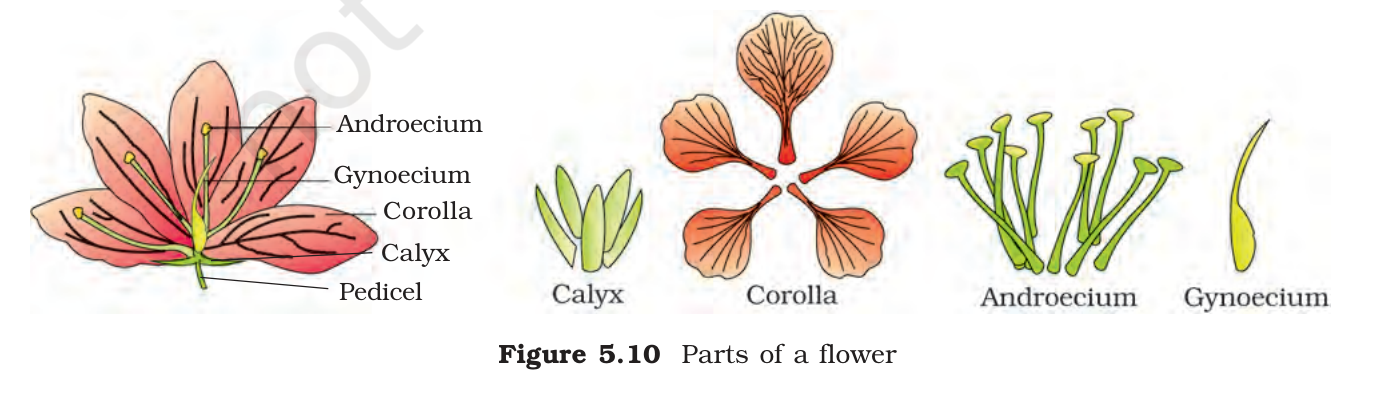
The calyx is the outermost floral whorl, and its members are the sepals. Sepals are usually green and leaf-like, and their work is to protect the flower while it is still a bud. The calyx is gamosepalous when the sepals are united and polysepalous when they are free.
The corolla is made of petals. Petals are usually brightly coloured, and the colour attracts insects that carry pollen. Like the calyx, the corolla may be gamopetalous, with united petals, or polypetalous, with free petals. Its outline varies a great deal, from a tube to a bell, a funnel or a wheel in different plants.
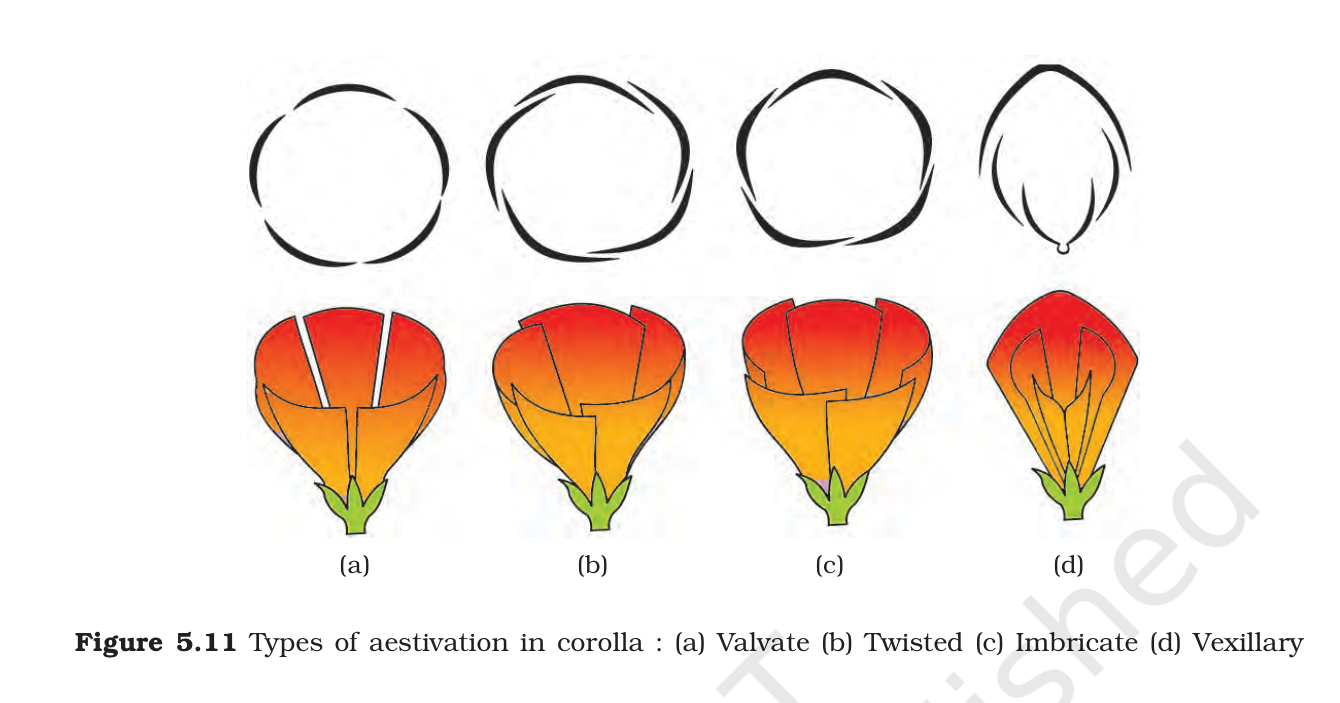
4.1.1 Aestivation
Aestivation is the way the sepals or petals of one whorl are arranged with respect to one another in the floral bud. Four types are named. In valvate aestivation the members of a whorl touch at their margins but do not overlap, as in Calotropis. In twisted aestivation one margin of each member overlaps the next one, and the pattern runs round the whorl, as in china rose, lady's finger and cotton. In imbricate aestivation the margins overlap but not in a fixed direction, as in Cassia and gulmohur. In vexillary, or papilionaceous, aestivation the largest petal, the standard, overlaps the two lateral wings, and the wings overlap the two smallest anterior petals, the keel; pea and bean are the examples. The four names are easy to mix, so attach one example to each and a simple sketch of the bud.
4.1.2 Androecium and gynoecium
The androecium is the male whorl, and it is made of stamens. A stamen carries a stalk, the filament, and the anther. The anther usually has two lobes, and each lobe contains two chambers, the pollen sacs, in which pollen grains form. A sterile stamen is a staminode. Stamens often fuse with other parts. A stamen attached to a petal is epipetalous, as in brinjal, and one attached to the perianth is epiphyllous, as in lily. The stamens in a flower may stay free, which makes them polyandrous, or join into bundles: one bundle is monoadelphous, as in china rose; two bundles are diadelphous, as in pea; more than two is polyadelphous, as in citrus. Filaments within one flower may also differ in length, as in Salvia and mustard.
The gynoecium is the female whorl and is made of one or more carpels. A carpel has three parts: the stigma, which receives pollen; the style, the tube that connects it to the base; and the ovary, the swollen base that carries the ovules. Where several carpels occur they can stay free, the apocarpous condition of lotus and rose, or they can fuse, the syncarpous condition of mustard and tomato. After fertilisation each ovule turns into a seed and the ovary becomes the fruit.
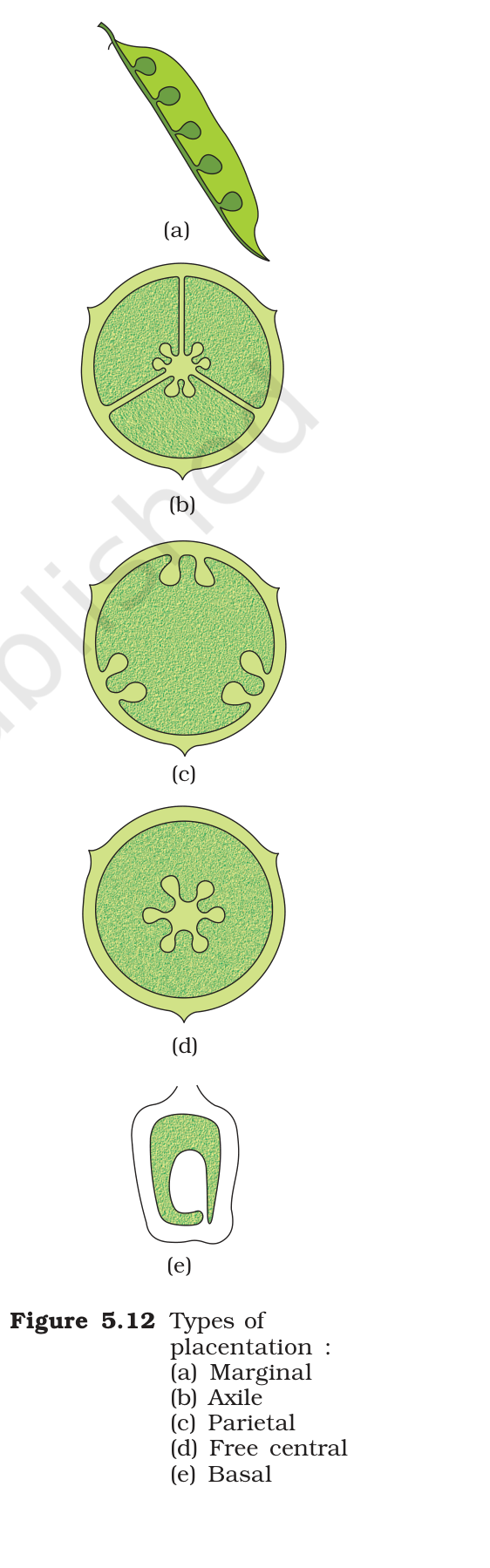
4.1.3 Placentation
Placentation describes where the ovules sit inside the ovary. Six types are named. In marginal placentation a ridge of placenta runs along the ventral suture and carries the ovules in two rows, as in pea. Axile placentation has an axial placenta, and the ovules attach to it inside an ovary split into several chambers, as in china rose, tomato and lemon. Parietal placentation puts the ovules on the inner wall; the ovary starts as one chamber and a false septum divides it into two, as in mustard and Argemone. In free central placentation the ovules sit on a central axis with no septa, as in Dianthus and primrose. In basal placentation the placenta sits at the base of the ovary and carries a single ovule, as in sunflower and marigold. The chapter prints six names in its list: marginal, parietal, axile, basal, central, and free central. Only five of these carry a description with an example in the body of the chapter, and the word central in the list points to the same central-axis arrangement that the free central entry describes. The name of each type follows the position of the placenta, so a diagram with the placenta marked settles the label.
4.1.4 Reading a floral formula
The formula packs the whole whorl and fusion story into one line. Brackets show that the members of a whorl are fused, and a line drawn over a symbol shows adhesion to another whorl. A superior ovary and an inferior ovary each get their own mark. When the formula is read with a floral diagram beside it, the diagram shows the position of the mother axis and the relative placement of the whorls. This is why a description, a formula and a diagram are written together: each one checks the other, and together they leave no room for an ambiguous floral character in an answer.
Exam
Aestivation and placentation are solved by one picture each. Draw the four buds side by side for aestivation, and draw the ovary in section for placentation. When a question gives a floral formula and asks for the diagram, read the brackets for fusion and the line above a symbol for adhesion before drawing anything.
Common mistake
Do not confuse apocarpous with syncarpous: free carpels make the ovary apocarpous, fused carpels make it syncarpous. Do not call the radula a floral part, since the radula belongs to molluscs. And do not write that parietal placentation is two-chambered from the start, because the second chamber appears through a false septum.