Concepts: The inflorescence and the flower
Morphology of Flowering Plants18 min readLesson 3 of 7
3.1 The flower as a modified shoot
A flower is a modified shoot. The shoot apical meristem changes into a floral meristem, the internodes stop elongating and the axis is packed short, and the apex begins to make floral appendages in place of leaves. When the tip of a shoot turns into a flower, that flower is solitary. When several flowers sit on one floral axis, their arrangement is called the inflorescence, and the study of that arrangement is a separate part of morphology.
3.1.1 Two kinds of inflorescence
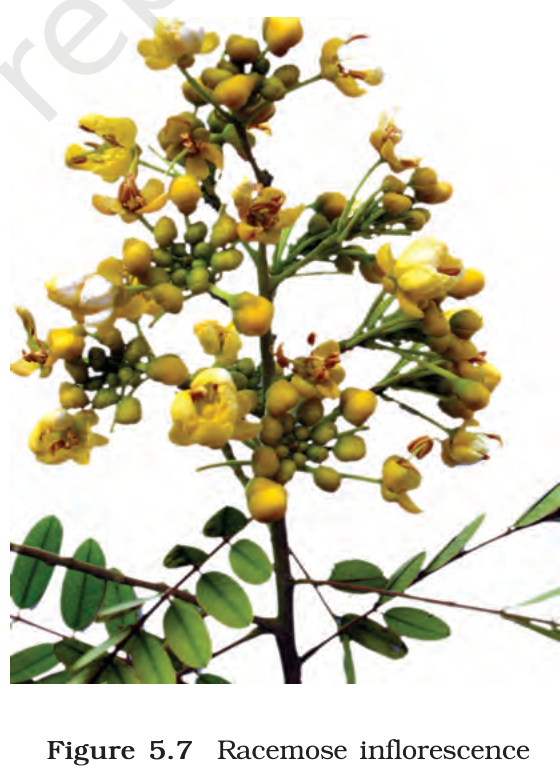
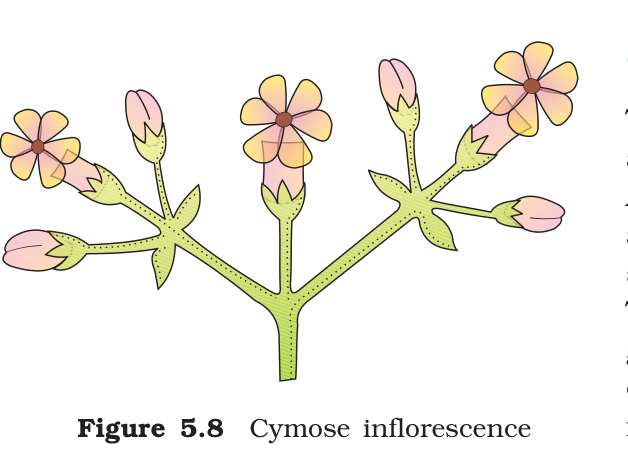
The deciding question is what happens to the apex. If the main axis keeps growing and the flowers open along its sides, the inflorescence is racemose. In this type the older flowers sit lower down and the younger ones towards the tip, so the succession is acropetal. If the main axis ends in a flower and stops growing, the inflorescence is cymose. Here the terminal flower is the oldest, the side flowers are younger, and the order is basipetal. That contrast, apex continuing versus apex ending in a flower, is the whole basis of the classification, and it should be written first in any answer.
3.1.2 The parts of a flower
A typical flower has four sets of parts arranged one after another on the swollen end of the stalk. That swollen end is the thalamus, or receptacle, and each set is a whorl on it. The outermost whorl is the calyx, made of sepals. Next comes the corolla, made of petals. Then the androecium, made of stamens, and finally the gynoecium, made of carpels. Calyx and corolla are the accessory organs, because they help but do not make the gametes. Androecium and gynoecium are the reproductive organs, and a flower that carries both is bisexual while one that carries only stamens or only carpels is unisexual.
When calyx and corolla resemble each other and cannot be told apart, as in the lily, the two together are called the perianth. The number of floral parts gives another description: a flower may be trimerous, with parts in threes, tetramerous, with parts in fours, or pentamerous, with parts in fives. A flower that carries bracts, the reduced leaves at the base of the pedicel, is bracteate, and one without them is ebracteate.
3.1.3 Symmetry of the flower
The symmetry of a flower is read from its outline. An actinomorphic flower can be cut into two equal radial halves by any plane through the centre: mustard, datura and chilli are examples. A zygomorphic flower gives matching halves in only one particular vertical plane: pea, gulmohur, bean and Cassia are examples. A flower that cannot be divided into matching halves by any vertical plane is asymmetric, or irregular, and canna is the example. The three labels are often asked as a one-line comparison, so keep one example with each.
3.1.4 Where the whorls sit on the thalamus
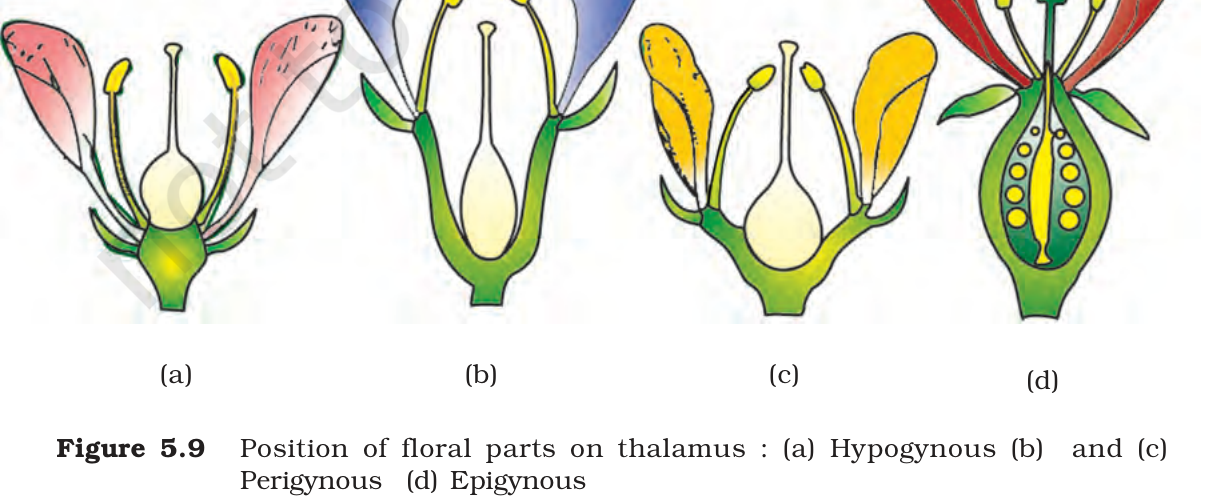
The position of the calyx, corolla and androecium relative to the ovary gives a second set of names. In a hypogynous flower the gynoecium occupies the highest place on the thalamus and the other parts sit below it, so the ovary is superior; mustard, china rose and brinjal are examples. In a perigynous flower the gynoecium sits in the centre while the other parts lie on the rim of the thalamus at about the same level, and the ovary is half inferior; plum, rose and peach are examples. In an epigynous flower the margin of the thalamus grows up around the ovary and fuses with it, so the other parts arise above the ovary and the ovary is inferior; guava, cucumber and the ray florets of sunflower are examples. The three positions are best drawn as a small set of sections, and the ovary label decides the name.
3.1.5 Practice from the NCERT exercises, questions 4, 8, 9 and 10
Exercise 4. The racemose inflorescence keeps its main axis growing, and its flowers open from the base upward in acropetal order. The cymose inflorescence ends its main axis in a flower, and its flowers open from the tip downward in basipetal order. The apocarpous ovary has free carpels, as in lotus and rose, while the syncarpous ovary has fused carpels, as in mustard and tomato.
Exercise 8. A flower is the reproductive unit of an angiosperm, a modified shoot whose parts are arranged in whorls on the thalamus. The four whorls, from the outside in, are calyx, corolla, androecium and gynoecium.
Exercise 9. The inflorescence is the way flowers are placed on the floral axis. The classifier is what the main axis does: if it keeps growing the result is racemose, and if it ends in a flower the result is cymose.
Exercise 10. The position of floral members on the thalamus decides whether a flower is hypogynous, with the ovary superior and other parts below; perigynous, with the ovary half inferior and the parts on the rim; or epigynous, with the ovary inferior and the other parts above it.
Exam
Flower answers should move from outside in: calyx, corolla, androecium, gynoecium. Then add symmetry, then the position on the thalamus. The racemose and cymose comparison is easiest as a two-column table on axis growth and flower order, with one example each. For the thalamus question, one labelled sketch of hypogynous, perigynous and epigynous flowers earns more than three paragraphs.
Common mistake
Do not write that the perigynous ovary is inferior, because it is half inferior and the epigynous ovary is the inferior one. Do not call the ray florets of sunflower a single flower, since each one is a small flower in a head. And do not confuse bract with bracteole: the bract sits at the base of the pedicel and the bracteole sits on the pedicel itself.