Concepts: Fruit, seed and the semi-technical description
Morphology of Flowering Plants20 min readLesson 5 of 7
5.1 The fruit
A fruit is the ripened ovary of a flowering plant, and it forms after fertilisation. A fruit that develops without fertilisation of the ovary is called parthenocarpic. Every fruit has a wall, the pericarp, with seeds inside. The pericarp may be dry or fleshy. A thick fleshy pericarp splits into three layers, with the epicarp outside, the mesocarp in the middle and the endocarp inside. Mango and coconut are drupes; each comes from a superior ovary of one carpel and each holds a single seed. In mango the epicarp is thin and outer, the mesocarp is fleshy and edible, and the endocarp is hard and stony. In coconut the mesocarp is fibrous.
5.2 The seed
After fertilisation the ovules become seeds. A seed is a seed coat plus an embryo, and the embryo holds a radicle, an embryonal axis and either one cotyledon or two. The number of cotyledons separates the two great groups of flowering plants.
5.2.1 The dicot seed
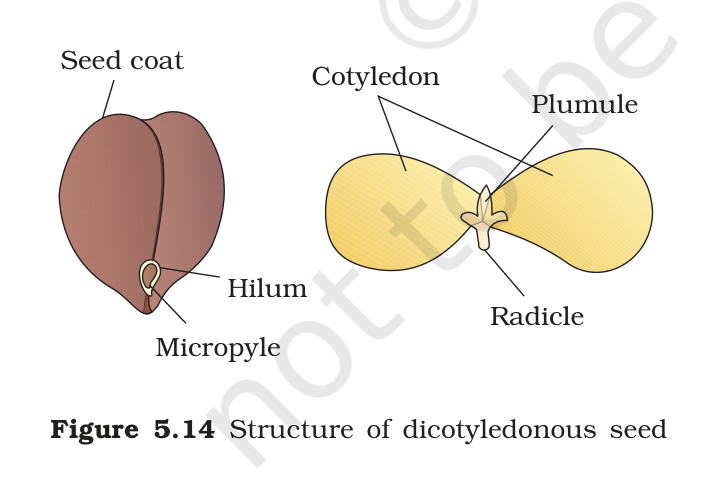
The seed coat of a dicot seed has two layers, an outer testa and an inner tegmen. The hilum is the scar on the coat where the seed was attached to the fruit, and just above it sits a small pore, the micropyle. Inside the coat sit the embryo and its two cotyledons, which are frequently fleshy food stores. The radicle and the plumule occupy the two ends of the embryonal axis. Castor keeps the endosperm produced by double fertilisation as a food store, so its seeds are endospermic. In bean, gram and pea the endosperm is used up by the time the seed matures, and those seeds are non-endospermic.
5.2.2 The monocot seed
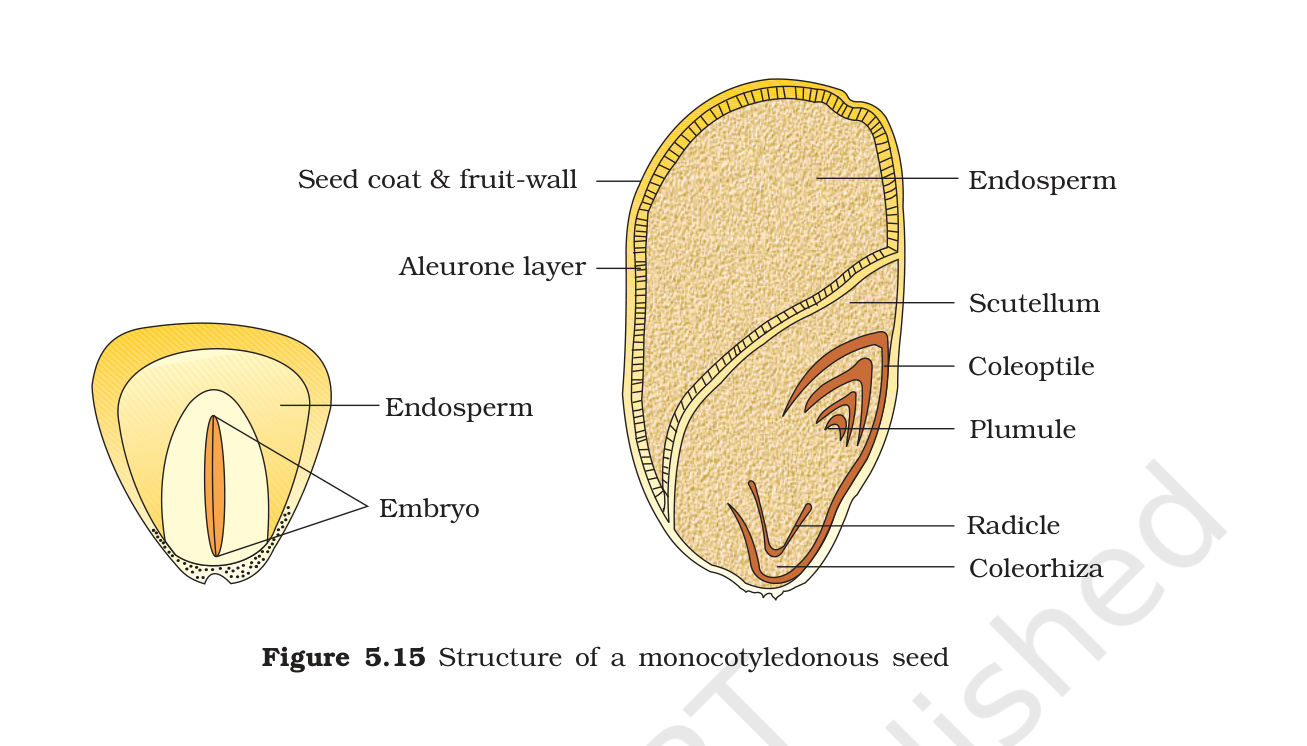
Monocot seeds are generally endospermic, though orchids are an exception. In a cereal such as maize the seed coat is membranous and fused with the fruit wall, so the grain is really a fruit. The endosperm is bulky and stores the food. A protein-rich band, the aleurone layer, lies between the endosperm and the embryo. At one end of that endosperm a groove houses the small embryo; its single cotyledon is a large shield-shaped body, the scutellum, and a short axis on the embryo carries the plumule with the radicle. A sheath, the coleoptile, covers the plumule, and a second sheath, the coleorhiza, covers the radicle. That is why maize is called a fruit and not a seed: the seed coat and fruit wall are fused into one covering.
5.3 Semi-technical description
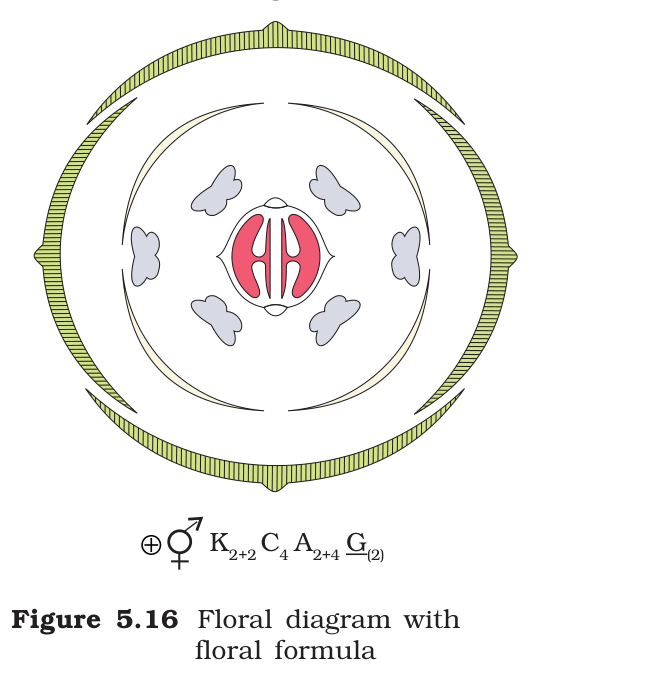
A flowering plant is described in a fixed sequence: habit first, then the vegetative parts, which are roots, stem and leaves, and then the floral parts, which are the inflorescence and the flower. The description is brief, uses scientific terms, and ends with a floral diagram and a floral formula. The symbols are Br for bracteate, K for calyx, P for perianth, C for corolla, A for androecium and G for gynoecium; a superior ovary and an inferior ovary get their own marks, and a line above a symbol shows adhesion while brackets show fusion. A floral diagram shows the number of parts, their arrangement and their relation to one another, with the mother axis marked by a dot at the top. Calyx is drawn as the outermost whorl and the gynoecium in the centre. Figure 5.16 of the chapter shows the mustard flower (Brassicaceae) in this form.
5.3.1 The Solanaceae
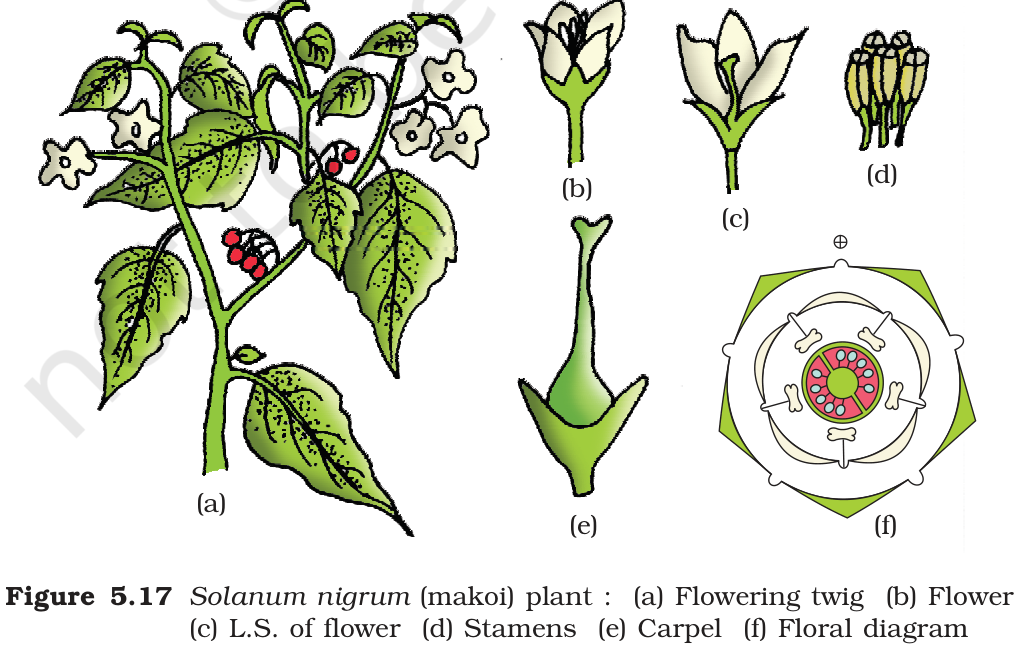
Solanaceae is the potato family, widespread in the tropics, subtropics and even temperate zones. The plants are mostly herbs, shrubs and rarely small trees. The stem is herbaceous, erect or branched, and in potato it is an underground stem. Leaves are alternate, simple, rarely pinnately compound and exstipulate, with reticulate venation. The inflorescence is solitary and axillary or cymose, as in Solanum. The flower is bisexual and actinomorphic. The calyx has five sepals, united, persistent and valvate. The corolla has five petals, united and valvate. There are five stamens, and they are epipetalous. The gynoecium is bicarpellary, syncarpous, with a superior ovary that is bilocular and carries a swollen placenta with many ovules in axile arrangement. The fruit is a berry or a capsule, and the seeds are many and endospermic. Economically the family gives food in tomato, brinjal and potato, spice in chilli, medicine in belladonna and ashwagandha, a fumigatory product in tobacco, and ornamentals in petunia.
5.3.2 Practice from the NCERT exercises, questions 3, 5, 6 and 7
Exercise 3. Aestivation is the arrangement of sepals or petals in the floral bud with respect to other members of the same whorl. Placentation is the arrangement of ovules inside the ovary. An actinomorphic flower can be divided into equal halves by any radial plane. A zygomorphic flower gives equal halves in one particular plane only. A superior ovary sits above the other floral parts on the thalamus. A perigynous flower has its gynoecium in the centre with the other parts on the rim of the thalamus. An epipetalous stamen is attached to a petal.
Exercise 5. A labelled gram seed should show the seed coat, hilum, micropyle, two cotyledons, the embryonal axis, the radicle and the plumule. A vertical section of maize should show the fused seed coat and fruit wall, the endosperm, the aleurone layer, the scutellum, the coleoptile, the plumule, the radicle and the coleorhiza.
Exercise 6. The semi-technical description of a Solanaceae flower runs as follows. Flower bisexual, actinomorphic, pentamerous. Calyx five sepals, gynosepalous, persistent, valvate. Corolla five petals, gamopetalous, valvate. Androecium five stamens, epipetalous. Gynoecium bicarpellary, syncarpous, superior ovary, bilocular, axile placentation with many ovules. Fruit a berry or capsule.
Exercise 7. The printed list has six names: marginal, parietal, axile, basal, central and free central. Five of them carry printed examples: marginal (pea), axile (china rose, tomato and lemon), parietal (mustard and Argemone), free central (Dianthus and primrose) and basal (sunflower and marigold). The position of the placenta inside the ovary decides the name.
Slideshow, slide 1 of 3. Use the left and right arrow keys to change slides and the space bar to play or pause.
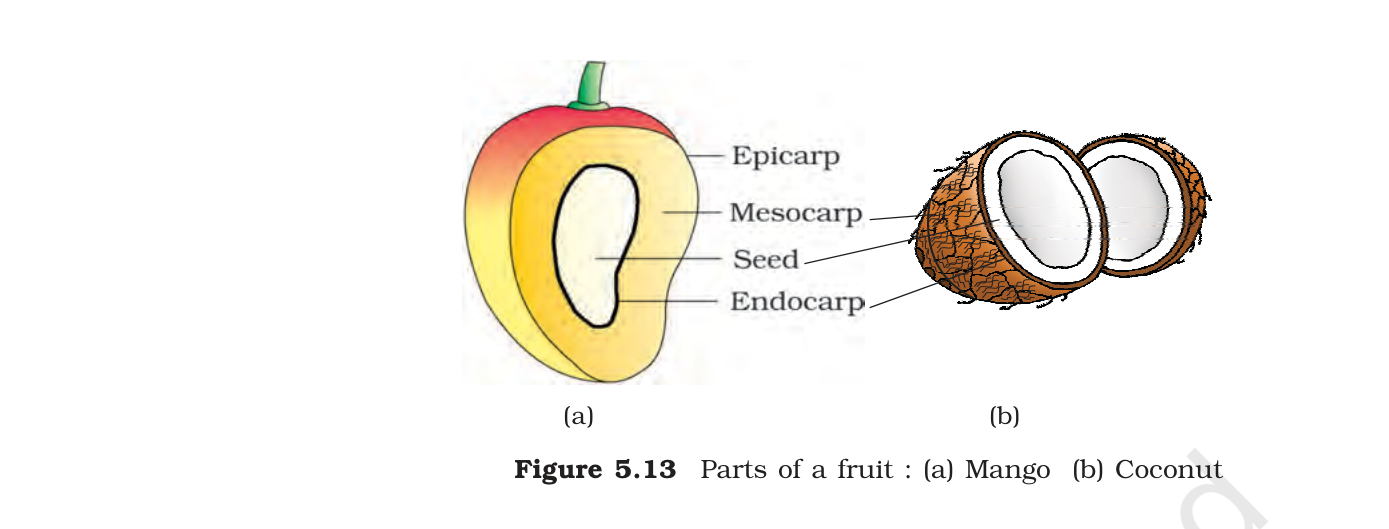
Parts of a fruit from the NCERT plate: a mango cut open with epicarp, mesocarp, seed and endocarp labelled, and a coconut split to show its layers.
Exam
For the fruit and seed questions, the marks sit on labels rather than prose. Practise one labelled gram seed and one vertical section of maize until every label is automatic. For the Solanaceae description, follow the fixed order of habit, vegetative parts and floral parts, then end with the floral formula, because a description that jumps between organs loses order marks.
Common mistake
Do not call maize a seed in a botany answer without explaining the fusion of seed coat and fruit wall, because the grain is a fruit. Do not write that the hilum is a pore, since the pore is the micropyle and the hilum is the scar. And do not forget that castor is endospermic while gram and pea are non-endospermic.