Concepts: The leaf
Morphology of Flowering Plants16 min readLesson 2 of 7
2.1 The leaf and its parts
The leaf is a lateral, usually flat structure carried on the stem. It grows out at a node and holds a bud in its axil; that axillary bud can later become a branch. Leaves arise from the shoot apical meristems and open in acropetal order, from the base of the shoot towards its tip. They are the main vegetative organs of photosynthesis, which is why their shape and arrangement matter so much in classification.
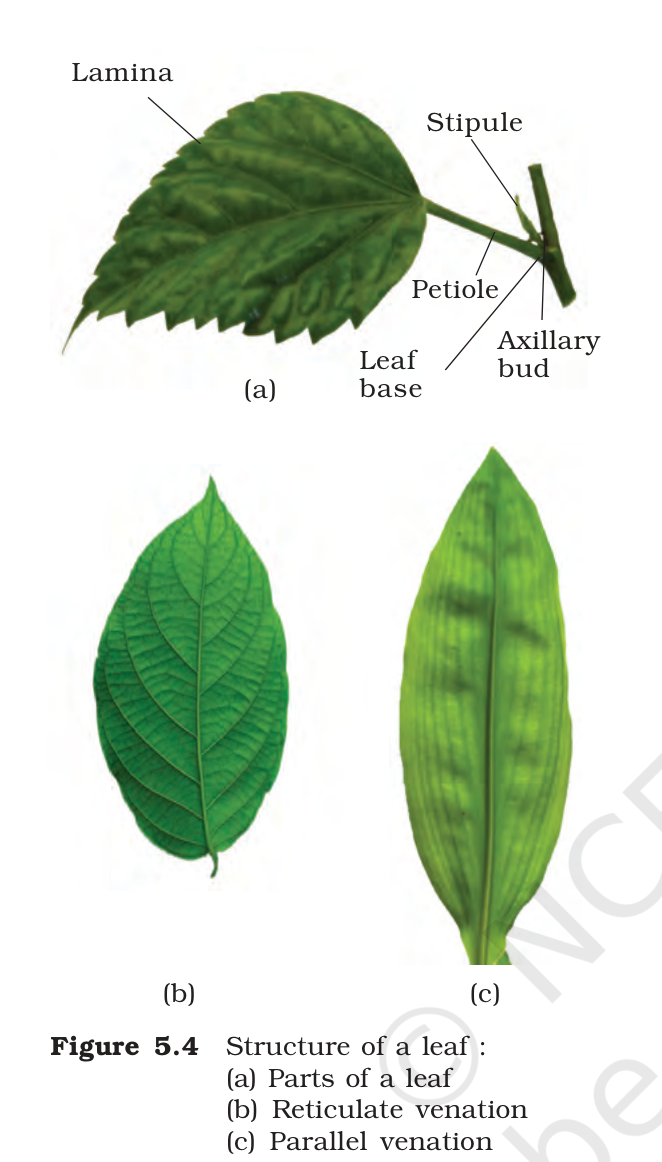
A typical leaf is built of three parts. The base fixes the leaf to the stem and sometimes carries two small lateral leaf-like parts, the stipules. In a monocot the base grows into a sheath that wraps the stem over part or all of its length. In some leguminous plants the base swells into a pulvinus. Next comes the petiole, the stalk that holds the blade out towards the light. A long flexible petiole lets the blade flutter in the wind, which cools the leaf and brings fresh air to its surface. The third part is the lamina or blade, the green expanded portion with veins and veinlets. A prominent central vein is the midrib. Veins give the blade rigidity and act as channels for water, minerals and food, while the shape, margin, apex, surface and depth of incision of the lamina vary from plant to plant.
2.1.1 Venation
Venation is the arrangement of veins and veinlets in the lamina. When the veinlets form a network, the pattern is reticulate, and when the veins run roughly parallel to one another it is parallel. Dicot leaves generally show reticulate venation and most monocot leaves show parallel venation. The two patterns are easy to see on a cleared leaf, and they are a quick first check on whether a plant is a dicot or a monocot.
2.1.2 Simple and compound leaves
A leaf is simple when its lamina is whole, or when the incisions do not reach the midrib. It is compound when the incisions cut down to the midrib and divide the blade into separate leaflets. In both kinds a bud sits in the axil of the petiole, but no bud sits in the axil of a leaflet, and that is the reliable way to tell a leaflet from a small leaf.
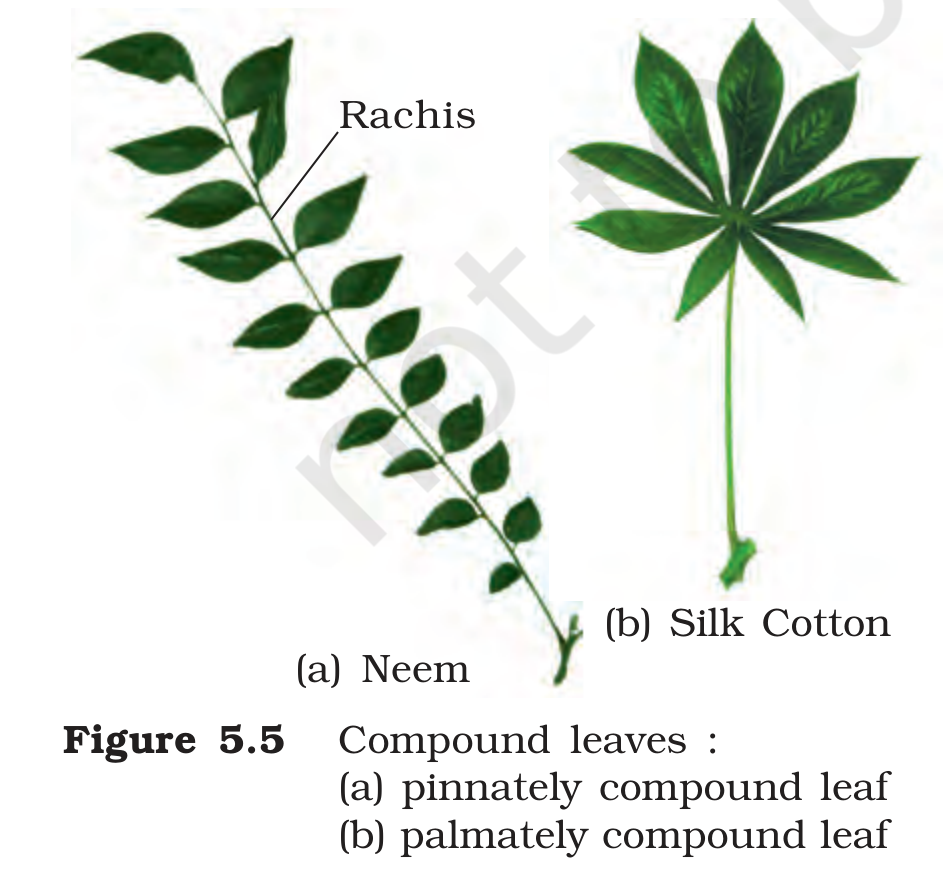
Compound leaves come in two forms. In a pinnately compound leaf, leaflets are arranged along a common axis called the rachis, which stands for the midrib of the leaf; neem is the example. In a palmately compound leaf, all the leaflets join at one place, the tip of the stalk, as in silk cotton.
2.1.3 Phyllotaxy
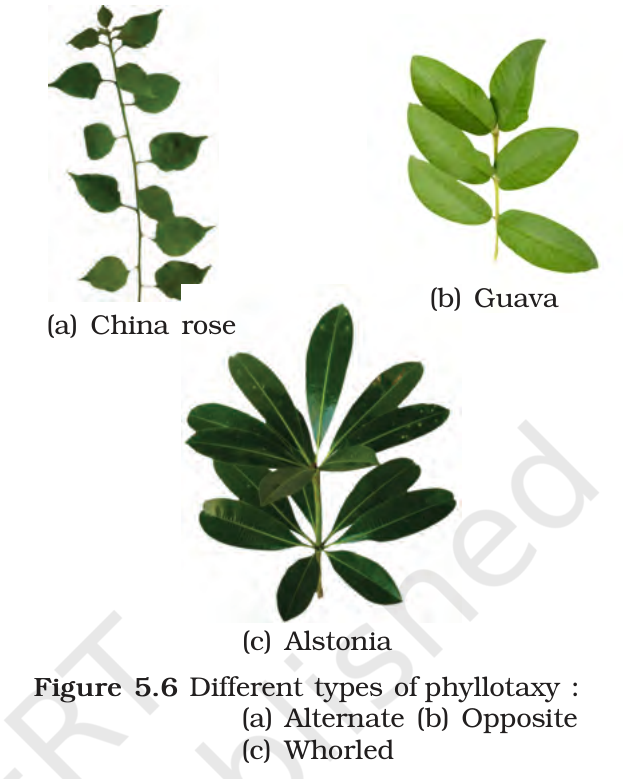
Leaves are not scattered at random on a stem; the pattern they follow is called phyllotaxy. Three patterns are named. In the alternate type a single leaf arises at each node, and successive nodes alternate their directions; china rose, mustard and sunflower show it. In the opposite type a pair of leaves arises at each node and the two face each other; Calotropis and guava show it. In the whorled type more than two leaves arise at one node and form a ring around the stem, as in Alstonia. The pattern decides how much light each leaf receives, so it is a functional character rather than a label.
2.1.4 Practice from the NCERT exercises, questions 1 and 2
Exercise 1. In a pinnately compound leaf the leaflets sit along a common rachis, and neem is the example. In a palmately compound leaf the leaflets all join at one point at the tip of the petiole, and silk cotton is the example. The rachis in the pinnate form stands in place of the midrib.
2.1.5 The leaf as a light trap
A leaf is shaped around one job: catching light and trading gases with the air. The blade spreads flat so that a large surface faces the sun, and the petiole holds that surface away from the stem so that it is not shaded. The veins do two things at once, because they stiffen the blade and they carry water in and food out. A network of veinlets reaches almost every part of the lamina, which is why a reticulate leaf can keep a broad blade supplied. The lower surface usually carries more stomata than the upper one, so gas exchange happens on the shaded side where water is less likely to evaporate quickly. Even the way leaves are arranged on the stem is part of the same design: alternate, opposite and whorled patterns all spread the blades so that each one gets its share of light. A leaf that loses too much water can fold or droop, and the plant then reduces the exposed surface until conditions improve.
Exam
Leaf questions usually want the three parts, the two venation patterns and the three phyllotaxy types, each with one example. For the compound leaf question, give the position of the leaflets: along a rachis for pinnate, at a single point for palmate. Add the bud test, because it separates a leaflet from a leaf and can rescue a wrong-looking diagram.
Common mistake
Do not say a leaflet has an axillary bud of its own, because it does not; only the whole leaf has a bud in its axil. Do not mix reticulate with monocots, since reticulate is the dicot pattern. And do not call the petiole the midrib, because the midrib is part of the lamina and the petiole is the stalk below it.