Concepts: The root and the stem
Morphology of Flowering Plants18 min readLesson 1 of 7
1.1 The two systems of a plant
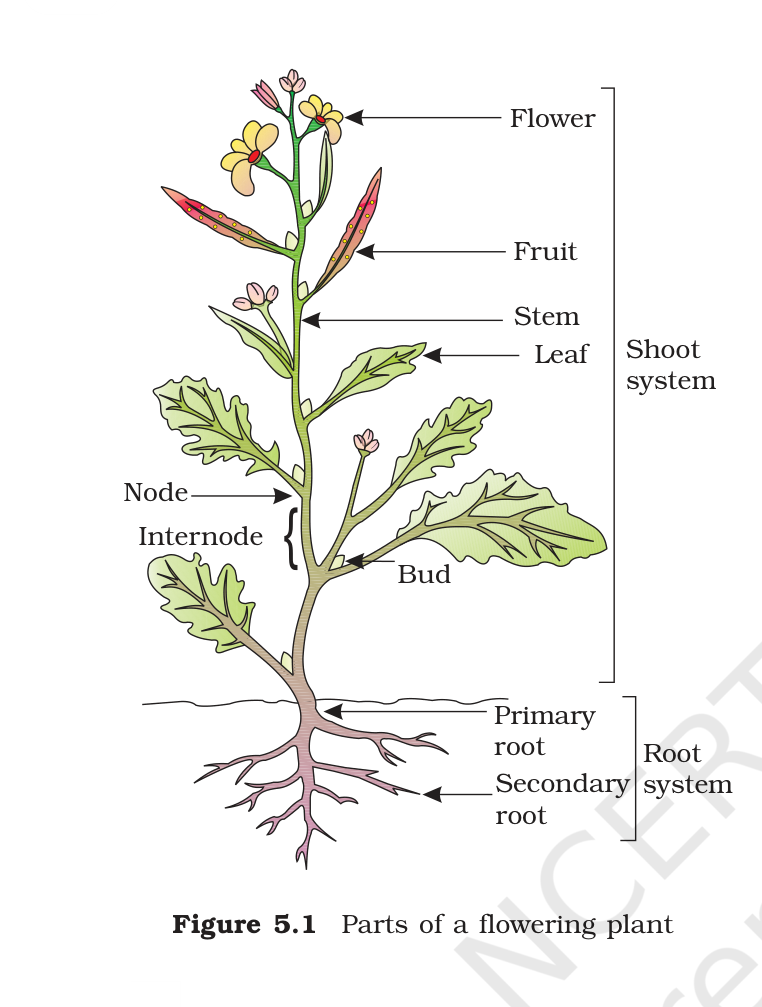
An angiosperm is built around two systems. The part below the ground is the root system, and the part above the ground is the shoot system, which carries the stem, leaves, flowers, buds and fruits. Pull up a weed and the division is plain: a branching root system at the base, and a stem rising from it with leaves at its nodes.
1.1.1 Kinds of root system
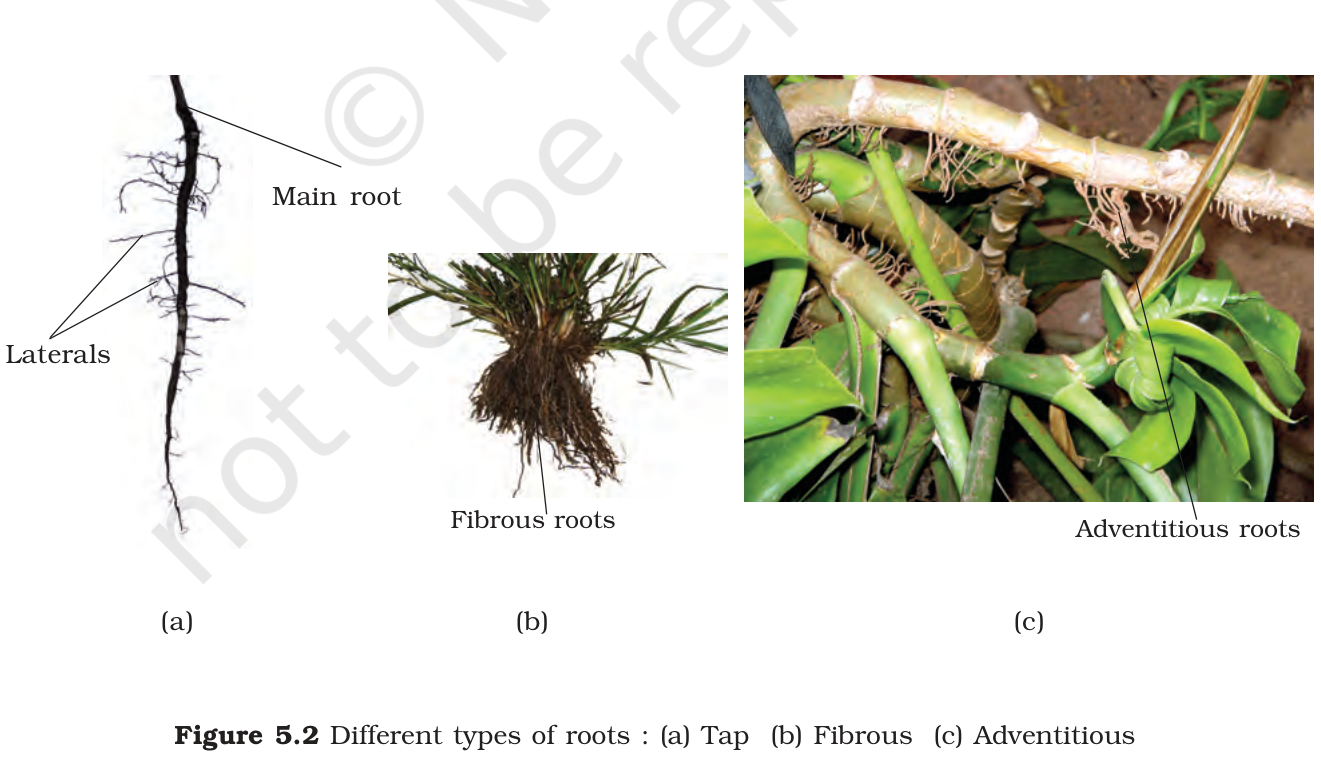
In most dicotyledonous plants the radicle of the embryo lengthens directly into a primary root, which grows down into the soil. Lateral roots branch from it in several orders, and these are called secondary roots, tertiary roots and so on. The primary root and all its branches make the tap root system, and mustard is the printed example.
In monocotyledonous plants the story is different. The primary root has a short life and is soon replaced by a large number of roots that arise from the base of the stem. That cluster makes the fibrous root system, and wheat shows it. A third kind of root comes from some part of the plant other than the radicle; these are the adventitious roots. Grass, Monstera and the banyan tree are the examples. A banyan tree also shows what such roots can do: they can grow down from the branches and support a huge crown.
1.1.2 What the root is for
The root system has four jobs in the chapter. It absorbs water and minerals from the soil, it anchors the plant, it stores reserve food, and it makes plant growth regulators. The storage role is familiar from a carrot, and the chemical role is easy to forget, so it belongs in a complete answer.
1.1.3 The root tip from bottom to top
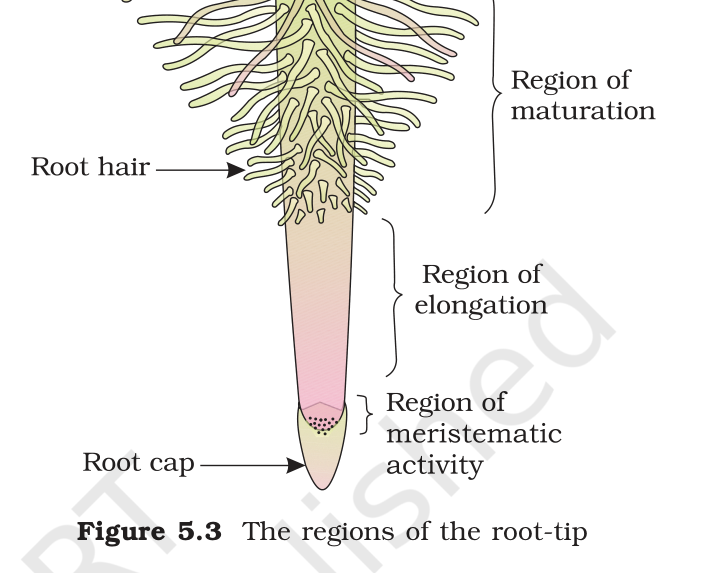
A root tip has four regions, and their order is a favourite question. At the very tip is the root cap, a thimble-shaped cover that protects the tender apex as it pushes through the soil. Just a few millimetres above the cap lies the region of meristematic activity. Its cells are small, thin-walled, dense with protoplasm and divide repeatedly. Above that is the region of elongation, where cells enlarge quickly and push the root deeper; this is where growth in length happens. The next zone is the region of maturation, where the cells differentiate and mature. A few epidermal cells in the maturation zone draw out into fine root hairs, and those hairs take up water and minerals. A diagram of the root tip should label all four regions from the cap upward.
1.1.4 The stem
The stem is the part of the axis that rises upward, and it carries the branches, leaves, flowers and fruits. In a germinating seed it grows out of the plumule of the embryo. Leaves are attached at points called nodes, and the stretches between two nodes are internodes. Buds sit on the stem, and they may be terminal, at the tip, or axillary, in the angle between a leaf and the stem. The stem is green when young and later often turns woody and dark brown.
What the stem does is spread the branches out so that leaves, flowers and fruits are held up to the light and the air. It also conducts water, minerals and the food made in photosynthesis. Some stems store food, some give support, some protect the plant, and some carry out vegetative propagation. The distinction between stem and root rests on the leaves, nodes, internodes and buds: only the stem bears them.
Exam
For a root-tip question, write the four regions in order from the tip: root cap, meristematic region, elongation region, maturation region. Add one function per region, because the marks sit on the link between structure and job. For a stem versus root question, the deciding characters are leaves, nodes, internodes and buds.
Common mistake
Do not call the root hair a branch of the root. Root hairs are single epidermal cells drawn out into a thread. Do not write that the tap root system is found in monocots, because monocots carry fibrous roots. And do not say the root cap absorbs water, since its work is protection of the growing tip.
1.1.5 How the two systems differ in growth
A root keeps its growing tip covered by the root cap and pushes through the soil, while a stem carries its growing points at the apex and in the axillary buds. The root system branches by lateral roots, and the shoot system branches by axillary buds. When a gardener pulls a weed, the root system comes away as one branching piece and the shoot system as another.
The tap root system gives a plant a deep anchor and reaches water far below the surface, while the fibrous system spreads a dense network near the top of the soil. Adventitious roots can arise from a stem, a leaf or a branch, and the banyan tree shows how far that can go: roots that start in the air can reach the ground and become props for the crown. Each arrangement answers a different problem of water, support or spread.
On a specimen the first check for a stem is for leaves. A stem carries leaves at nodes and buds in the leaf axils, and its tip may show a terminal bud. A root has no leaves, no buds and no nodes, and its branching comes in orders from the primary root. The second check is the growing point. A root tip is protected by a cap, while a stem tip is a bud covered by young leaves. These checks settle a specimen in a practical class without a microscope.