

Concepts: DNA, its structure and packaging
Molecular Basis of Inheritance24 min readLesson 1 of 8
1.1 A long polymer of nucleotides
DNA is a long polymer of deoxyribonucleotides, and the length of a DNA molecule is measured as the number of nucleotides, usually counted in base pairs. That length is a characteristic of an organism. A bacteriophage called phi x 174 has 5,386 nucleotides, bacteriophage lambda has 48,502 base pairs, Escherichia coli has about 4.6 million base pairs, and the haploid content of human DNA is about 3.3 billion base pairs. The chapter opens with these numbers because every property of DNA, from its stability to the way it is packaged, follows from its size and chemistry.
A nucleotide has three parts: a nitrogenous base, a pentose sugar and a phosphate group. The sugar is deoxyribose in DNA and ribose in RNA. There are two families of nitrogenous bases, the purines (adenine and guanine) and the pyrimidines (cytosine, thymine and uracil). Cytosine is common to DNA and RNA, thymine belongs to DNA and uracil stands in its place in RNA. A base joins the hydroxyl of the 1 prime carbon of the sugar through an N-glycosidic linkage to give a nucleoside, such as adenosine or deoxyadenosine. Adding a phosphate at the 5 prime carbon of the sugar through a phosphoester linkage turns the nucleoside into a nucleotide. Two nucleotides then join through a 3 prime to 5 prime phosphodiester bond, and more nucleotides join the same way to make a polynucleotide chain.
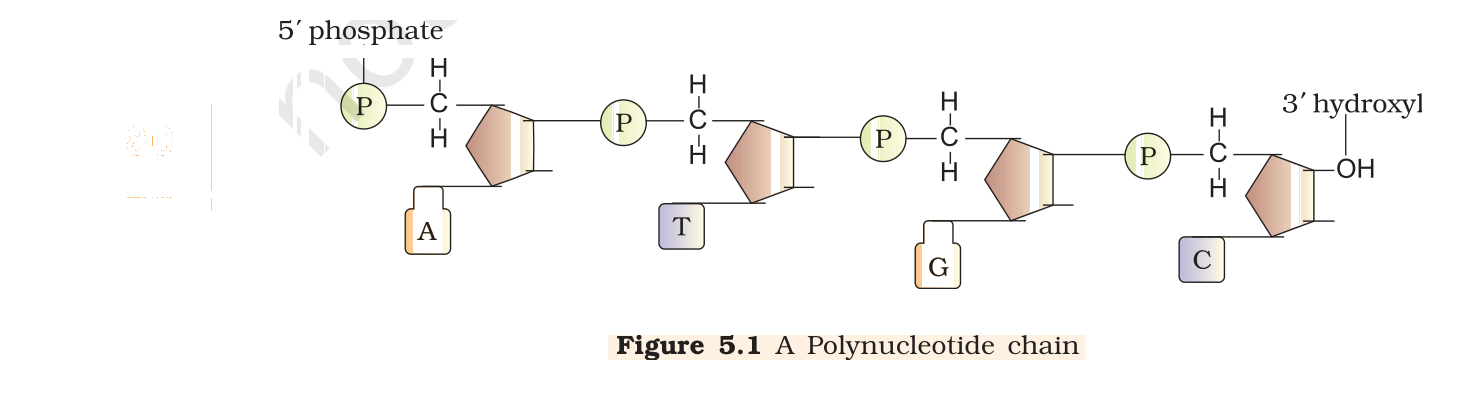
The chain has a direction. At one end there is a free phosphate group on the 5 prime carbon of the sugar, and at the other end a free hydroxyl on the 3 prime carbon. The repeating sugar and phosphate units form the sugar-phosphate backbone, and the bases stick out from it. Because the backbone is built in one direction, every strand has a 5 prime end and a 3 prime end, and the sequence of bases along the strand is always written from the 5 prime end to the 3 prime end.
1.2 The double helix
Watson and Crick proposed the double helix model in 1953 from the X-ray diffraction data of Maurice Wilkins and Rosalind Franklin. Their model had several decisive features. The two strands of the polynucleotide chain run in opposite directions, so the molecule is antiparallel. The bases of one strand pair with the bases of the other strand, and the two chains are held together by hydrogen bonds between these paired bases. The pairing rule is strict: adenine pairs with thymine by two hydrogen bonds, and guanine pairs with cytosine by three. The sugar-phosphate backbones lie on the outside of the helix, winding like a spiral staircase, and the base pairs lie perpendicular to the axis like the steps of that staircase.
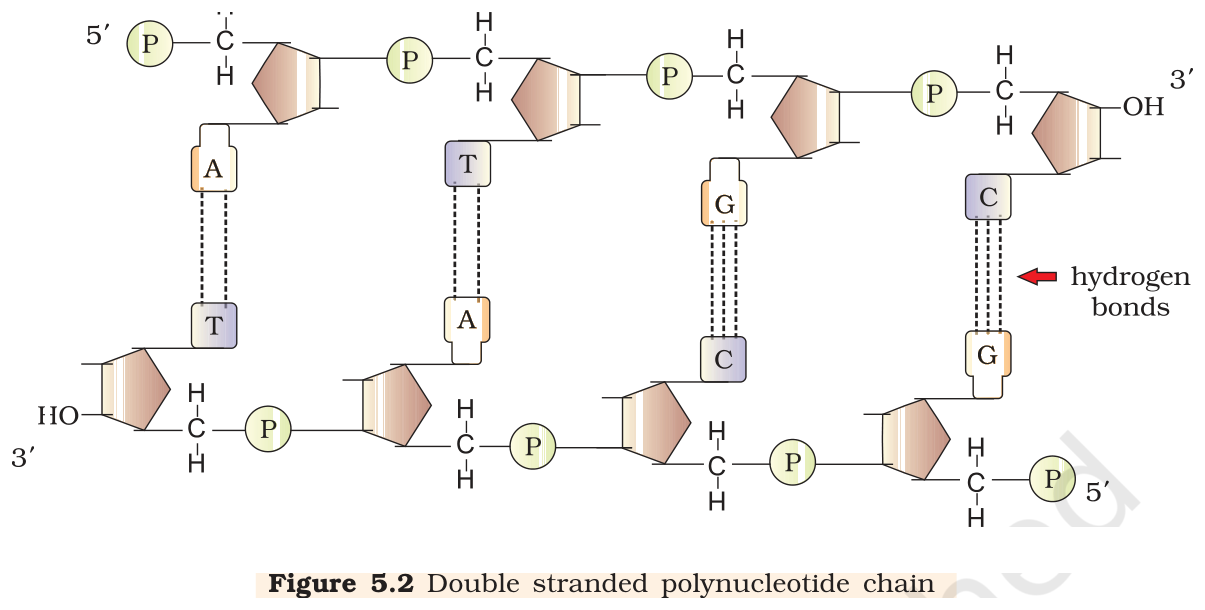
The dimensions are asked often, so they are worth memorising as one set. The pitch of the helix, the distance covered in one complete turn, is 3.4 nanometres. Each turn contains ten base pairs, so the rise per base pair is 0.34 nanometres. The diameter of the helix is about 2 nanometres. The pairing rule makes the two strands complementary: wherever one strand has an adenine, the other has a thymine, and wherever one has a guanine, the other has a cytosine. Complementary base pairing does two jobs. It keeps the two strands at a constant distance, which gives the helix a uniform width, and it lets each strand act as a template for the other, which is the basis of both replication and transcription.
The specificity of the base pairs is not the only source of stability. The flat bases stack one above another along the helix, and these stacking interactions, together with the hydrogen bonds and the sequence of bases, decide whether a stretch of DNA is easy or hard to unwind. The two chains are not identical; their sequences are complementary. If one stretch of a strand reads A T G C, the opposite stretch on the other strand reads T A C G, and the direction in which it reads is reversed because of the antiparallel arrangement.
1.3 Chargaff's rules
Erwin Chargaff had already shown, before the model was proposed, that the ratio of adenine to thymine and the ratio of guanine to cytosine in a double-stranded DNA are both close to one. The first rule follows at once from the pairing rule, because every adenine in one strand faces a thymine in the other. The observation that the base composition varies between species, while the ratios stay near one, was an important clue that the model had to explain. The percentage of guanine plus cytosine, called the GC content, differs between organisms but the A equals T and G equals C rule always holds for a double-stranded molecule.
1.4 Packing the molecule into a nucleus
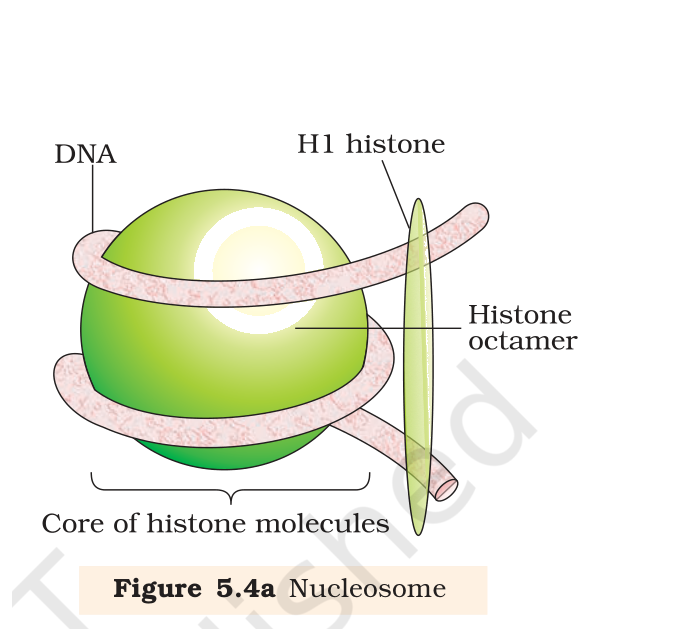
A human cell contains roughly two metres of DNA, yet the nucleus is only a few micrometres across. The packing begins with proteins called histones, which are rich in the positively charged amino acids lysine and arginine and therefore carry a positive charge at cellular pH. The negative phosphate groups of DNA bind to these positive proteins. Eight histone molecules form a histone octamer, and about 200 base pairs of DNA wrap around it to form a nucleosome. Under the electron microscope, the chromatin looks like beads on a string, with each bead a nucleosome. The nucleosomes coil further to form chromatin fibres, and the chromatin is then organised into the chromosomes seen at cell division.
Chromatin is not uniformly packed. Euchromatin is loosely packed and is the region where transcription is active, while heterochromatin is densely packed and transcriptionally inactive. In prokaryotes the DNA is not wrapped around histones, and it lies in the nucleoid region with a smaller set of associated proteins. The packaging question matters because the cell has to keep two metres of DNA both compact and accessible, and the answer is a hierarchy of coiling, not a single fold.
Exam
Keep the structural numbers as one list: pitch 3.4 nm, ten base pairs per turn, rise 0.34 nm per base pair, diameter 2 nm. State that adenine pairs with thymine by two hydrogen bonds and guanine with cytosine by three, and that the two strands are antiparallel. In diagram questions, label the 5 prime and 3 prime ends of both strands.
Common mistake
The two strands of a DNA molecule are complementary, not identical, so the sequence of one determines the other but does not repeat it. Do not confuse the nucleosome (DNA plus histone octamer) with the chromosome, and do not say that prokaryotic DNA has histones.