

Concepts: The search for genetic material and the RNA world
Molecular Basis of Inheritance20 min readLesson 2 of 8
2.1 The question before the proof
Mendel described factors that passed from parents to offspring, but he could not say what those factors were made of. By the 1920s, chromosomes had been seen and DNA had been found in them, but proteins were the favoured candidate because they have twenty building blocks while DNA has only four. The search that settled the question used bacteria and viruses, because they reproduce quickly and because their genetic material can be tracked with radioactive labels.
Griffith worked with Streptococcus pneumoniae, the bacterium that causes pneumonia. He had two strains, a smooth strain with a polysaccharide coat that killed mice, and a rough strain without the coat that did not. Heat-killed smooth bacteria were harmless. When heat-killed smooth bacteria were mixed with live rough bacteria and injected, the mice died, and live smooth bacteria could be recovered from them. Something from the dead smooth cells had changed the live rough cells into smooth ones. Griffith called this the transforming principle but did not identify it.
2.2 The transforming principle is DNA
Avery, MacLeod and McCarty purified the principle in the 1940s. They prepared extracts from heat-killed smooth bacteria and treated them with enzymes that destroy proteins, with enzymes that destroy RNA and with enzymes that destroy DNA. Extracts that had been treated with a DNA-destroying enzyme could no longer transform rough cells. Extracts treated with protein- or RNA-destroying enzymes still worked. Only DNA could carry the transforming ability, so DNA was the genetic material.
2.3 The Hershey-Chase experiment
Hershey and Chase worked with bacteriophages, viruses that infect bacteria. A phage has a protein coat and a DNA core, and it reproduces by injecting its genetic material into a bacterium and leaving the empty coat outside. The two materials carry different elements: DNA contains phosphorus and no sulphur, while protein contains sulphur and no phosphorus. Growing phages in a medium with radioactive phosphorus labelled their DNA, and growing them with radioactive sulphur labelled their protein coat.
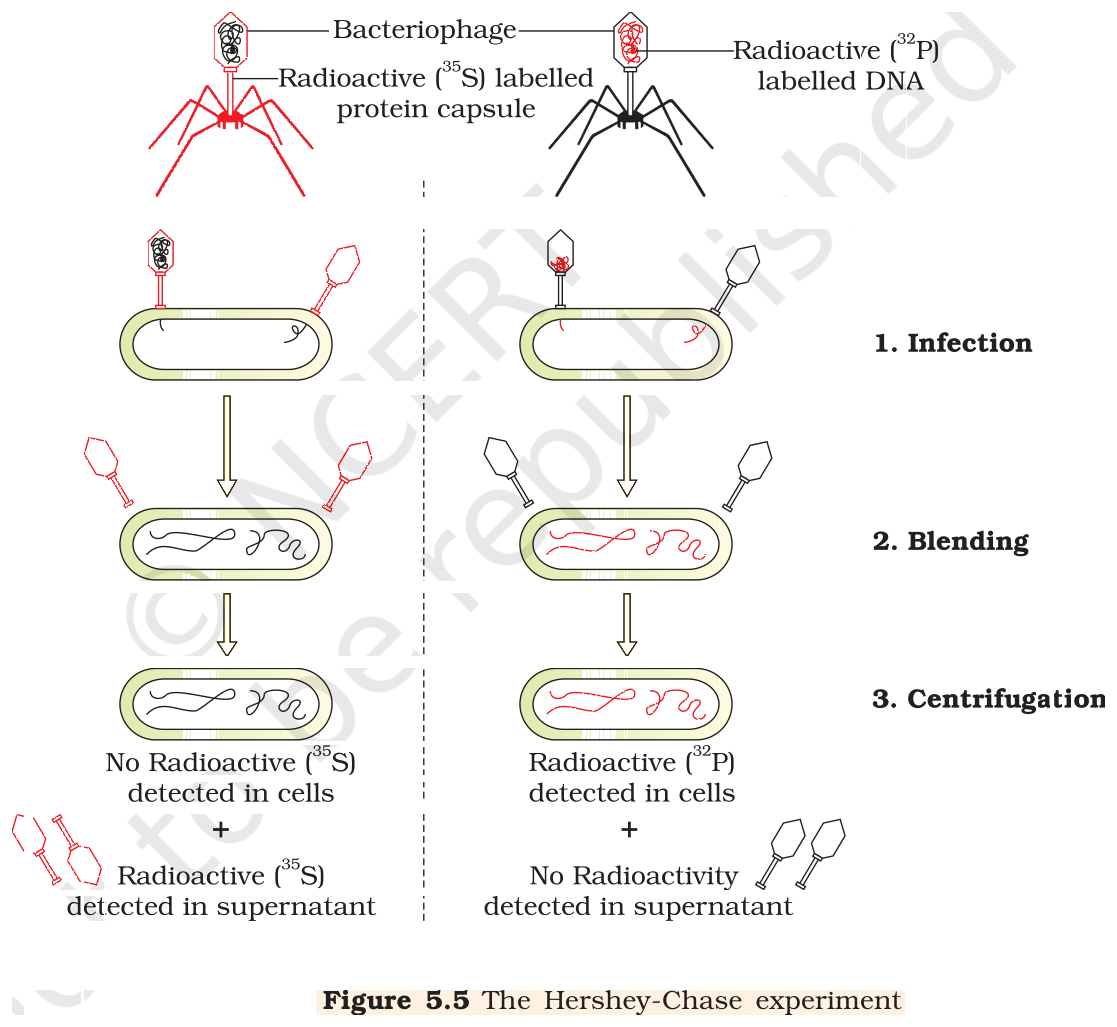
Radioactive phages were allowed to attach to Escherichia coli. The cultures were then agitated in a blender to remove the viral coats from the bacteria, and the mixture was spun in a centrifuge to separate the virus particles from the bacteria. Bacteria infected with phages carrying radioactive DNA were radioactive, which showed that DNA had passed from the virus into the bacterium. Bacteria infected with phages carrying radioactive protein were not radioactive, which showed that protein had not entered. DNA was therefore the genetic material, and the experiment gave both a clean result and a clean method.
2.4 What makes a molecule fit to be the genetic material
A genetic material has three jobs. It must store information, it must be able to replicate and pass that information to the next generation, and it must allow changes, because mutations supply the variation on which evolution acts. DNA does all three. Its bases store the information, its complementary strands provide a template for copying, and chemical changes in the bases produce mutations. DNA is also chemically stable: its deoxyribose lacks the 2 prime hydroxyl of ribose, and that absence makes the molecule much less reactive than RNA. The methyl group on thymine adds another small but real measure of stability. Finally, the double helix allows the information to be protected in one strand while the other is being copied.
2.5 RNA as genetic material and the RNA world
Some viruses, such as the tobacco mosaic virus, the influenza virus and HIV, use RNA as their genetic material. RNA can therefore store and transmit information. It also has a property that DNA lacks. Some RNA molecules act as catalysts, and a catalytic RNA is called a ribozyme. The discovery that RNA can catalyse reactions in the absence of protein was a surprise, and it led to the RNA world hypothesis. In the earliest cells, RNA may have carried both the information and the catalysis, with DNA and proteins appearing later. The hypothesis also explains why the chapter moves from DNA to RNA to protein: the flow is DNA to RNA to protein, with RNA doing the work of an adapter and sometimes of a catalyst.
The comparison between DNA and RNA is a frequent question. RNA is better as a catalyst because its 2 prime hydroxyl can take part in reactions, while DNA is better as a store because the same hydroxyl is absent. RNA is single-stranded in most of its roles, so it is less protected, and it is copied less accurately, which is an advantage for viruses that need to change quickly. DNA is double-stranded, more stable and copied with high fidelity, which is what a long-lived cell needs. The two molecules therefore divide the work: DNA stores, RNA transmits and sometimes catalyses, and protein does the structural and enzymatic work of the cell.
Exam
In the Hershey-Chase experiment, the correct labels are phosphorus-32 in DNA and sulphur-35 in protein. State what was labelled, what was blended, what was centrifuged and what the radioactivity in the bacterial pellet proved. In Griffith's experiment, mention the heat-killed smooth strain, the live rough strain and the recovery of live smooth bacteria.
Common mistake
Do not say that Avery, MacLeod and McCarty found that protein was the genetic material, and do not describe the blender as killing the bacteria. The blender removes the phage coats from the bacterial cells, and the centrifuge separates the coats from the cells.