

Concepts: Translation and regulation of gene expression
Molecular Basis of Inheritance26 min readLesson 5 of 8
5.1 The adapter and the factory
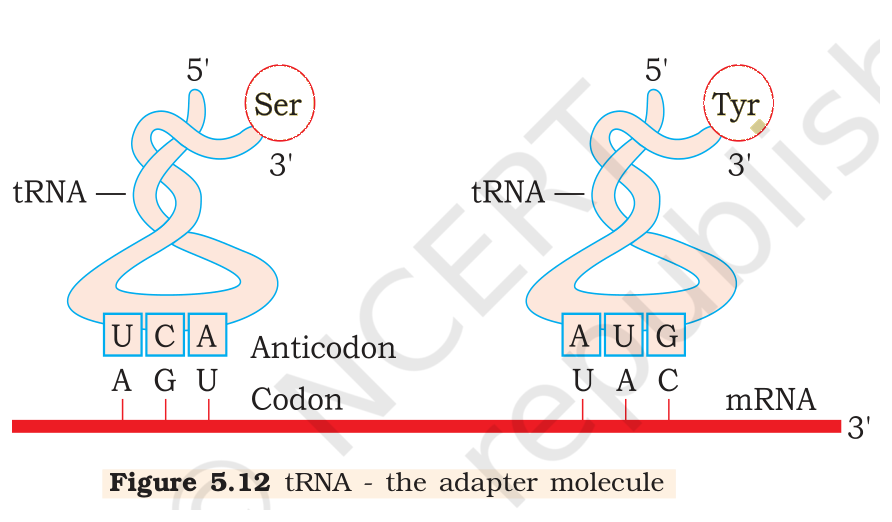
Translation is the process of reading the message in mRNA and building the corresponding chain of amino acids. Two molecules make the process possible. The transfer RNA is the adapter. It has an anticodon loop that pairs with a codon on the mRNA, and an amino acid acceptor end that carries the amino acid specified by that codon. There are many species of tRNA, each with its own anticodon and its own amino acid. The amino acid is attached to the tRNA by an enzyme called aminoacyl-tRNA synthetase in a reaction that uses ATP. This step is called charging or aminoacylation, and it is the step where the genetic code becomes physically linked to an amino acid.
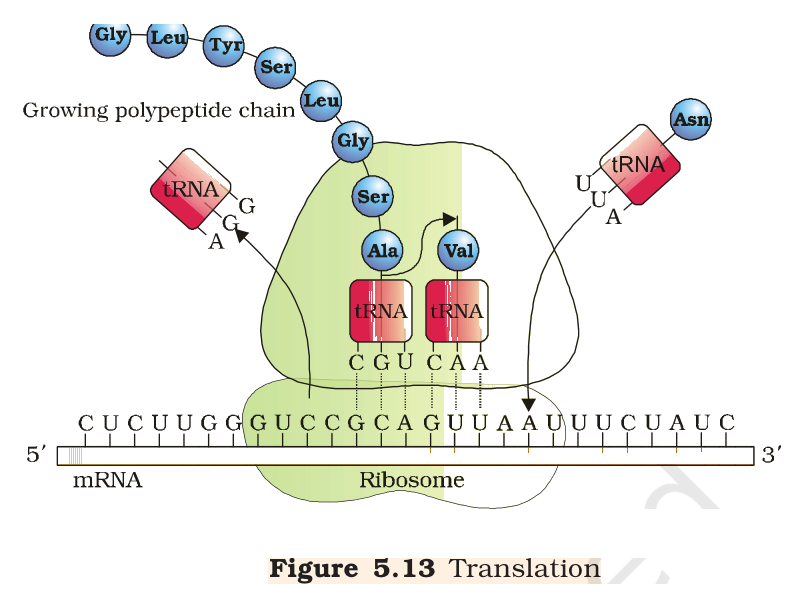
The ribosome is the factory. It has a large subunit and a small subunit, and it brings the mRNA, the charged tRNAs and the growing polypeptide together in the right positions. The small subunit binds the mRNA, the large subunit contains the peptidyl transferase activity that forms peptide bonds, and the ribosome moves along the mRNA one codon at a time. The peptidyl transferase activity is not a protein but a catalytic RNA in the large subunit, which is a reminder that RNA retains catalytic roles in the modern cell.
5.2 The three steps of translation
Initiation begins at the start codon AUG. The small ribosomal subunit binds the mRNA near its 5 prime end, the initiator tRNA carrying methionine pairs with the start codon, and the large subunit joins to form the complete ribosome. Initiation factors help this assembly and are released once it is complete.
Elongation adds amino acids one by one. A charged tRNA enters the ribosome and pairs its anticodon with the next codon. The ribosome catalyses the formation of a peptide bond between the growing chain and the new amino acid, then moves by one codon so that the next codon is exposed. The spent tRNA leaves and a new charged tRNA arrives. The polypeptide therefore grows from the amino-terminal end, and the mRNA is read in the 5 prime to 3 prime direction.
Termination happens when a stop codon, UAA, UAG or UGA, reaches the ribosome. No tRNA pairs with these codons. Instead, release factors bind the stop codon, the peptidyl transferase activity is switched to hydrolysis, the finished polypeptide is released, and the ribosome dissociates into its two subunits. The completed protein then folds into its functional shape, sometimes with the help of chaperones, and may be modified before it works.
5.3 Regulation of gene expression
A cell does not express every gene all the time. Gene expression is regulated mainly at the level of transcription, and the bacterial lac operon is the standard model of how it works. The operon is a set of genes under one control region. It contains a promoter, an operator, and three structural genes: the z gene for beta-galactosidase, the y gene for permease and the a gene for transacetylase. The enzyme coded by z breaks lactose into glucose and galactose, permease brings lactose into the cell, and transacetylase modifies certain sugars.
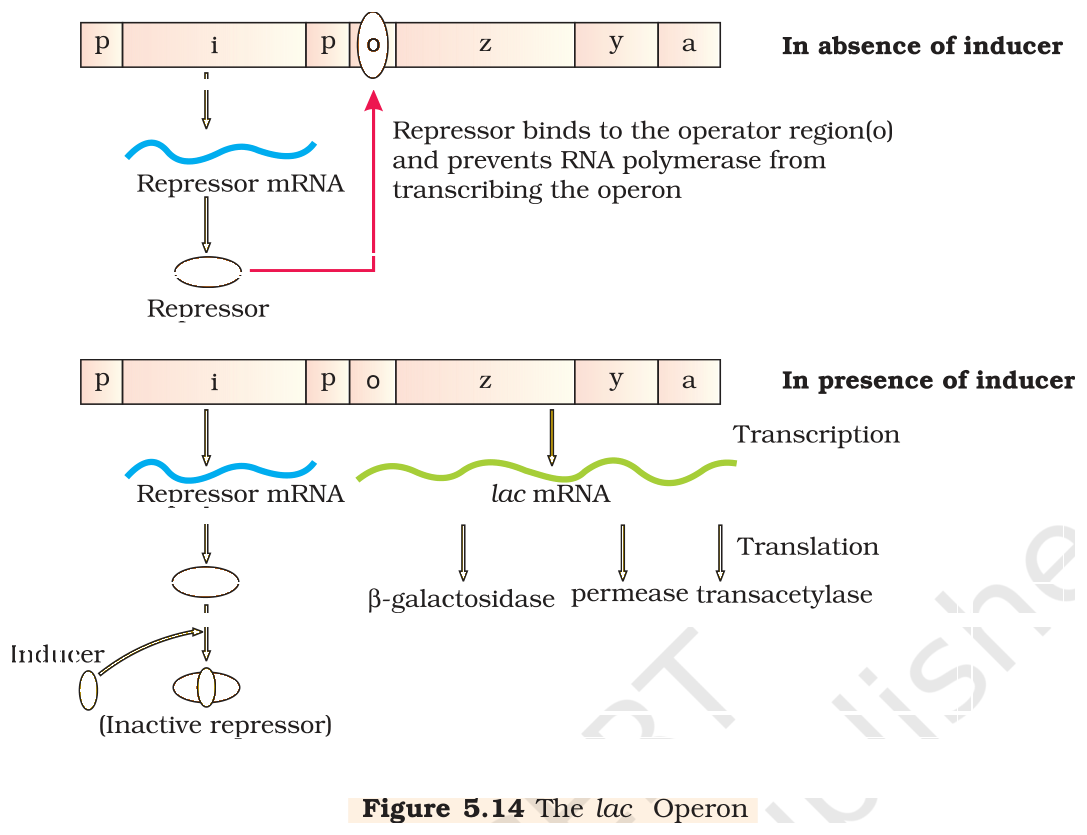
The i gene, which lies outside the operon, codes for a repressor protein. In the absence of lactose, the repressor binds the operator. The bound repressor blocks RNA polymerase from moving from the promoter into the structural genes, so transcription is switched off. This is negative regulation, because the control is imposed by a repressor that represses transcription. When lactose is available, some of it is converted into allolactose, which binds the repressor and changes its shape so that it can no longer bind the operator. The operator is free, RNA polymerase transcribes the operon, and the three enzymes are made.
The operon is therefore inducible. It is switched on by the presence of the substrate, and switched off again when the substrate is exhausted because the repressor returns to the operator. This logic is described as induction and repression of the operon. The lac operon also responds to glucose through catabolite repression, but the induction by lactose is the mechanism that textbook questions ask about. The logic of the operon explains why the enzymes appear only when the substrate is present and why they disappear when it is used up. The same principle of an operator and a repressor appears in other bacterial operons, with the difference that some are repressible rather than inducible. In a repressible operon the pathway is switched on by default and is switched off when the end product of the pathway accumulates. Regulation can also happen after transcription, through splicing and RNA stability, and after translation, through protein modification, but the lac operon remains the standard example of control at the level of transcription.
Exam
In translation answers, name the start codon AUG, list initiation, elongation and termination, mention the ribosome's two subunits, and say that the peptidyl transferase is a catalytic RNA. In lac operon answers, draw the opera with i gene, promoter, operator and z, y and a genes, and describe the repressor and inducer in that order.
Common mistake
Do not say that the ribosome moves 3 prime to 5 prime along the mRNA; it moves codon by codon in the 5 prime to 3 prime direction. Do not say that lactose itself binds the repressor; the inducer is allolactose. And do not call the lac operon positive regulation, because the repressor switches it off.