

Concepts: Transcription and the genetic code
Molecular Basis of Inheritance26 min readLesson 4 of 8
4.1 Copying one gene into RNA
Transcription is the process of copying the information from one strand of DNA into RNA. Only a segment of the DNA is copied at a time, and that segment, together with the sequences that control its copying, is called a transcription unit. A transcription unit has three regions. The promoter marks the start and tells RNA polymerase where to bind. The structural gene is the part that is copied into RNA. The terminator marks the end and stops the polymerase. The DNA has two strands, and only one of them is the template; the other is called the coding strand because its sequence matches the RNA, except that RNA has uracil where DNA has thymine.
The strand that is copied is read in the 3 prime to 5 prime direction, and the RNA is built in the 5 prime to 3 prime direction. This is the same rule as replication, because RNA polymerase also adds nucleotides to a free 3 prime hydroxyl. The promoter lies towards the 5 prime end of the coding strand, which places it upstream of the gene, and the terminator lies downstream.
4.2 Transcription in bacteria
Bacteria have a single RNA polymerase that carries out all transcription. The enzyme has a sigma factor and a rho factor. The sigma factor helps the polymerase bind the promoter and start transcription, and it is released once elongation begins. Elongation proceeds along the template, adding ribonucleotides to the growing RNA. Termination happens in one of two ways. In one, the rho factor helps the polymerase fall off the template at the terminator; in the other, a terminator sequence rich in guanine and cytosine forms a hairpin in the RNA that makes the polymerase pause and dissociate.
The three steps are initiation, elongation and termination, and the finished product is an mRNA that is ready to be translated, because bacteria have no nucleus and no separation between transcription and translation. Ribosomes can attach to the mRNA and begin translation even before transcription has finished.
4.3 Transcription in eukaryotes and processing
Eukaryotes have three RNA polymerases. RNA polymerase I makes the ribosomal RNAs, RNA polymerase II makes the messenger RNA, and RNA polymerase III makes transfer RNA, the 5S ribosomal RNA and the small nuclear RNAs. Each polymerase recognises a different set of promoters and needs transcription factors, which are proteins that assemble on the promoter and help the polymerase bind. The primary transcript made by RNA polymerase II is called heterogeneous nuclear RNA or precursor mRNA, and it is much longer than the final messenger RNA because it contains stretches that will be removed.
Slideshow, slide 1 of 3. Use the left and right arrow keys to change slides and the space bar to play or pause.
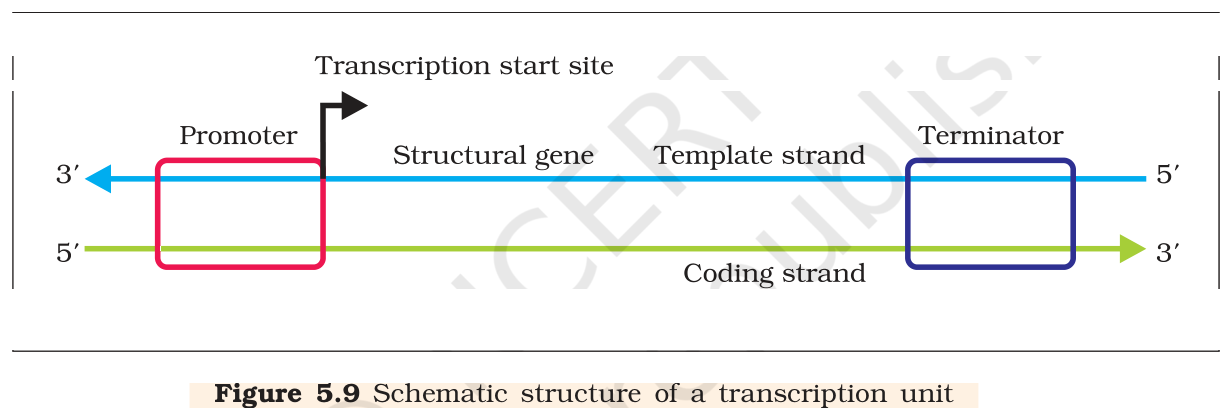
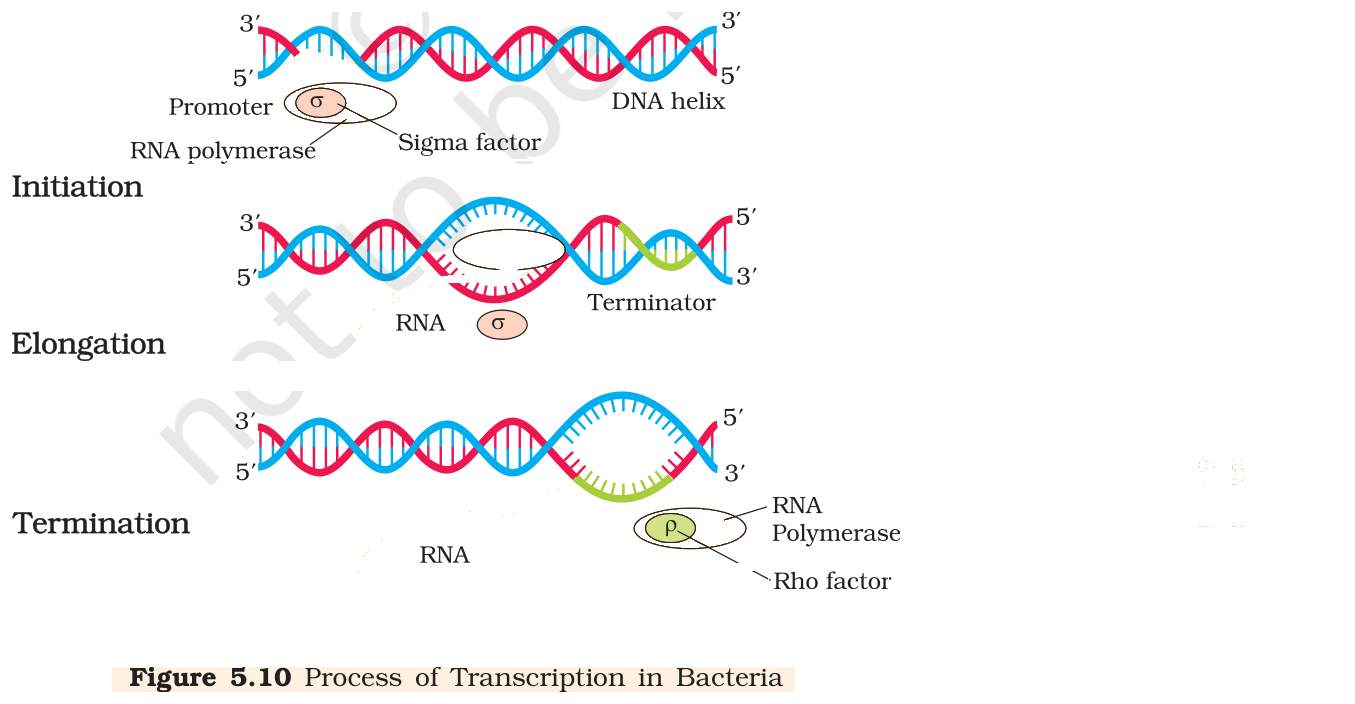
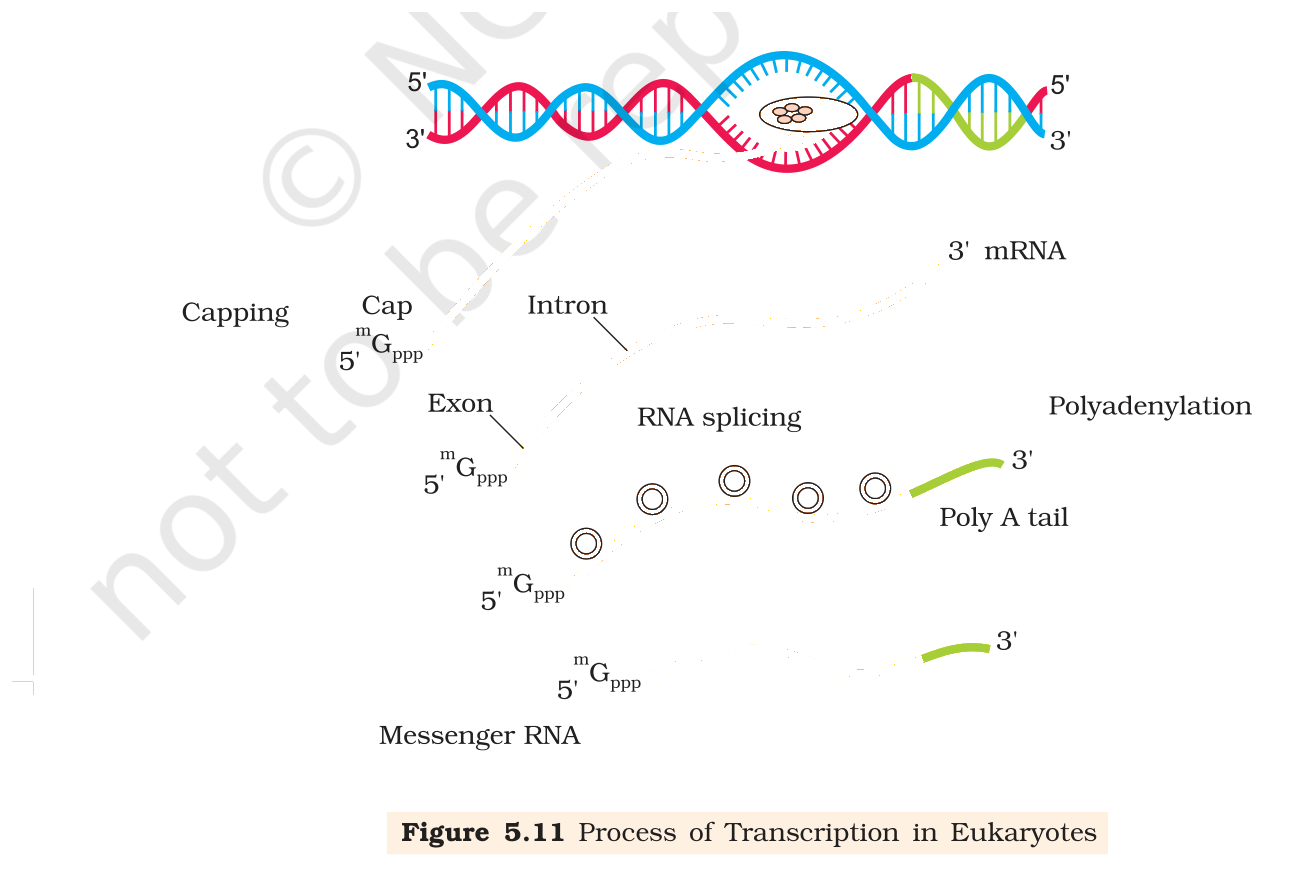
Schematic structure of a transcription unit showing the promoter, structural gene, template strand, coding strand and terminator.
The precursor mRNA undergoes three processing steps. Capping adds a methylated guanosine triphosphate to the 5 prime end. Tailing adds a chain of adenine residues, the poly-A tail, to the 3 prime end. Splicing removes the introns, the stretches that do not code for protein, and joins the exons, the stretches that do. The processed mRNA is then exported to the cytoplasm. The existence of introns makes eukaryotic genes split genes, and splicing is the process that converts a split gene transcript into a continuous coding sequence.
4.4 The genetic code
The genetic code is the set of rules by which the sequence of bases in mRNA is read as a sequence of amino acids. The code is a triplet code: three consecutive bases, called a codon, specify one amino acid. There are sixty-four possible codons. Sixty-one of them code for amino acids and three, UAA, UAG and UGA, are stop codons that signal the end of translation. The codon AUG is both a start codon and the codon for methionine.
The code has several properties that examiners ask for. It is degenerate, because most amino acids are specified by more than one codon. It is unambiguous, because a given codon always specifies the same amino acid. It is non-overlapping, because each base belongs to only one codon, and it is read continuously without commas. It is nearly universal, since the same codons carry the same meaning in bacteria, plants and animals, and this is used in genetic engineering. The wobble hypothesis explains how a single transfer RNA can read more than one codon when the third base varies.
4.5 Mutations in the code
A point mutation changes a single base. A substitution replaces one base with another and may change one codon. If the new codon specifies the same amino acid, the mutation is silent. If it specifies a different amino acid, the mutation is a missense mutation, and sickle-cell anaemia is the standard example: the codon GAG in the beta-globin gene becomes GUG, so glutamic acid is replaced by valine. If the new codon is a stop codon, the mutation is a nonsense mutation and the protein is shortened. An insertion or deletion of bases that is not a multiple of three shifts the reading frame, and every codon after the change is read differently; this is a frameshift mutation and usually destroys the protein.
Exam
Draw the transcription unit with its three regions in order, promoter to terminator, and label the template strand as 3 prime to 5 prime. In eukaryote answers, name RNA polymerase II for mRNA and list capping, tailing and splicing as the three processing steps. For the code, remember UAA, UAG and UGA as stop codons and AUG as the start.
Common mistake
Do not say that both DNA strands are copied for one gene, and do not mix the template strand with the coding strand. The coding strand has the same sequence as the RNA. Do not write that the code is ambiguous because the same amino acid can be coded by several codons; that property is degeneracy.