

Concepts: DNA replication
Molecular Basis of Inheritance24 min readLesson 3 of 8
3.1 Why replication has to be precise
Every cell divides and passes its DNA to two daughter cells, so before division the DNA must be copied. The copying has to be accurate, because an error becomes a mutation in every descendant of that cell. Watson and Crick saw that their model suggested a copying mechanism. Because the two strands are complementary, each strand can act as a template for a new strand, and the product is two double helices that are identical to the parent. The model they proposed is called semiconservative replication, because each new molecule keeps one old strand and one new strand.
3.2 The Meselson-Stahl experiment
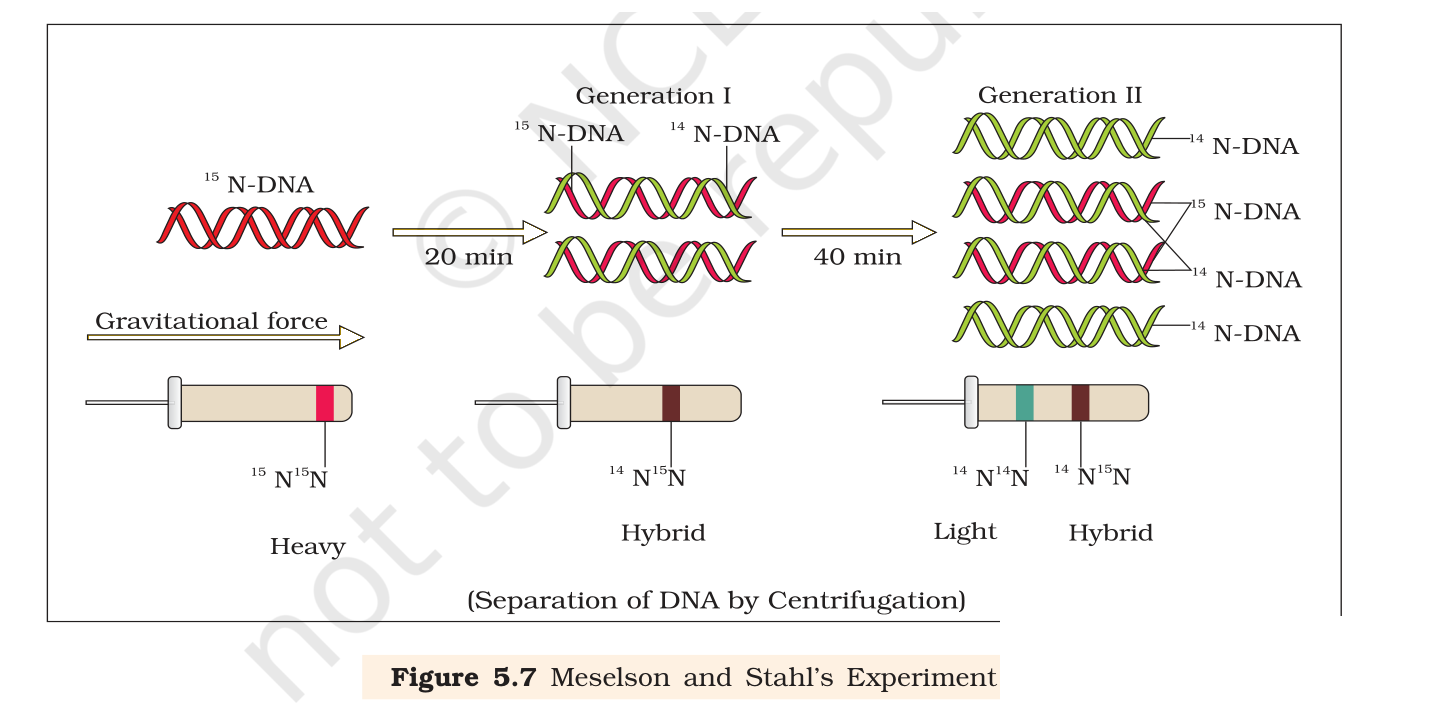
The proof came from a density experiment. Meselson and Stahl grew Escherichia coli in a medium whose nitrogen was the heavy isotope nitrogen-15, so the bacterial DNA became heavy. They then transferred the bacteria to a medium with ordinary nitrogen-14 and took samples after one generation and after two generations. DNA from each sample was spun in a solution of caesium chloride, which forms a density gradient, and the DNA banded at the position that matched its density.
After one generation, all the DNA formed a single band of intermediate density. After two generations, there were two bands, one of intermediate density and one of light density, in equal amounts. The result excluded the conservative model, which would have kept the original heavy molecule intact, and matched semiconservative replication exactly. If replication had been dispersive, the second generation would have shown a single band between the heavy and light positions rather than two distinct bands. The same experiment is also described with radioactive labels: Taylor and his colleagues labelled the chromosomes of Vicia faba with tritiated thymidine and found that both chromatids carried the label after the second division, which supported the same conclusion in a eukaryote.
3.3 The machinery of the fork
Replication starts at a specific site called the origin of replication. In a circular bacterial chromosome there is one origin, while a linear eukaryotic chromosome has many origins so that long molecules can be copied in a reasonable time. At the origin the double helix is opened and a replication fork forms. Helicase unwinds the helix, topoisomerase relieves the twisting strain ahead of the fork, and single-strand binding proteins keep the separated strands from rejoining. DNA polymerase cannot start a chain from nothing, so an RNA primer is laid down first, and the primer is later removed and replaced with DNA.
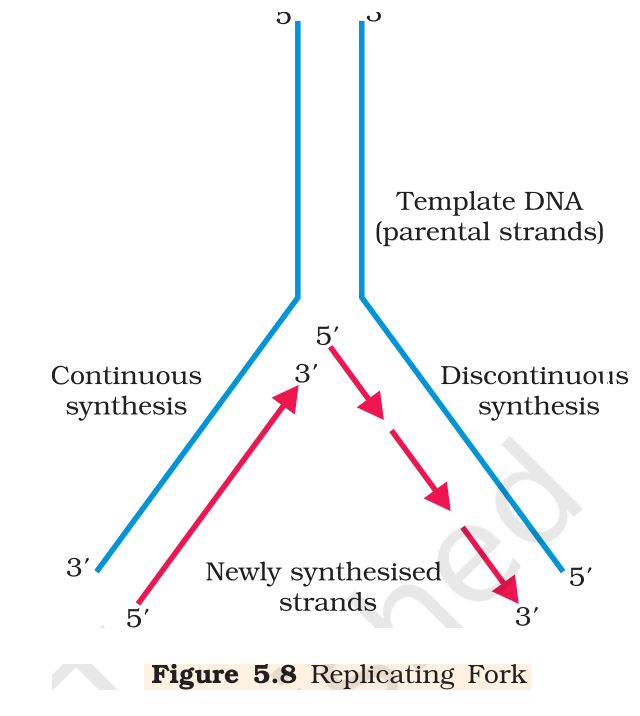
DNA polymerase works only in the 5 prime to 3 prime direction, adding deoxyribonucleoside triphosphates to a free 3 prime hydroxyl. The two template strands run in opposite directions, and this is what makes replication asymmetric. On one template the new strand can be built continuously towards the fork; that is the leading strand. On the other template the new strand must be built away from the fork in short pieces, and these pieces are called Okazaki fragments. Each fragment begins with its own primer, and DNA ligase later joins the fragments into one continuous strand. The lagging strand is therefore synthesised discontinuously.
3.4 Speed, accuracy and timing
The bacterial chromosome of Escherichia coli has about 4.6 million base pairs and replicates in roughly eighteen minutes, which requires about two thousand nucleotides to be added per second. Such speed is possible because many polymerase molecules work at once and because the two forks move in opposite directions from the origin. Accuracy comes from three places: base pairing limits which nucleotide can be added, the polymerase has a proofreading activity that removes a wrongly added nucleotide, and mismatch repair systems correct errors that escape proofreading.
In eukaryotic cells, replication happens during the S phase of the cell cycle. The DNA in the nucleus is replicated, and the cytoplasmic organelles have their own DNA and their own replication. The whole process is tightly linked to the cell cycle, so that replication is finished before the cell enters mitosis. A failure at any of these steps is serious, which is why the enzymes of replication are among the most conserved proteins known.
3.5 Direction and the two strands
A common exam mistake is to say that both new strands grow in the same direction. The direction of growth is always 5 prime to 3 prime on the new strand, but because the two templates are antiparallel, that direction is towards the fork on one template and away from the fork on the other. The leading strand needs one primer, while the lagging strand needs a series of primers, one for each Okazaki fragment. The primers are RNA, not DNA, which is the reason the enzyme primase is needed in addition to DNA polymerase.
Exam
Write the labels of the fork diagram in order: parental strands, 5 prime and 3 prime ends, leading strand with continuous synthesis, lagging strand with Okazaki fragments, RNA primers and DNA ligase. In the Meselson-Stahl answer, quote the band pattern after one and after two generations, because the marks are for the pattern, not for the procedure alone.
Common mistake
Replication is semiconservative, so after one generation no molecule is fully heavy or fully light. Do not write that the lagging strand is the "old" strand; lagging and leading describe the new strands, not the templates.