

Concepts: Double fertilisation, endosperm and embryo
Sexual Reproduction in Flowering Plants18 min readLesson 4 of 8
4.1 Two fusions in one embryo sac
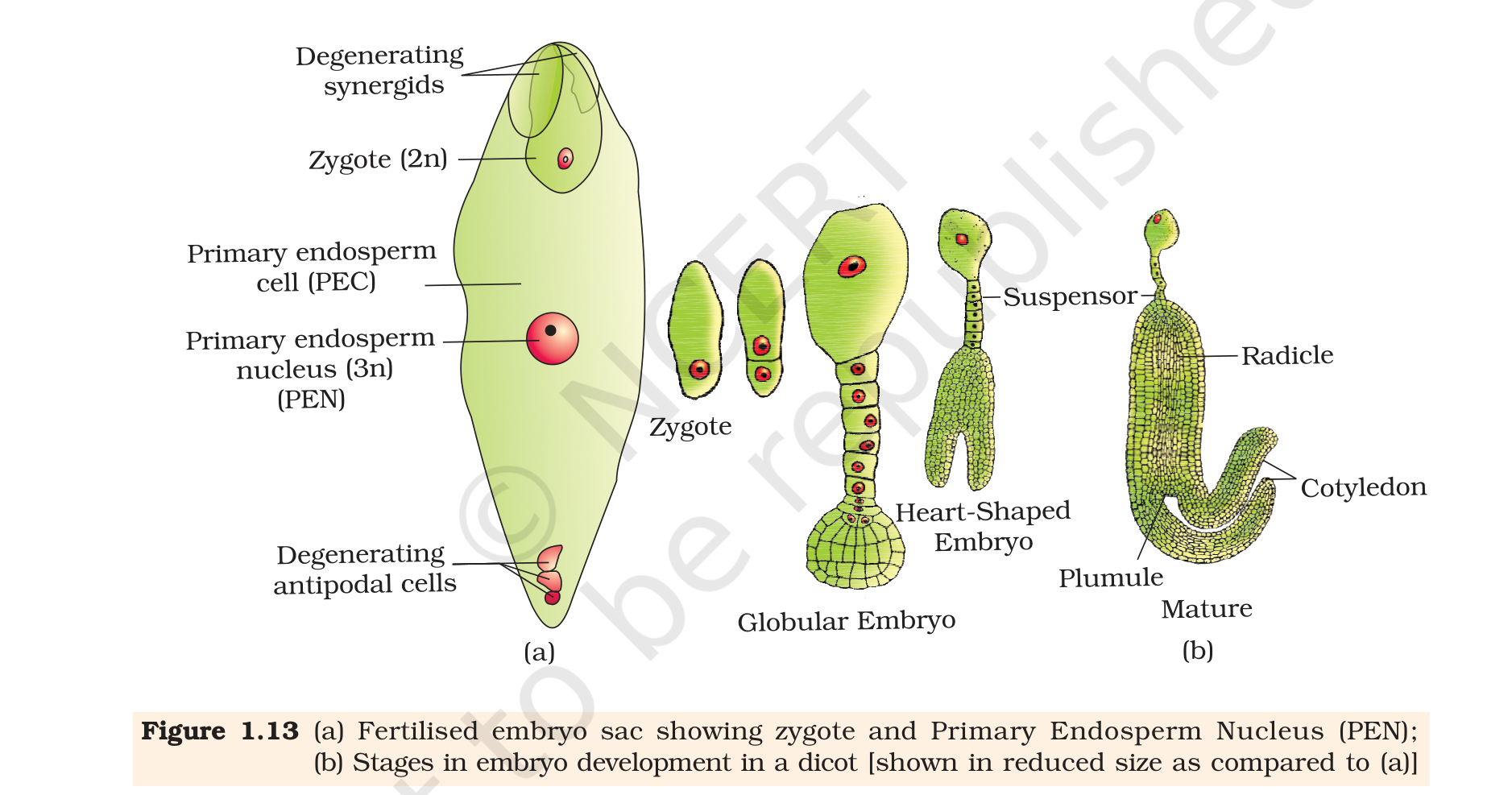
The pollen tube reaches the embryo sac and enters one synergid through the filiform apparatus. Inside the synergid it releases the two male gametes it carries. One of them moves to the egg cell and its nucleus fuses with the egg nucleus. This is syngamy, and the product is the diploid zygote.
The second male gamete moves to the two polar nuclei in the central cell and fuses with both. The fusion of three haploid nuclei is triple fusion, and the product is the triploid primary endosperm nucleus, usually shortened to PEN. The central cell now becomes the primary endosperm cell, or PEC.
Because syngamy and triple fusion both happen inside a single embryo sac, the whole event is called double fertilisation. Flowering plants are the only group in which it occurs. The zygote will form the embryo, and the PEC will form the endosperm.
| Fusion | Nuclei that join | Product | Ploidy |
|---|---|---|---|
| Syngamy | One male gamete and the egg | Zygote | 2n |
| Triple fusion | One male gamete and two polar nuclei | Primary endosperm nucleus | 3n |
Exam
A three-mark question on double fertilisation expects the two fusion events, the two products and the word triploid. Always say that the male gamete fuses with both polar nuclei, not with one, because the name triple fusion records three nuclei, not three cells.
4.2 Endosperm comes first
Endosperm development starts before embryo development, and that order is deliberate. The embryo needs food while it is being built, so the endosperm is laid down first and the zygote usually begins to divide only after some endosperm exists. The delay is an adaptation that hands the embryo a settled food supply before the work of building cells begins.
Division of the primary endosperm cell gives triploid tissue. In the usual pattern the primary endosperm nucleus splits again and again while walls are held back, so free nuclei collect in the central cell. This is the free-nuclear stage. Walls appear only later, turning the tissue cellular. How many free nuclei accumulate first differs from one species to another.
The tender coconut you drink shows both stages. Coconut water is free-nuclear endosperm, a fluid packed with thousands of nuclei, and the white kernel around it is cellular endosperm.
Endosperm does not always survive into the mature seed. In pea, groundnut and beans the developing embryo uses it up, so the seed is non-albuminous. In castor and coconut the endosperm stays in the mature seed and is used during germination, so the seed is albuminous. Cereals such as wheat, rice and maize also keep a store of endosperm in the grain.
4.3 From proembryo to a mature embryo
The zygote sits near the micropylar end, and it is there that the embryo forms. The first divisions produce a proembryo. The proembryo then passes through a globular stage, then a heart-shaped stage, and finally matures. The earliest stages look much the same in dicots and monocots, and the differences appear later.
A typical dicot embryo has an embryonal axis and two cotyledons. The part of the axis above the cotyledons is the epicotyl, and it ends in the plumule, which is the stem tip. The part below the cotyledons is the hypocotyl, and it ends at the radicle, the root tip. A root cap covers the radicle.
A monocot embryo has a single cotyledon. In the grass family this cotyledon is called the scutellum and lies on one side of the embryonal axis. Below the attachment of the scutellum, the radicle and root cap are enclosed in a sheath called the coleorhiza. Above the scutellum, the epicotyl carries the shoot apex and a few leaf primordia inside a hollow sheath, the coleoptile. The coleoptile and coleorhiza are the two sheaths to remember for a grass embryo, and they are easy to swap in an exam.
| Feature | Dicot embryo | Grass embryo |
|---|---|---|
| Cotyledons | Two | One, called the scutellum |
| Axis above cotyledons | Epicotyl with plumule | Epicotyl with shoot apex and leaf primordia |
| Axis below cotyledons | Hypocotyl with radicle | Radicle and root cap inside coleorhiza |
| Protective sheath | None of this kind | Coleoptile over the shoot, coleorhiza over the root |
| Food store | Mostly in cotyledons | Mostly in endosperm |
4.4 The order of events to write in an answer
Many students lose marks by describing the events out of order. A clean sequence runs as follows. The pollen tube enters a synergid through the filiform apparatus. It discharges two male gametes. One gamete fuses with the egg nucleus, giving the zygote, which is diploid. The other gamete fuses with the two polar nuclei, giving the triploid PEN. The central cell becomes the primary endosperm cell. The endosperm develops first, free nuclear and then cellular, and only then does the zygote divide to form the embryo. The ovule becomes the seed and the ovary becomes the fruit.
Why does the zygote wait? The delay is the point. A zygote that divided before the endosperm was ready would build an embryo with nothing to feed it. Botanists describe the pause as dormancy of the zygote inside the fertilised ovule, and it lasts until endosperm development is under way.
Common mistake
Do not call the whole seed the endosperm. In a non-albuminous seed such as pea or groundnut the endosperm has already been consumed. Also, a heart-shaped embryo is a stage of a dicot, and the cotyledon of a grass embryo is a scutellum, not an extra sheath.