

Concepts: Pollination, outbreeding devices and pollen-pistil interaction
Sexual Reproduction in Flowering Plants22 min readLesson 3 of 8
3.1 Pollen has to be carried
Neither the male gametes nor the egg can swim to meet each other in a flowering plant, so the pollen grain must travel to the stigma. Pollination is that transfer. Flowering plants do not leave the transfer to luck alone. Their flowers carry shapes, colours, scents, rewards and timings that make a particular carrier do the work.
Pollination is classified by the source of the pollen.
Autogamy is pollination within the same flower. It sounds simple, but complete autogamy is uncommon in a normal flower that opens and exposes its anthers and stigma, because pollen release and stigma receptivity must coincide and the two organs must sit close enough for contact. Some plants, including Viola, Oxalis and Commelina, produce two kinds of flowers. Chasmogamous flowers are ordinary open flowers with exposed anthers and stigma. Cleistogamous flowers never open. Their anthers and stigma lie close together inside the bud, so pollen meets the stigma when the anthers dehisce. A cleistogamous flower is therefore invariably autogamous and sets seed even when no pollinator visits.
Geitonogamy is the transfer of pollen to a stigma of another flower on the same plant. A pollinating agent usually carries the pollen, so the act looks like cross-pollination. Genetically it is not, because both flowers belong to one plant.
Xenogamy is the transfer of pollen to a flower on a different plant. It is the only one of the three that brings pollen with a different genetic makeup to the stigma.
| Type | Pollen comes from | Genetic effect |
|---|---|---|
| Autogamy | Same flower | Selfing, offspring genetically like parent |
| Geitonogamy | Another flower, same plant | Selfing, because the plant is the same |
| Xenogamy | Flower on a different plant | Cross-pollination, new gene combinations |
3.2 Wind and water as carriers
Wind and water are abiotic agents. Most flowering plants use animals instead, and only a minority depend on these two.
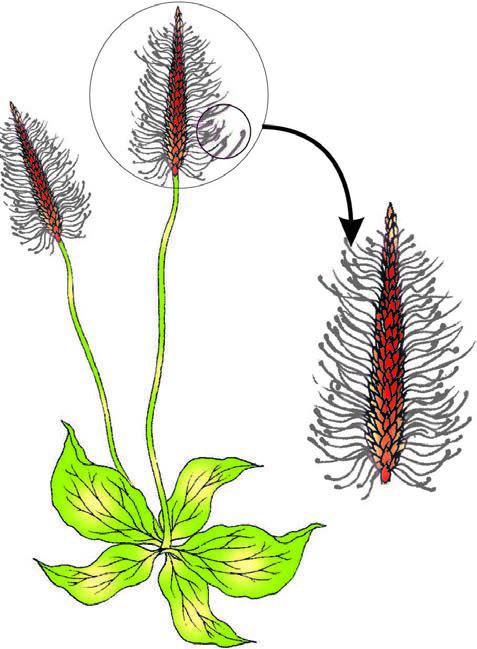
Wind pollination is the more common of the two. It needs pollen that is light and dry so air currents lift it, which is why wind-pollinated pollen is not sticky. The stamens hang out of the flower in the open wind, and the stigma is large and often feathery so that airborne grains catch on it. Many wind-pollinated flowers keep a single ovule in the ovary and pack many flowers into an inflorescence. The silky threads on a corn cob are the stigmas and styles of the female flowers, waving to trap pollen, and wind pollination is routine among grasses.
Water pollination is rare, confined to roughly thirty genera, mostly monocotyledons. Vallisneria and Hydrilla live in fresh water, and seagrasses such as Zostera in the sea. In Vallisneria the female flower opens at the water surface on a long stalk, while the male flowers release pollen onto the surface, where currents carry it to the female flowers. In seagrasses the female flowers stay submerged and the pollen is released underwater in long ribbon-like threads that drift to the stigma. A mucilaginous covering protects many water-borne pollen grains from wetting. Not every aquatic plant uses water: water hyacinth and water lily hold their flowers above the surface and are pollinated by insects or wind like land plants.
Both wind-pollinated and water-pollinated flowers share a plain look. They are not colourful and they do not make nectar, because there is no animal to pay.
3.3 Animals as carriers
Most angiosperms use animals. Bees are the most important group, with butterflies, moths, flies, beetles, wasps and ants also visiting, and birds and bats taking over in some regions. Larger animals are not excluded: lemurs, tree-dwelling rodents and even gecko and garden lizards pollinate some species.
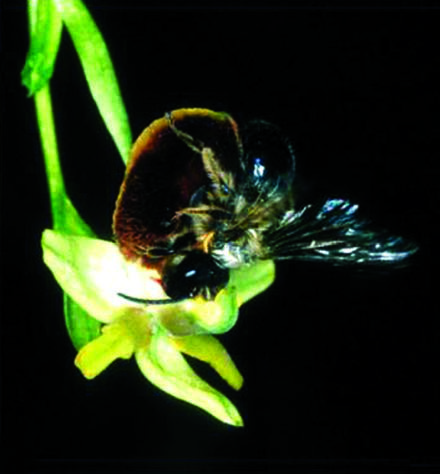
Flowers that depend on animals usually pay for the visit. Nectar and pollen are the usual rewards. The animal reaches in for the reward and in doing so touches the anthers and the stigma, picking up pollen that is sticky in these species. Insect-pollinated flowers tend to be large, colourful, scented and rich in nectar, and small flowers group into inflorescences to look bigger from a distance. Flowers pollinated by flies and beetles offer something different: a foul smell that suits the tastes of these insects.
A reward can also be a nursery. The tallest flower of Amorphophallus is about six feet high and provides a safe place for insects to lay eggs. The relation between a moth and the plant Yucca goes further. The moth lays eggs inside the locule of the ovary and pollinates the flower while doing so, and the moth larvae emerge as the seeds begin to develop. Neither partner finishes its life cycle without the other.
Not every visitor is a pollinator. Some insects eat pollen or nectar and touch neither anther nor stigma, and these visitors are called pollen or nectar robbers.
3.4 Devices that prevent selfing
Repeated self-pollination leads to inbreeding depression, so many plants protect themselves from their own pollen. Four devices appear in this chapter.
The first is a difference in timing. Pollen may be released before the stigma is receptive, or the stigma may be receptive long before the pollen is shed, so the two are never ready together. The second is a difference in position, with anther and stigma placed so that pollen from the same flower cannot reach the stigma. Together these two prevent autogamy.
The third is self-incompatibility, a genetic mechanism. When the pollen comes from the same flower or another flower of the same plant, the pistil blocks fertilisation by stopping pollen germination or pollen tube growth inside the pistil.
The fourth is the separation of sexes in flowers. A plant with unisexual flowers on the same individual, such as castor or maize, is monoecious. Autogamy is impossible in such plants, though geitonogamy is not, since a pollinator can still move pollen between male and female flowers of one plant. A dioecious plant such as papaya carries male flowers on one plant and female flowers on another. Dioecy rules out both autogamy and geitonogamy.
3.5 Pollen-pistil interaction
A stigma receives many kinds of pollen, and pollination itself does not guarantee that the right one has arrived. The pistil tests the pollen and answers it. Compatible pollen, from the same species and not blocked by self-incompatibility, is accepted and its germination is encouraged. Incompatible pollen is rejected, halted while it is still on the stigma or blocked later within the style. Botanists describe this back and forth as a chemical dialogue between grain and pistil, and only part of the molecular detail has been worked out.
A compatible pollen grain germinates through one germ pore and produces a pollen tube. The contents of the grain move into the tube, which grows down through the stigma and style towards the ovary. If the grain was released with two cells, the generative cell splits while the tube is growing and the two male gametes appear then. If the grain was already three-celled, both gametes travel in the tube from the outset. The tube reaches the ovule by way of the micropyle and pushes into a synergid, guided by the filiform apparatus. This whole sequence, from pollen landing to the tube reaching the embryo sac, is the pollen-pistil interaction.
You can watch the first step in a school lab. Dust pollen from pea, chickpea, Crotalaria, balsam or Vinca on a drop of about ten per cent sugar solution and look at it under low power after 15 to 30 minutes. Pollen tubes emerge from the grains.
Exam
A six-mark answer on pollination should move in this order: definition, three kinds with one example each, agents, adaptations of wind and water flowers, rewards, outbreeding devices, pollen-pistil interaction. Each device deserves one line and one example. Do not merge self-incompatibility with dioecy, because the first is genetic and the second separates the sexes on different plants.
Common mistake
Cleistogamy is not a failure of pollination; it is a way to guarantee it without any pollinator. Also, geitonogamy needs an external agent even though it is genetically selfing. And wind-pollinated flowers do not need colourful petals, because colour is an advertisement for animals.