

Concepts: Seed, fruit, apomixis and polyembryony
Sexual Reproduction in Flowering Plants16 min readLesson 5 of 8
5.1 What a seed is
A seed is a fertilised ovule, and it is the end product of the sexual cycle in a flowering plant. Seeds form inside fruits. A typical seed has one or two seed coats, one or two cotyledons and an embryonal axis. The cotyledons are usually thick and swollen because they store food, and in legumes that store is the reason we eat the seed.
The integuments of the ovule harden into the seed coats as the seed matures, and the micropyle survives as a small pore in the coat. That pore matters at germination, because oxygen and water enter the seed through it. The water content of a mature seed falls to about 10 to 15 per cent of its mass, and metabolism slows almost to a stop. The embryo may then rest in a state called dormancy, or it may germinate at once if moisture, oxygen and a suitable temperature are present.
Seeds are classified by what they carry besides the embryo. A non-albuminous seed has no endosperm left, because the embryo used it all during development, as in pea and groundnut. An albuminous seed keeps part of its endosperm, as in wheat, maize, barley and castor. A third structure appears in a few seeds. In black pepper and beet, some nucellus survives in the mature seed, and that leftover tissue is the perisperm. Perisperm is nucellus, never endosperm, and the difference is a favourite one-mark question.
5.2 Why seeds matter
A seed makes a plant independent of water for reproduction. Pollination and fertilisation no longer need a film of water, so seed formation is dependable. Seeds carry food for the seedling until it can photosynthesise on its own, and the hard seed coat protects the young embryo. They also travel: seeds disperse to new habitats and let a species colonise fresh ground. Since seeds are products of sexual reproduction, they carry new gene combinations and generate variation.
The dry, dormant seed is also the basis of agriculture. Storage works only because the seed is dehydrated and inactive. A seed that germinated as soon as it formed could not be stored for the next sowing season, and a farmer could not keep grain for the year.
Some seeds stay alive for a very long time. Most lose viability in months or a few years, but some last for centuries. The record held in this chapter is a lupine, Lupinus arcticus, dug out of Arctic tundra, which germinated and flowered after an estimated 10,000 years of dormancy. A date palm, Phoenix dactylifera, found in an excavation near the Dead Sea germinated after about 2,000 years.
5.3 Fruit, true and false
The ovary turns into the fruit at the same time as the ovules turn into seeds. The wall of the ovary becomes the pericarp. Fruits can be fleshy, as in guava, orange and mango, or dry, as in groundnut and mustard. The number of seeds in a fruit usually follows the number of ovules that were fertilised in the ovary.
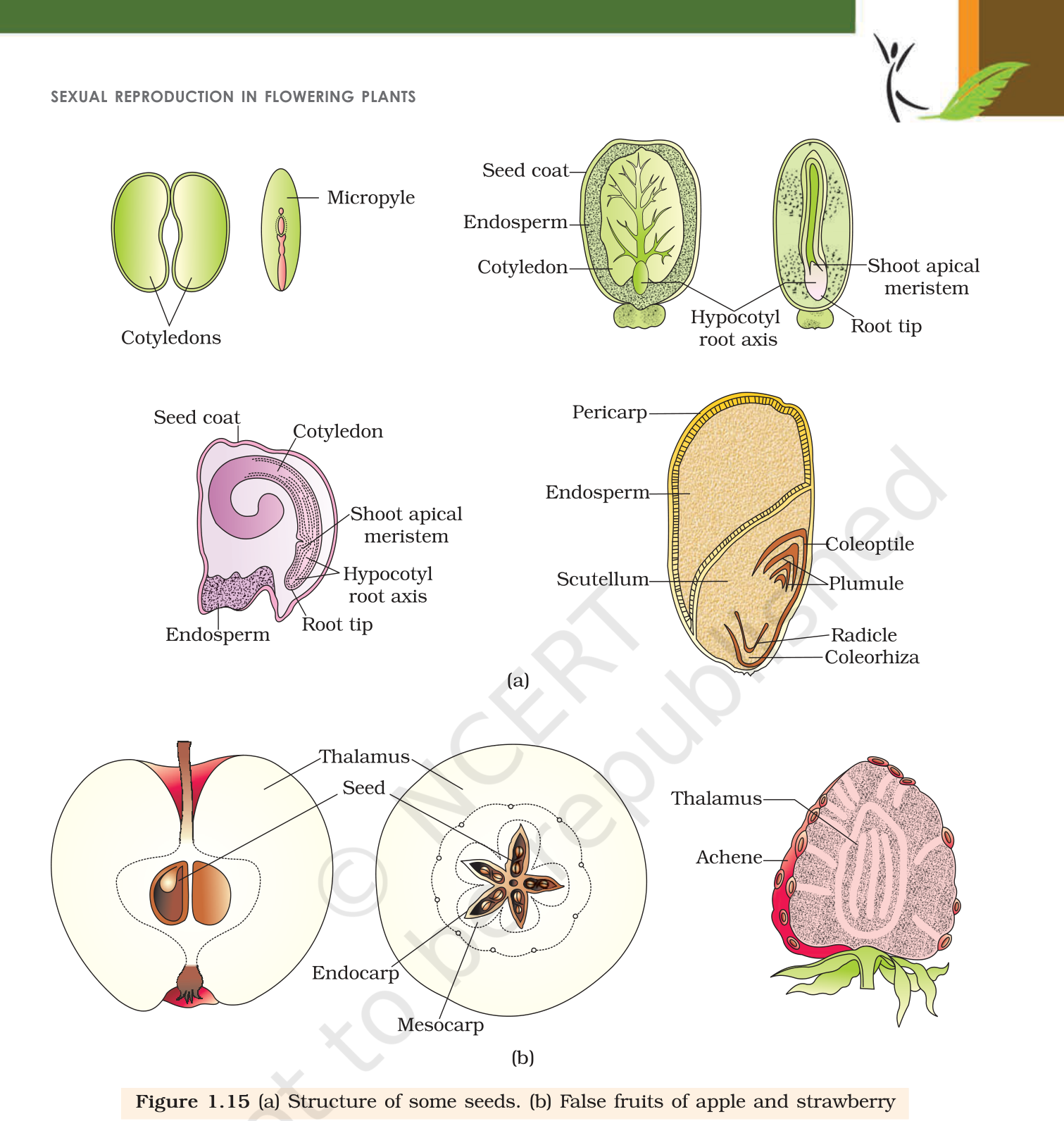
Most fruits develop from the ovary alone, and these are called true fruits. In a handful of species the thalamus joins in as well, and the fruit that follows is described as false. Apple, strawberry and cashew are the examples given here. Some fruits develop without fertilisation at all. A fruit of this kind is parthenocarpic, and banana is the standard example. Parthenocarpy can also be induced by applying growth hormones, and the fruits produced this way are seedless.
| Term | What it means | Example |
|---|---|---|
| True fruit | Develops from the ovary alone | Mango, groundnut |
| False fruit | Thalamus also contributes | Apple, strawberry, cashew |
| Parthenocarpic fruit | Develops without fertilisation | Banana |
| Perisperm | Persistent nucellus in the seed | Black pepper, beet |
5.4 Apomixis
A few flowering plants make seeds without fertilisation, and the process is called apomixis. It occurs in some members of Asteraceae and in several grasses. In some of these species the egg cell forms without meiosis, stays diploid and develops into an embryo on its own. In others, as in many Citrus and mango varieties, cells of the nucellus around the embryo sac start dividing, push into the sac and develop into embryos.
Apomixis looks like sexual reproduction from the outside and is really a form of asexual reproduction. The offspring are genetically identical to the parent, which is why apomictic embryos can be called clones.
5.5 Polyembryony and the hybrid seed problem
When an ovule carries more than one embryo, the condition is polyembryony. It follows naturally from the nucellar route above: if several nucellar cells each build an embryo, one seed holds many embryos. Cut open a seed of orange and you may find several embryos of different sizes and shapes.
Apomixis matters to farmers for an economic reason. Hybrid varieties raise yields, but hybrid seed must be bought fresh every year, because plants grown from the seed of a hybrid segregate and lose the hybrid characters. Producing hybrid seed is expensive, so farmers pay a high price each season. If a hybrid could be converted into an apomict, its progeny would not segregate. A farmer could then keep seed from the crop and sow it again without buying new hybrid seed every year. That is why many laboratories work on the genetics of apomixis.
- Draw the L.S. of a flower and label all four whorls from outside in.
- Write the anther wall layers in order and give one function of each.
- Rehearse the microsporogenesis sequence in six words or phrases.
- Compare the two-celled and three-celled pollen grain without looking at notes.
- Draw the seven-celled, eight-nucleate embryo sac and mark the filiform apparatus.
- List the four outbreeding devices with one example each.
- Write out syngamy and triple fusion with the ploidy of each product.
- Explain why the endosperm develops before the embryo.
- Distinguish albuminous from non-albuminous seeds with two examples each.
- Define apomixis and polyembryony and link them to hybrid seed production.