

Concepts: The flower, the stamen and the pollen grain
Sexual Reproduction in Flowering Plants18 min readLesson 1 of 8
1.1 A flower is a reproductive shoot
Flowers draw people in with colour and scent, and we use them at weddings, in temples and on graves. That social life of flowers hides the biological reason they exist. A flower is the organ in which a flowering plant makes its gametes and brings them together, and every part of it serves that job. Floriculture, the cultivation of flowers for sale, is built on the same structures that a botanist reads as reproductive organs.
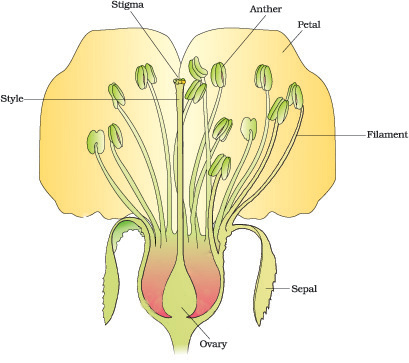
Four whorls sit on the receptacle, from outside in. The calyx is made of sepals, the corolla of petals, the androecium of stamens and the gynoecium of one or more pistils. The first two whorls protect and advertise the flower. The last two make the gametophytes. The male gametophyte, the pollen grain, develops inside the anther, which is part of the stamen. The female gametophyte, the embryo sac, develops inside the ovule, which sits in the ovary of the pistil. A board answer to "where do the gametophytes develop" is therefore anther and ovule, not stamen and pistil.
The decision to flower is taken long before a bud opens. Hormonal and structural changes set off the floral primordium, inflorescences appear, and only then do the floral parts differentiate. Keep that sequence in mind while reading the rest of the chapter: primordium, inflorescence, floral bud, flower.
1.2 The stamen and its anther
One stamen has two parts. A long slender stalk, the filament, carries the anther at its tip, and the lower end of the filament joins the thalamus or a petal. Stamen number and length differ widely between species, which is why stamens are so useful in identification and classification. The anther is usually bilobed, and each lobe carries two theca, so the whole anther is dithecous. Seen in a transverse section, the anther is four-sided and holds four microsporangia at its corners, two in each lobe. A longitudinal groove often separates the theca on each side.
The microsporangia lengthen along the anther and become pollen sacs packed with pollen grains. Their wall has four layers. The epidermis is the outermost layer. The endothecium lies below it, and the middle layers follow. These three outer layers protect the developing spores and later help the anther dehisce, or split, so that pollen can escape. The tapetum is the innermost layer that lines the sac, and it feeds the developing pollen grains. Tapetal cells have dense cytoplasm and usually more than one nucleus, because their nuclei divide without the cell dividing at the same time.
| Wall layer | Position | Main role |
|---|---|---|
| Epidermis | Outermost | Protection |
| Endothecium | Below epidermis | Protection and dehiscence |
| Middle layers | Between endothecium and tapetum | Protection |
| Tapetum | Innermost, lining the sac | Nutrition of developing pollen |
1.3 Microsporogenesis
When the anther is young, a compact group of similar cells called the sporogenous tissue fills the centre of each microsporangium. Any one of these cells can become a pollen mother cell, also called the microspore mother cell. Meiosis in that cell gives four haploid microspores arranged as a tetrad. The whole process, from pollen mother cell to separate microspores, is microsporogenesis.
The later steps are easy to mix up. The tetrad does not stay together. As the anther matures and dries, the four microspores separate from one another and each one becomes a pollen grain. One microsporangium can produce several thousand pollen grains, and all of them are released when the anther dehisces.
The sequence to write in an exam is: sporogenous tissue, pollen mother cell, meiosis, microspore tetrad, individual microspores, pollen grains. Only the first two stages are diploid. The tetrad and the microspores are haploid, since meiosis halves the chromosome number.
Slideshow, slide 1 of 3. Use the left and right arrow keys to change slides and the space bar to play or pause.
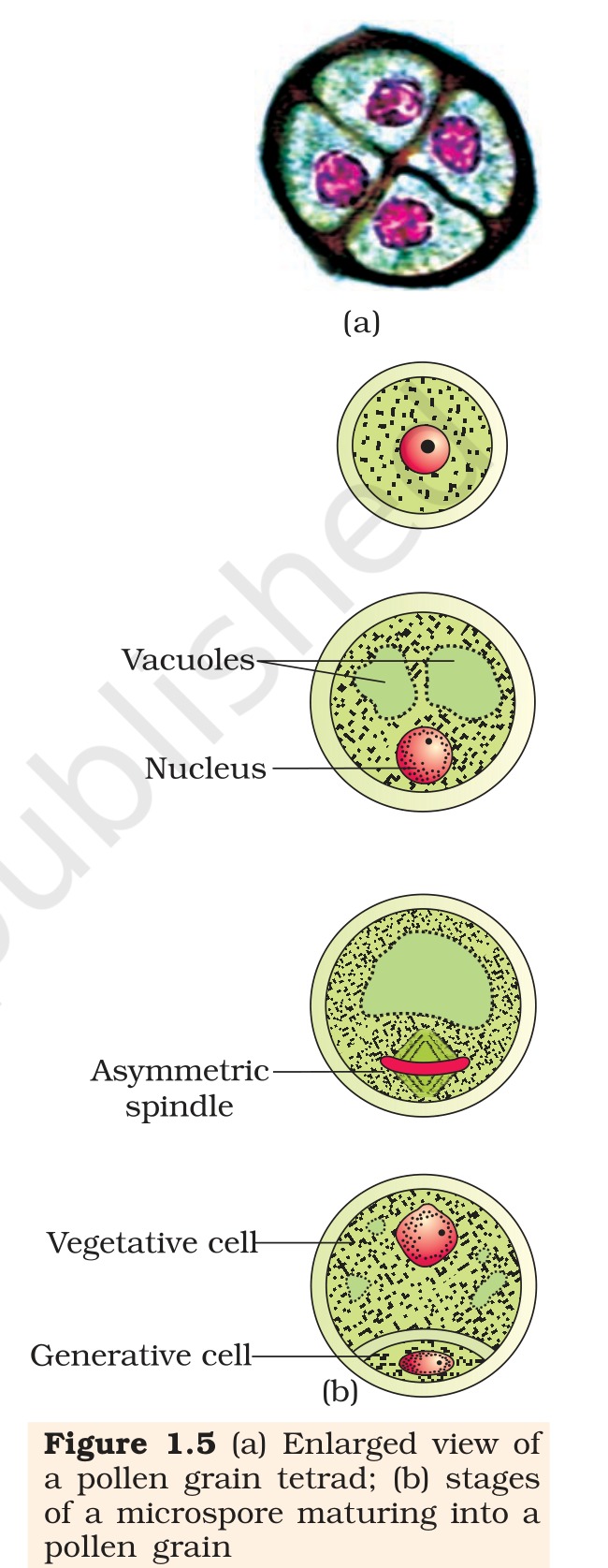
Microspore tetrad and the labelled stages of pollen-grain maturation printed as Figure 1.5.
1.4 The pollen grain
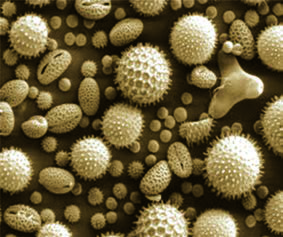
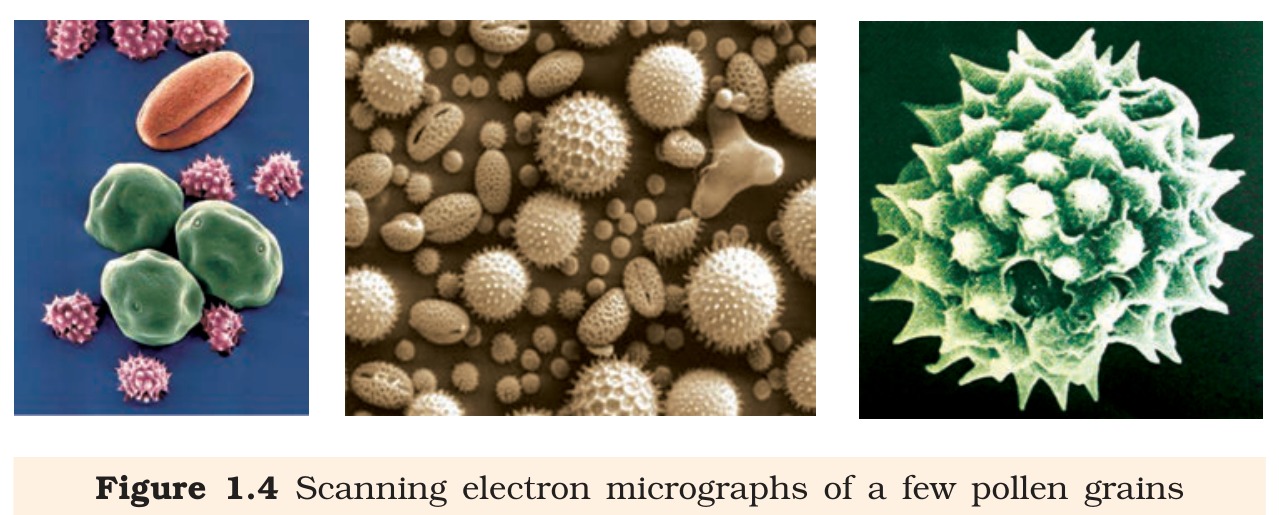
A mature pollen grain is roughly spherical and 25 to 50 micrometres across. Its wall has two layers. The outer exine is hard and built mainly of sporopollenin, one of the most resistant organic materials known. It survives high temperatures, strong acids and strong alkalis, and no enzyme that breaks it down has been found. That resistance is why pollen grains turn up intact in fossils and in sediment samples. The exine is not continuous. It has thin unthickened openings called germ pores, and it is through one of these that the pollen tube later emerges. The inner wall, the intine, is a thin and continuous layer of cellulose and pectin.
The living part of the grain has a plasma membrane and cytoplasm around two cells. The vegetative cell is large, has plenty of stored food and a big irregular nucleus. The generative cell is small, spindle shaped, dense and floats inside the cytoplasm of the vegetative cell. Roughly six in ten species release their pollen at this point, while the grain still has two cells. In the rest, the generative cell splits by mitosis first, so what leaves the anther already holds two male gametes inside three cells.
How long pollen stays alive varies. Rice and wheat pollen lose viability within about 30 minutes of release, while several members of Rosaceae, Leguminosae and Solanaceae stay viable for months. For plant breeding, pollen of many species can be kept for years in liquid nitrogen at -196 degrees Celsius and used as a pollen bank, the pollen equivalent of a seed bank.
Exam
Three marks often come from a comparison. Learn the two-celled and three-celled states, and remember that the generative cell divides by mitosis, so its products are haploid male gametes. The exine is protective and sporopollenin rich; the intine is thin and cellulosic. Germ pores are gaps in the spore wall, which is why the pollen tube starts exactly there.
Common mistake
Do not write that the pollen grain is a gamete. It is the male gametophyte, a haploid plant body of two or three cells. The male gametes are the two cells produced by the generative cell. Also do not say that the tapetum protects the pollen; it feeds it, while the outer three wall layers protect the sac.