

A unique planet
Our Home: Earth, a Unique Life-Sustaining Planet15 min readLesson 1 of 5
1.1 The last chapter of the book
We have reached the end of the Grade 8 journey. Earth is a planet orbiting the Sun, but it is no ordinary planet: it holds life, with mountains, oceans, deserts and forests. Satellites now let us photograph our home from space.
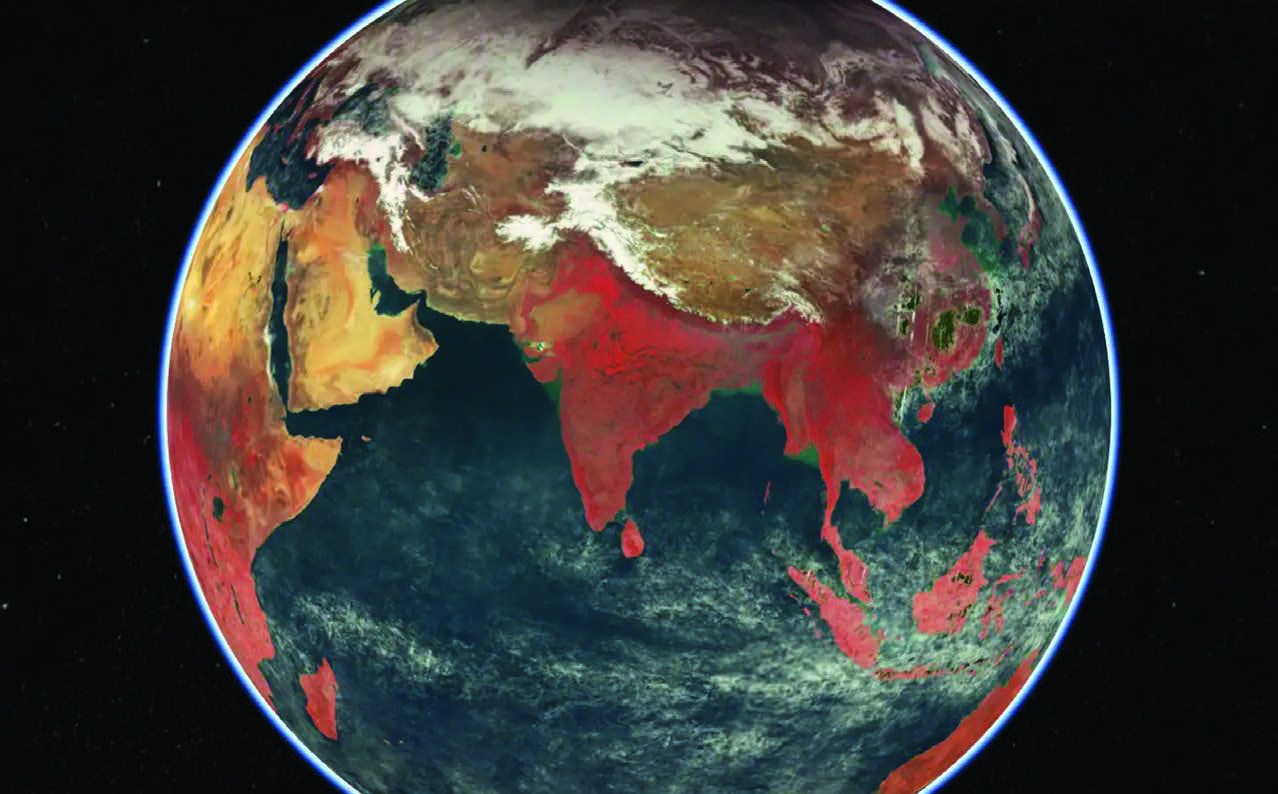
The opening image of the chapter was taken by an ISRO Earth-observation satellite and built from nearly 3000 smaller pictures, like a mosaic. It is a false-colour image, meaning scientists chose colours to represent different kinds of information. The data reveal land vegetation and ocean microbes, and can pick out sea temperature, oil spills and wind patterns.
1.2 The thin layer that holds life
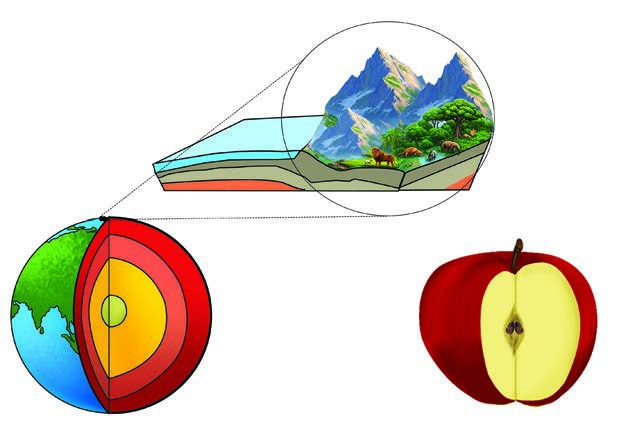
All life on Earth lives in a very thin surface layer. Life's domain runs from the highest peaks to the deepest ocean trenches, yet this crust is a sliver of the whole planet. Picture Earth shrunk to an apple: the living layer would be only as thick as the peel.
This delicate layer is what makes Earth special. It gives us air to breathe, water to drink and soil for crops. It also supplies rock and timber for homes, buildings and roads.
1.3 Features we take for granted
Some things about Earth are so ordinary that we never notice how unusual they are. The air we breathe does not fly off into space. Gravity holds us on the ground, yet the heart can still pump blood up to the head. Water, soil and sunlight combine to grow our food.
When we list these features, we begin to see how many conditions must be just right for life to continue.
1.4 Our neighbour planets
Eight planets circle the Sun in paths that are almost circular. The order outward from the Sun is Mercury, then Venus, followed by Earth and Mars, then Jupiter, Saturn, Uranus and Neptune. The first four are small and rocky, while the last four are large and mostly made of gases.
All planets get energy from the Sun, so a planet close to the Sun is generally hot and one far away is cold. Venus breaks this pattern: it is the second planet, yet it has the highest average temperature. Its thick atmosphere is almost entirely carbon dioxide, which traps heat.
1.5 The greenhouse effect
Carbon dioxide and similar gases in an atmosphere absorb the radiation a planet gives off after it has been warmed by the Sun. This holds heat near the surface. The same effect on Earth is mild and keeps temperatures in the range where water stays liquid.
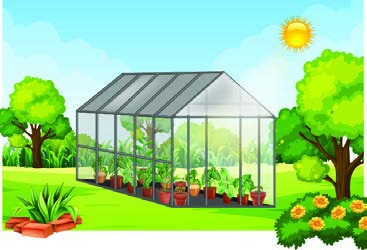
Venus shows what happens when the effect runs away: the trapped heat makes it hotter than Mercury, even though Mercury is closer to the Sun. The greenhouse used to grow plants works differently. It keeps warmed air inside a closed glass space, while a planet's atmosphere holds heat by absorbing radiation.
1.6 Reading Earth's portrait
A satellite image is more than a pretty picture. The opening mosaic used about 3000 separate images, and the false colours assigned to different bands of data make it easier to separate land from water, plants from bare ground and clouds from ice. Scientists use such data to watch crops, forests and oceans over time.
The same tools can detect ocean temperature, oil spills and wind direction. They let us monitor changes across the whole planet without travelling to every place.
1.7 Why the thin crust matters
The crust holds the soil, water and air that life uses. It is thin, which makes it vulnerable. Ploughing, mining, building and pollution can damage this layer quickly, and repairing it takes much longer.
The materials we use every day also come from the crust. Rock, sand, clay, metals and fossil fuels are all extracted from it. Understanding how thin and limited this layer is helps us see why careful use of resources matters.
1.8 Rocky planets and gas giants
The four planets nearest the Sun are small and rocky: Mercury, Venus, Earth and Mars. The four farther out are much larger and made mostly of gases: Jupiter, Saturn, Uranus and Neptune. This split in size and makeup is one of the basic patterns of the solar system.
Temperature generally falls as distance from the Sun increases, because the same amount of sunlight spreads over a larger area. Venus is the exception, and its thick atmosphere explains why.