

Spheres of life and reproduction
Our Home: Earth, a Unique Life-Sustaining Planet16 min readLesson 3 of 5
3.1 The four spheres
Earth's conditions support life, and life is sustained by connections between living and non-living things. These can be grouped into four spheres.
The atmosphere is the layer of air around Earth. It supplies oxygen for respiration and carbon dioxide for photosynthesis. Using sunlight, plants combine carbon dioxide from the air with water drawn from the soil to make food, releasing oxygen. The atmosphere also traps some heat through the mild greenhouse effect and carries water vapour that forms clouds and rain.
The hydrosphere covers every drop of water: seas and oceans, rivers and lakes, ponds, springs and water underground. Water covers about 70 per cent of the surface. It is a good solvent, carries nutrients through plants, regulates body temperature in animals and supports digestion and hydration. It is home to millions of forms, from tiny plankton to giant whales, and freshwater is needed for crops.
The geosphere is the solid part of Earth: its rocks, soil and minerals. Soil holds nutrients such as nitrogen and potassium, set free as rocks weather and remains of organisms decay. Minerals provide salt, coal, oil, iron and copper. The variety of landforms, rocks and soils is called geodiversity, and it creates many different habitats.
The biosphere is all living beings together with the places where they live, on land, in water and in the air. Plants produce food, animals feed on plants or on one another, and decomposers break dead material into nutrients that go back to the soil.
3.2 Keeping the balance
Earth works like a huge team project among land, air, water and life. A single change, like clearing a forest, can alter rain, soil, air and the creatures living there. Life survives because all the parts work together in balance rather than because of one factor. Caring for clean air, water, soil and every kind of life is therefore essential.
3.3 Why reproduction matters
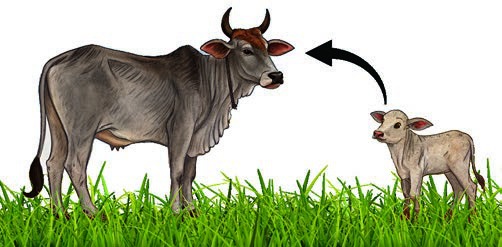
If living things did not reproduce, life would eventually disappear. Reproduction keeps each kind of organism going and maintains the continuity of life. Cows have calves and cats have kittens because parents pass instructions to their offspring. These instructions, called genes or genetic material, are stored in every cell and guide how the young one develops.
3.4 Copies and mixtures
There are two main ways of reproducing. In asexual reproduction, a single parent produces offspring that are exact copies of itself. Many plants reproduce when a leaf, stem or root is planted: this is called vegetative propagation. Money plant cuttings, the eyes of a sprouted potato and pieces of ginger can all grow into new plants. Bacteria and amoeba split into two look-alike cells, hydra grows buds, and planaria can regrow from a small piece of its body.
In sexual reproduction, two parents are involved. Each parent produces special reproductive cells called gametes, which carry half of that parent's genetic material. When gametes fuse, the resulting cell carries a full instruction set, drawn half from each parent; the young one resembles both but matches neither exactly.
3.5 In flowering plants
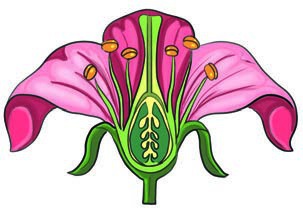
Flowers contain male and female parts. Pollen grains in the anther are the male gametes, while the ovules, seated deep in the flower, are the female gametes. Wind, insects or animals carry pollen to another flower in pollination. When pollen and ovule combine, fertilisation forms a zygote, which develops into a seed. The fleshy part around the ovule becomes the fruit. Animals eat fruit and drop seeds far away, and seeds use stored food to grow when they get water.
3.6 In animals
In animals the male gamete is the sperm and the female gamete is the egg. In fish and frogs, sperm and eggs are released into water and fertilisation happens outside the body. In birds and mammals, fertilisation happens inside the female's body. Birds lay eggs that hold food for the embryo until hatching, while most mammals keep the developing young inside the mother, who supplies food and oxygen until birth.
3.7 Soil, the living skin
Soil is easy to overlook, but it is a busy place. It holds nutrients such as nitrogen and potassium, water and air, along with roots, worms, insects and countless microbes. Its nutrients come partly from the breakdown of rocks and partly from the remains of plants and animals.
Decomposers turn dead matter into simpler substances that plants can absorb, so soil fertility depends on the life within it. Erosion, overuse and pollution can strip this thin layer away, and rebuilding it is slow.
3.8 Why variation matters
Asexual reproduction produces copies, which is fast and reliable when conditions are stable. Sexual reproduction mixes instructions from two parents, so the offspring are not identical. That variation can help a population survive when conditions change, because some individuals may carry features better suited to the new situation.
Over many generations, small differences can add up. This is how populations can adapt to new environments, and it is one reason variety within a species matters for the future.