

Why Earth can support life
Our Home: Earth, a Unique Life-Sustaining Planet15 min readLesson 2 of 5
2.1 The right distance
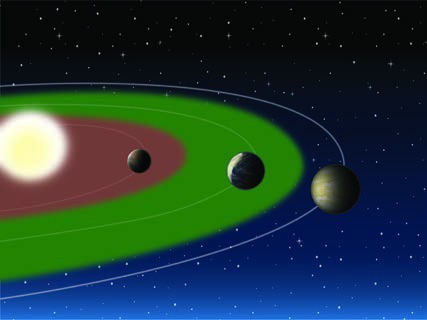
Distance from the Sun tops the list of reasons Earth can support life. Earth sits where water can remain liquid. Closer to the Sun, water would boil away; farther away, it would freeze. Some microbes can survive frozen conditions, but liquid water is essential for life to develop.
The range of distances around a star where water stays liquid is called the habitable zone, or the Goldilocks zone. Earth lies in the Sun's habitable zone. Because most of Earth's surface is covered in water, the planet looks blue from space and is called the Blue Planet.
2.2 A nearly circular orbit
Most planetary paths, Earth's included, are close to circular. As a result, the sunlight and heat reaching us stay nearly constant all year. Without this steadiness, summers and winters could become far more extreme over much of the planet.
2.3 The right size
Earth's size lets it hold on to an atmosphere. Atmosphere is the layer of gases around the planet, and it plays a major part in sustaining life. Gravity pulls those gases towards Earth.
If Earth were much smaller with the same density, its gravity would be too weak to hold the atmosphere, and the gases would drift into space. Mars has an atmosphere about 100 times thinner than Earth's, and Mercury has none. If Earth were much larger, the stronger gravity would press on living bodies with crushing force. The right size, in other words, keeps both the atmosphere and the life it supports in place.
2.4 Oxygen and the ozone layer
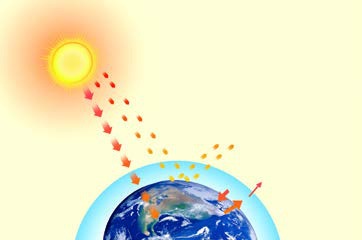
Oxygen in the atmosphere allows us to breathe and is used by almost all life. Part of the oxygen turns into ozone, a molecule built from three oxygen atoms. Ozone collects in the ozone layer, which acts as a shield that blocks ultraviolet rays capable of harming living cells.
2.5 A magnetic shield
A freely suspended magnet settles in a fixed direction because Earth itself behaves like a giant magnet. Scientists think churning molten iron in the core generates the magnetic field.
Space sends tiny high-energy particles towards Earth. Some arrive from far across the universe as cosmic rays, while others stream from the Sun as the solar wind. Such particles could erode the atmosphere, thin the ozone layer and admit extra ultraviolet radiation. Earth's magnetic field pushes many of them away, protecting the atmosphere and life.
2.6 Mars and Mangalyaan
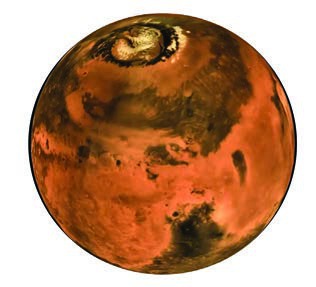
Mars sits near the outer edge of the habitable zone. Spacecraft and rovers have surveyed it, yet none has found evidence of life. Scientists think Mars may once have had liquid water and conditions suitable for simple life. That possibility is one reason the planet still interests them.
India's Mangalyaan, launched in 2013 by ISRO, carried instruments to study the Martian atmosphere, surface and signs of past water. It proved that India could carry out planetary science cheaply and cleverly.
Science seldom settles a question for good. Further exploration may turn up fresh evidence, perhaps even unfamiliar forms of life.
2.7 The atmosphere as a blanket
A planet's atmosphere does more than provide gases to breathe. It stores heat, carries water vapour and produces weather. On Earth the atmosphere moves heat from the tropics towards the poles, which moderates temperature differences across the planet.
Without an atmosphere, Earth would lose heat to space quickly and could not keep water liquid. The layer also protects the surface from small debris that burns up as it enters, and it scatters sunlight so that the sky is bright during the day.
2.8 Shields and their limits
The ozone layer and the magnetic field are two different protections. Ozone absorbs ultraviolet radiation high in the atmosphere, while the magnetic field deflects charged particles far above the surface. Both matter for life, though neither is visible to us.
The ozone layer can be damaged by certain chemicals, and the magnetic field can weaken locally. These possibilities are why monitoring the atmosphere and space weather is part of environmental science.
2.9 Searching beyond Earth
Mars is the most studied candidate for past life because it lies near the edge of the habitable zone and may once have had liquid water. Rovers have examined rocks and soil, while orbiters have mapped the surface and atmosphere.
Mangalyaan added important measurements at low cost and showed that a developing space programme could contribute to planetary science. Whether life ever existed on Mars remains an open question, and that is exactly what keeps the search going.