

Air pressure and how winds form
Pressure, Winds, Storms, and Cyclones14 min readLesson 2 of 5
2.1 The air around us pushes
The envelope of air around the Earth is called the atmosphere. It contains nitrogen, oxygen, argon, carbon dioxide and small amounts of other gases, and it extends many kilometres above the surface. Air has weight, and a column of air presses on everything beneath it.
The chapter's paper-plate activity makes this visible. An inverted paper plate is covered with a sheet of chart paper and lifted with a stick. When the covering sheet is unfolded and larger, more effort is needed to lift the plate, even though the sheet's weight has not changed. The extra effort is the air pushing down on the larger area. Air exerts a force on every object, and the pressure it creates is called atmospheric pressure.
A balloon blown up with air expands in all directions because the air inside pushes on the walls everywhere. When the mouth of an inflated balloon is left open, air escapes; the pressure inside was higher than the pressure outside.
2.2 How strong is atmospheric pressure
A rubber sucker shows the size of this pressure. Press the sucker firmly against a smooth surface and most of the air under its cup is pushed out. The pressure of the air outside is then higher than the pressure inside, so the outside air holds the sucker against the surface. Pulling it off takes a force large enough to overcome that pressure difference.
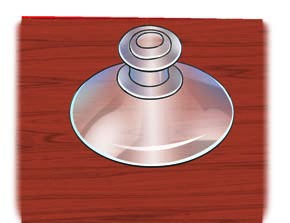
The pressure is surprisingly large. The air column above an area of 15 cm × 15 cm presses with a force close to the weight of a 225 kg object, about 2250 N. We are not crushed because the fluids and gases inside our body push outwards with about the same pressure, so the inward and outward pressures balance.
2.3 Air moves from high to low pressure
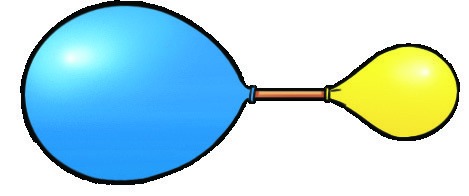
The chapter connects two balloons with a straw, one inflated and one limp, and observes what happens. Air moves from the inflated balloon, where the pressure is higher, into the limp balloon, where the pressure is lower. The flow continues until the pressures become equal, and then both balloons are nearly the same size. The larger the pressure difference, the faster the air moves.
This is the basic rule of wind: air travels from where pressure is high towards where it is low. Wind is simply moving air, and the difference in pressure decides its direction and speed.
2.4 Sea breeze and land breeze
The same rule explains the daily breeze at a coast. During the day, land heats up faster than water. The air above the land becomes warm and light, rises, and leaves an area of low pressure near the ground. Cooler air from the sea, where the pressure is higher, moves towards the land. This daytime wind is the sea breeze.
At night the situation reverses. The sea is warmer than the land, warm air rises above the sea and a low-pressure area forms there. Air then moves from the land towards the sea, giving the land breeze. The chapter points out that both breezes are driven mainly by pressure differences over land and water.
2.5 A closer look at the paper-plate test
The paper-plate activity is worth reading carefully. The same chart-paper sheet is used in two ways, first folded into a smaller cover and then spread out as a larger one. Folding changes the area but not the weight of the sheet. Lifting the plate is harder with the larger cover, so the extra effort must come from the air pressing on the larger area. The experiment turns an invisible force into something the hand can feel.
The result also explains why atmospheric pressure is easy to forget. Air presses on us all the time, but the pressure is the same on all sides, so we do not notice it. The sucker makes the difference visible by removing air from one side, so that the pressure on the other side suddenly matters.
2.6 Pressure units used by weather scientists
The pascal is the scientific unit of pressure, but weather reports often use other units because atmospheric pressure changes are small compared with the full value. A practical unit of air pressure is the millibar (mb), which equals 100 Pa. Air pressure is also reported in hectopascals (hPa), and one hectopascal is also 100 Pa. A weather map with lines joining places of equal pressure, and numbers such as 994 mb or 1008 mb, shows where pressure is high and where it is low; moving air follows the difference between these regions.
2.7 Winds on a larger scale
Sea and land breezes are small, daily examples of wind. The same rule works on larger scales: wherever a region of low pressure forms, air from surrounding high-pressure regions moves towards it. A larger pressure difference produces a stronger wind. This is the link between the calm days and the windy days described at the start of the chapter.
2.8 Why a breeze feels stronger on some days
A breeze is the air flowing towards a low-pressure region, and its strength depends on how large that pressure difference is. On some days the difference is small and the air drifts gently; on others it is large and the wind pushes hard against a cyclist. Local conditions also change the flow. Buildings, trees and hills can channel the air into narrow gaps, making the wind feel stronger in one street than in the next, and a coast can have a steady breeze while inland air stays still. Reading a weather map with its pressure numbers is one way to predict how strong the wind is likely to be.