

Cyclones and quick revision
Pressure, Winds, Storms, and Cyclones16 min readLesson 4 of 5
4.1 Birth of a cyclone
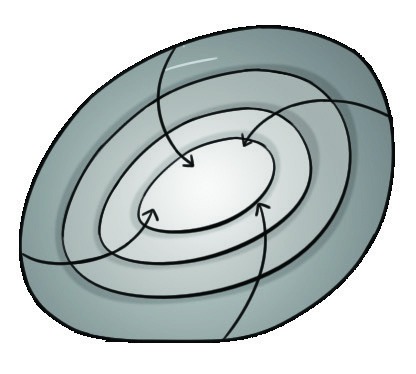
Cyclones are large storms that develop over warm ocean water. The ocean heats the air above it, and warm, moist air rises. Condensing vapour gives back heat to the air, which warms it further and makes it rise even more. This creates an even lower pressure near the surface, so air from surrounding regions rushes in and begins to rise as well.
The Earth's rotation makes the moving air spin. The cycle repeats, and the result is a deep low-pressure centre with fast winds circling it. This spinning system of clouds, wind and rain is a cyclone.
4.2 The eye and landfall
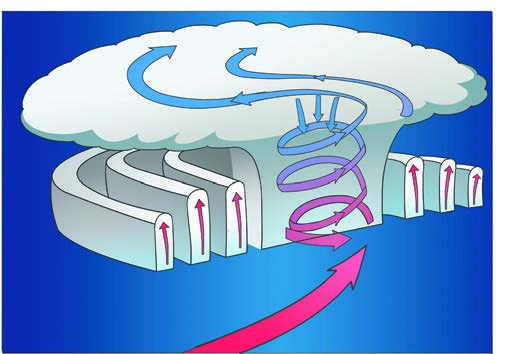
In a cyclone, the lowest pressure is at the centre, which is called the eye. Winds at the eye are calm, but the surrounding region has strong winds and heavy rain. This is why the centre of a cyclone is not the most violent place; the danger lies in the ring around it.
A cyclone gains strength over the ocean and weakens once it reaches land, because the supply of warm, moist air is cut off. On the way it moves with very high wind speeds, higher than those of ordinary thunderstorms.
4.3 The damage a cyclone leaves
Even as a cyclone weakens over land, it can leave destruction that takes months or years to repair. Wind drives sea water onto the coast, building a storm surge that can be 3 to 12 metres high. The surge floods coastal areas and sometimes reaches far inland. Heavy rain can make rivers overflow and trigger landslides. Salt water sweeping inland spoils drinking water and harms farmland, and the salt can make soil less fertile.
Roads may be blocked by fallen trees and debris, which delays help. Power outages can last for days and disrupt emergency services. The Amphan cyclone of 2020, with peak wind speeds of about 270 km/h, is an example of how severe a cyclone can be.
4.4 Staying safe
Weather reports and alerts from the India Meteorological Department help people prepare. Weather satellites track cyclones and help predict their paths, and national and international organisations cooperate in monitoring these storms. People in cyclone-prone areas should keep an emergency kit ready and move to a designated cyclone shelter when warned.
4.5 Common mistakes to avoid
- Treating pressure as equal to force: pressure is force divided by area, so the same force gives different pressures on different areas.
- Thinking broad straps increase pressure: they spread the force, so the pressure is smaller and the bag feels more comfortable.
- Believing liquid pressure depends on the amount of liquid: it depends on the height of the liquid column, which is why overhead tanks are placed high.
- Saying air moves from low pressure to high pressure: it moves from high pressure to low pressure.
- Thinking high-speed wind raises pressure: fast wind is accompanied by lower pressure, which is why roofs can lift.
- Believing the eye of a cyclone is stormy: the eye has calm winds, while the ring around it is violent.
- Thinking thunder is caused by the flash itself: thunder is produced when lightning heats the air and the air expands suddenly.
Exam
For pressure, write P = F / A with F in newtons and A in square metres, and give the unit as the pascal. For liquids, link pressure to the height of the column, not the amount of liquid. For winds, write the rule that air flows from high pressure to low pressure. For cyclones, describe the warm ocean, rising moist air, condensation releasing heat, and the spin caused by the Earth's rotation, then name the calm eye and the strong ring around it.
- Define pressure, write its formula and give its SI unit.
- Explain why broad straps are more comfortable than narrow straps.
- Explain why a sharp knife cuts better than a blunt one.
- Explain why liquid pressure depends on the height of the column and why tanks are on roofs.
- Describe how a rubber sucker shows atmospheric pressure and why we are not crushed by it.
- Explain how winds, sea breezes and land breezes form.
- Explain how a thunderstorm and lightning form, and list three lightning safety rules.
- Describe how a cyclone forms, what the eye is, and two safety measures.