

Pressure: force spread over an area
Pressure, Winds, Storms, and Cyclones14 min readLesson 1 of 5
1.1 Wind at work
Fallen leaves lift and swirl in the air, trees sway and sometimes bend, doors slam, windows rattle and clothes flutter on a line. In each case the moving air is applying a force, and the effect is felt as wind pressure. This chapter follows that idea from a simple bag strap to thunderstorms and cyclones.
1.2 Two bags, one lesson
Megha and Pawan walk to a picnic spot carrying bags with identical loads. Pawan keeps shifting his bag and looks uncomfortable. "Both bags are equally heavy," Megha points out. "Why does yours hurt?" Pawan thinks and answers that his bag has narrow straps while hers has broad ones.
The difference is the area over which the weight acts. A narrow strap presses the whole load on a small patch of the shoulder, while a broad strap spreads the same load over a larger patch. The force is the same, but the effect is very different. This is why we need a quantity that combines force and area. That quantity is pressure, defined as the force acting on a unit area of a surface.
pressure = force / area, or P = F / A
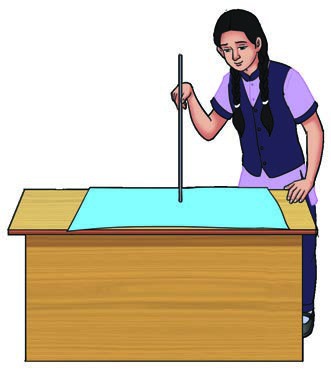
The force here acts perpendicular to the surface. The SI unit of force is the newton and the unit of area is the square metre, so the SI unit of pressure is the newton per square metre (N/m²). This unit is also called the pascal, written Pa. If a force of 100 N acts on a cardboard sheet of area 2 m², the pressure is 50 N/m², or 50 Pa.
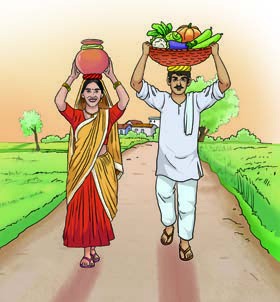
The same reasoning explains other everyday choices. A bucket with a broad handle is easier to carry than one with a thin wire handle. People carrying pots or vegetable baskets on their heads often place a folded cloth underneath, which spreads the load over a larger area.
1.3 Smaller area, bigger effect
The chapter's activities compare two ways of doing the same job. Driving an iron nail by its head spreads the hammer's force over a large area, while striking the pointed end concentrates the same force on a tiny area. The pointed end goes in easily. A sharp knife cuts an apple easily because its edge touches the fruit over a tiny area, so the pressure is large. The blunt edge spreads the force and makes cutting difficult. In general, for the same force, a smaller area gives a bigger pressure.
1.4 Pressure inside a liquid
Liquids exert pressure too. The chapter uses two glass pipes of different diameters, each closed at the bottom with a rubber balloon and filled to the same height. Both balloons bulge by the same amount. The pipes hold different amounts of water, so the weight of the water cannot be the deciding factor. What matters is the height of the water column. When more water is added to one pipe, the balloon bulges more, showing that pressure increases with the height of the liquid column.
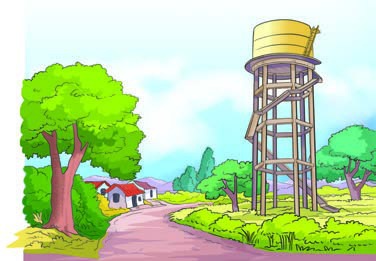
This is why water tanks are placed on rooftops or on tall stands. The height of the tank above a tap decides the pressure at the tap, and a taller column gives a stronger stream. A tap on a lower floor therefore gets water with more pressure than a tap on a higher floor.
Liquids also push sideways. If four small holes are made at the same height around the bottom of a plastic bottle and the bottle is filled, water flows out from all of them. The liquid exerts pressure on the walls and on the bottom of its container. So a liquid pushes sideways and upwards as well as downwards.
The dam in the chapter's illustration makes the same point on a large scale. Water presses horizontally on the dam wall, and the pressure near the base is much greater because the water column above is taller. A broad base helps the dam support the structure and withstand this horizontal pressure.
1.5 Pressure in tools and daily tasks
Tools are designed around pressure. A knife, a nail, a needle and a spade all concentrate force on a small area so that the pressure is large enough to do the job. A drawing pin shows both sides at once: the point has a tiny area so it enters the board easily, while the broad head spreads the thumb's force so that the thumb is not hurt. A blunt blade spreads the same force over a wider area, so the pressure falls and cutting becomes difficult.
The same logic works in reverse when pressure needs to be reduced. A wide strap, a broad handle, a cloth pad under a head load and the wide feet of a camel all increase the area over which a force acts. The force has not changed, but the pressure has become small enough to be comfortable or to stop the object from sinking.
1.6 Pressure at every depth
In a liquid, pressure grows with depth and acts in all directions. A diver feels more pressure at greater depth, and a dam needs its strongest construction near the base. The chapter's bottle with holes at the same height shows the sideways effect: water leaves every hole because the liquid pushes on the walls. If the holes were at different heights, the lowest one would send water out with the greatest pressure, because the column above it is the tallest.
The practical rule is simple. Pressure in a liquid depends on the height of the column above the point, not on how wide the container is. That is why a narrow pipe and a wide tank filled to the same height produce the same pressure at the bottom.