

High-speed winds, storms and lightning
Pressure, Winds, Storms, and Cyclones15 min readLesson 3 of 5
3.1 Fast winds lower the pressure
The chapter's next activity hangs two balloons a short distance apart and asks you to blow air through the gap between them. Instead of moving apart, the balloons move towards each other. Blowing creates a region of low pressure between them, and the higher pressure on their outer sides pushes them together. Blowing harder increases the speed at which they approach. The conclusion is that high-speed winds are accompanied by reduced pressure.
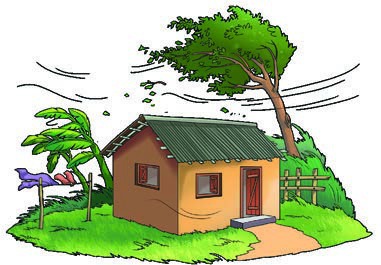
This explains why strong winds can take off roofs. When fast wind passes over a house, the pressure just above the roof falls. The air pressure under the roof stays higher, and if the difference is large enough and the roof is weak, it can be lifted and blown away. Keeping doors and windows open during a storm lets air move through the house, which reduces the pressure difference between the inside and the roof and lowers the risk.
3.2 How a storm builds
Warm, moist air is lighter than cool, dry air. When the land is heated, this warm air rises and creates a low-pressure area near the surface. Cooler air from the surrounding higher-pressure areas flows in to take its place, gets heated, and rises too. The process continues as a circulation of rising warm air and incoming cooler air.
As the rising air expands and cools, its water vapour condenses into tiny droplets that form clouds. The droplets merge into larger drops, which fall as rain, hail or snow. A storm is strong wind accompanied by rain. In hot, humid tropical regions such as India, storms are more frequent, and under certain conditions the rising air can reach great heights where the droplets freeze into ice particles.
3.3 Thunder and lightning
Strong winds moving upward and downward rub water droplets and ice particles against one another, and rubbing builds static charges. The lighter, positively charged ice particles rise to the upper part of the cloud, while the heavier, negatively charged droplets gather lower down. This separation of charge inside the cloud is the first step towards lightning.
When the negatively charged lower part of a cloud comes close to the ground, it makes the ground and nearby tall objects, such as trees and buildings, positively charged. Air normally does not conduct electricity, so the opposite charges stay apart. When the charge build-up becomes very large, the air's insulating property breaks down and the charges flow suddenly, producing the bright flash called lightning.
Lightning can occur within a single cloud, from one cloud to another, or from a cloud down to the ground. The sudden flow heats the surrounding air, which expands rapidly and produces the sound called thunder. When a storm brings lightning and thunder, it is a thunderstorm. Such storms occur under several local names in India, including Kalboishakhi in West Bengal, Bihar and Jharkhand, Bordoisila in Assam, and mango showers in Kerala, Karnataka and Tamil Nadu.
Lightning can start fires, damage buildings and cause burns or death in people and animals. During lightning, stay away from tall objects, head for a low open spot and crouch with as little contact with the ground as possible. Do not lie flat. Avoid umbrellas with metal rods, get out of water, and remember that being inside a bus or a car is comparatively safe. Buildings are protected by a lightning conductor, a metal rod fixed along the wall with a pointed end above the highest point of the building and the other end buried in the ground, which gives the charges an easy path to the earth.
3.4 Inside a thundercloud
A thundercloud is a busy place. Warm air rises fast inside it, while colder air and rain sink in other parts. The strong up-and-down motion carries water droplets and ice particles past one another, and the rubbing transfers charge. In a typical storm cloud, the lighter ice particles end up positive and collect near the top, while heavier droplets carry negative charge towards the base. The ground beneath the cloud responds by becoming positive. The cloud has become a giant store of separated charge.
The separation is not a single event. It builds as long as the vertical winds keep carrying particles past each other, which is why a thunderstorm can produce many flashes rather than just one. The bigger the cloud and the stronger the updrafts, the larger the charge that can accumulate.
3.5 From charge to flash
Air normally resists the flow of electricity, so the positive ground and the negative cloud base remain apart even though they attract each other. When the charge difference becomes very large, the air can no longer hold them apart. A sudden flow of charge takes place, and its bright path is the flash we call lightning.
The flash heats the air along its path, and heated air expands very quickly. That sudden expansion sends out a sound wave, which we hear as thunder. Because light travels much faster than sound, we usually see the flash before we hear the thunder. Counting the seconds between the two gives a rough idea of how far away the strike was.
3.6 Safety around lightning
The safest place during a thunderstorm is indoors, well away from windows, electrical wiring and plumbing. Outdoors, move away from tall trees, poles and metal structures, avoid open fields and hilltops, and crouch low without lying flat. A car or bus with a metal body offers protection because the charge passes around the outside rather than through the people inside. A lightning conductor does the same job for a building: it gives the charge a deliberate path to the ground instead of letting it travel through the walls.