

Calendars from sky cycles
Keeping Time with the Skies16 min readLesson 2 of 5
2.1 The day from the Sun
Seen from the Earth, the Sun rises in the east, sets in the west and rises again the next day. This apparent daily motion comes from the Earth's rotation on its axis. Solar noons come about 24 hours apart on average; this span is the mean solar day.
The Sun's highest point can be tracked by watching shadows. Fix a stick vertically in the ground and mark the tip of its shadow every minute around midday. The shortest shadow marks the Sun's highest point. Record the time of the shortest shadow for several days and compare the durations; the average comes out close to 24 hours.
2.2 The month from the Moon
One complete lunar-phase cycle lasts about 29.5 days, close to a month. That natural cycle gives the month, the unit just above the day.
2.3 The year from the seasons
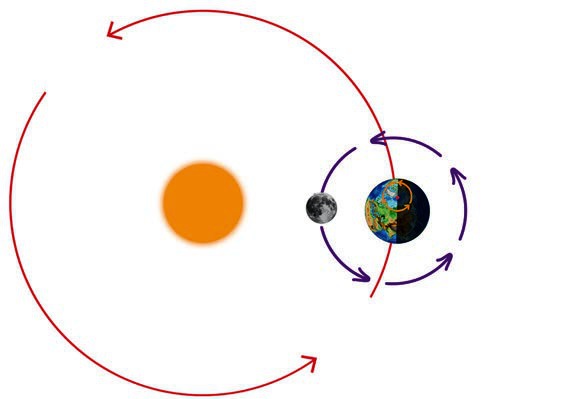
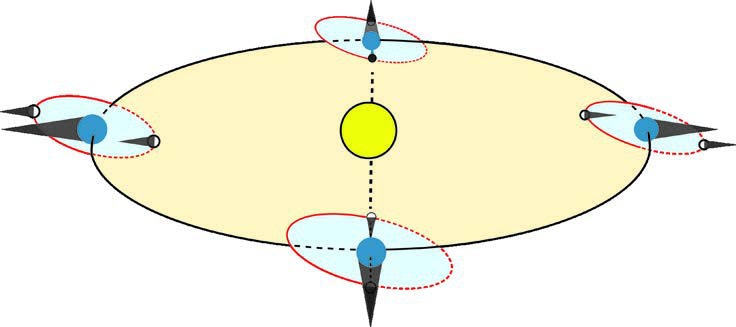
The Earth revolves around the Sun in nearly 365 and a quarter days. During this revolution the Earth goes through one full cycle of seasons, which defines the solar year. The cycles of the Sun, Moon and seasons therefore give the day, the month and the year.
2.4 Lunar calendars
Nearly 12 lunar-phase cycles fit inside one seasonal cycle. Ancient observers noticed this and built lunar calendars, using the day as the smallest unit, months of about 29.5 days and years built from 12 such months. Lunar phases gave a simple, dependable way to count time.
Twelve lunar months come to about 354 days, while the seasonal year is about 365 days. So the lunar months slip against the seasons year after year.
2.5 Solar calendars
Knowing when seasons would arrive mattered for farming. That need produced solar calendars, which follow the seasons. The Gregorian calendar, the one in common use today, is a solar calendar. Its months add up to 365 days, which is why some months have 30 days, some have 31 and February has 28.
The Earth takes nearly a quarter of a day extra to complete one revolution, so the extra hours grow into about one day every four years. A leap year supplies it: Gregorian years divisible by four gain a day, giving February 29 days and keeping the calendar in step with the seasons.
The correction is not perfect. The gap between one spring equinox and the next, called the tropical year, is slightly shorter than 365 and a quarter days. Adding a day every four years therefore overshoots a little, so leap years are skipped in century years such as 1700, 1800 and 1900, except when the year is divisible by 400, as in 1600 and 2000. Astronomers also track the sidereal year, the interval until the same stars rise again at sunset; it runs about 20 minutes longer than the tropical year.
2.6 Luni-solar calendars
A third kind of calendar counts months by the Moon's phases and also adjusts to stay in step with the seasons. Twelve lunar months give 354 days, about 11 short of the solar year, so every two or three years an extra month called Adhika Maasa is added. Such calendars are called luni-solar calendars, and many are used in different parts of India.
Their months carry old names: Chaitra and Vaisakha, Jyeshtha and Ashadha, Shravana and Bhadrapada, Ashwin and Kartika, Margashirsha (Agrahayan), Pausha, Magha, Phalguna. A month starts after the new Moon in Amant calendars and after the full Moon in Purnimant ones.
2.7 The Indian National Calendar
The Indian National Calendar is solar and runs 365 days, opening on 22 March, the day after the spring equinox. Months last 30 or 31 days and carry names borrowed from older Indian calendars. In an ordinary year, months two through six have 31 days and the remaining months have 30. A day is inserted into Chaitra, the opening month, in leap years, which moves the new year to 21 March.
A Calendar Reform Committee, formed by the Government of India in 1952, was asked to propose a calendar that would be accurate and uniform across the country. Its proposal, the Unified National Calendar, took effect on 21 March 1956, which corresponded to 1 Chaitra 1878 Saka. The calendar follows principles similar to those of the Surya Siddhanta. Meghnad Saha, the astrophysicist known for the Saha equation, chaired the committee.