

Phases of the Moon
Keeping Time with the Skies15 min readLesson 1 of 5
1.1 A kite festival surprise
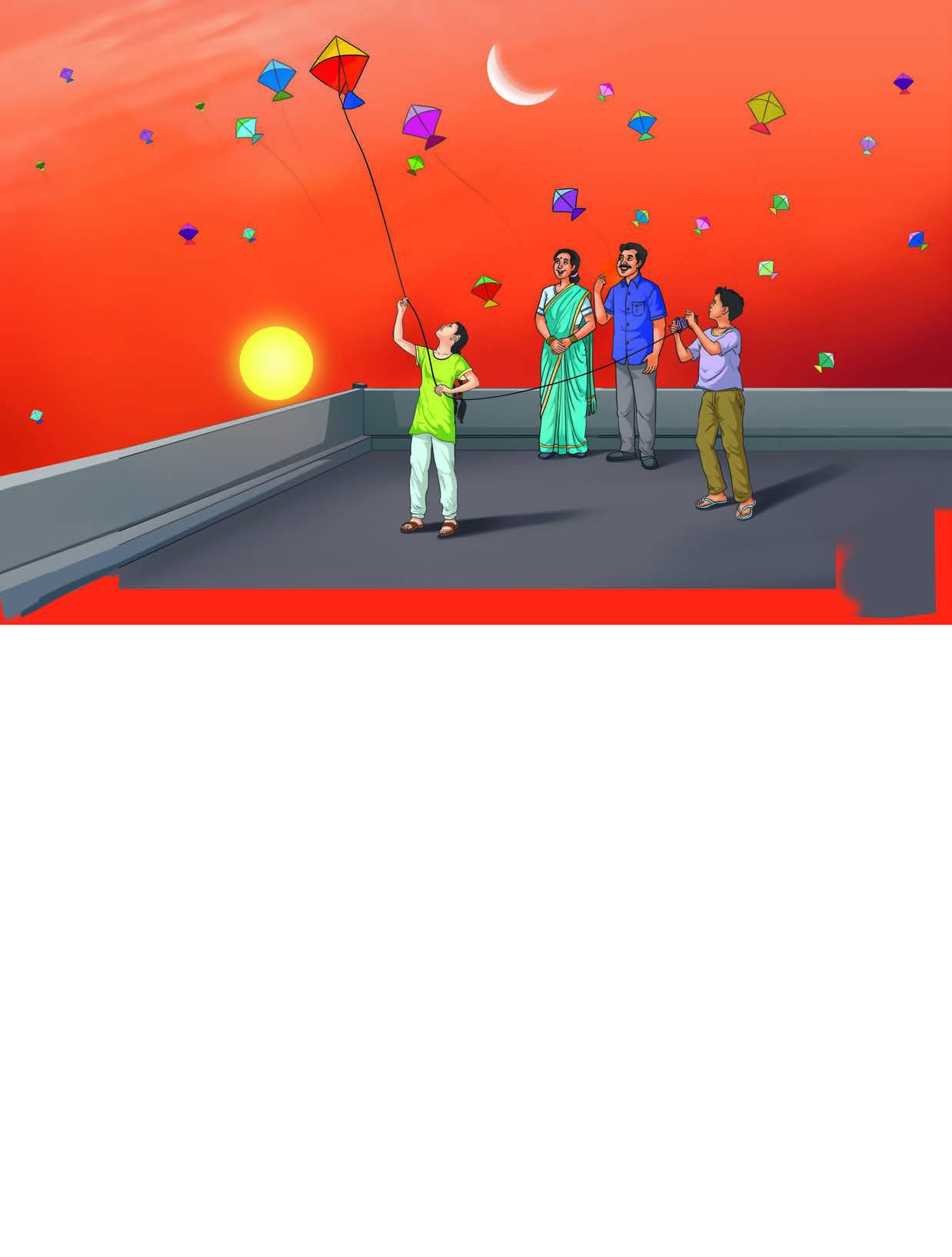
Meera was in Ahmedabad for the International Kite Festival on Makar Sankranti. Looking up at the kites, she noticed the Moon shining in the daytime sky. She had thought the Moon appeared only at night, and she knew its shape changed from night to night. The Moon is a sphere that shines with sunlight it reflects, so why does its visible shape keep changing? A lunar eclipse is rare and brief, so it cannot explain a shape that changes every day.
1.2 Watching the Moon for a month
The best way to understand the changes is to observe the Moon carefully for about a month. Start on the first morning after a full Moon day, when the Moon is easiest to spot at sunrise. Record the date, whether the Moon was seen at sunrise or sunset, and shade the bright part of a drawn circle to match what you see.
From the second day, record if the lit area is growing or shrinking and if the Moon sits nearer the Sun or farther away. After about two weeks the Moon may not be visible at sunrise or sunset, so continue the observations at sunset for the next two weeks.
1.3 Waning and waxing
The lit area of the Moon drops to a half circle from full within roughly seven days, and it keeps shrinking for another week until it disappears. These two weeks are the waning period. Purnima marks the full Moon day, when the disc is a complete bright circle, and Amavasya marks the day when nothing of it can be seen.
After Amavasya the lit area returns to a half circle in about seven days and becomes a full circle a week later. This is the waxing period. The waning halves are generally called Krishna Paksha and the waxing halves Shukla Paksha. One complete cycle, full Moon back to full Moon, lasts roughly a month.
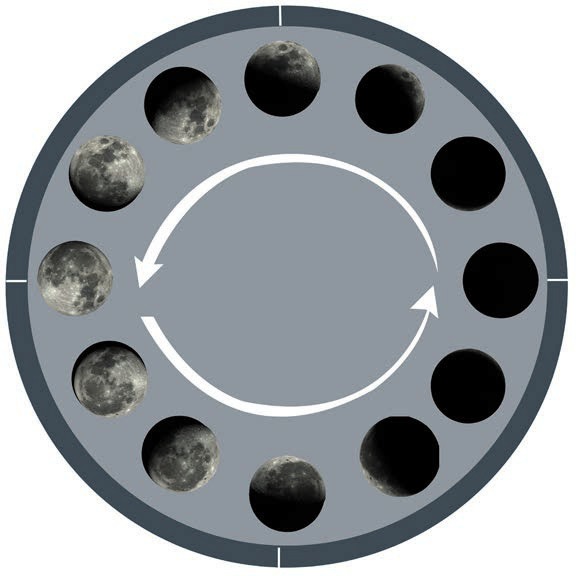
The changing shapes of the bright part, seen from the Earth from one day to the next, are called the phases of the Moon.
1.4 Finding the Moon in the sky
At full Moon the Moon sits almost opposite the Sun: while sunrise begins in the east, the Moon is close to setting in the west. On later mornings at sunrise, the Moon has moved nearer to the Sun in the sky. Once only half the disc stays lit, the Moon stands overhead at sunrise, and a few days later the crescent has edged even closer to the Sun.
Look for a waxing Moon after sunset and a waning Moon around sunrise. The Moon's rise and set times therefore differ from the Sun's, shifting later by roughly 50 minutes daily. Some days the Moon rises in the afternoon, which is why it can be seen in the eastern sky during daylight. Knowing the phase and whether the Moon is waxing or waning tells you where and when to look.
1.5 Why the phases happen
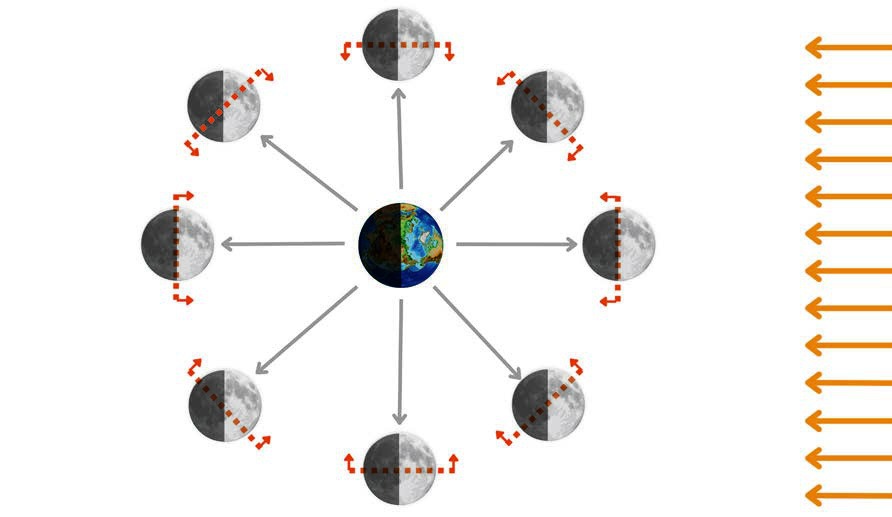
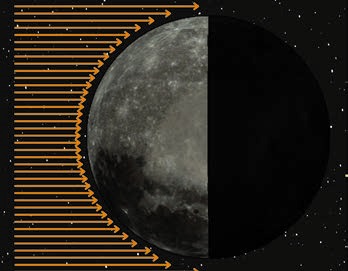
The Moon gives off no light itself. Sunlight always lights one half of the Moon; the opposite half stays dark. The Moon circles the Earth once a month, and the same half always points our way. That half is not always the lit half.
Only the lit part turned towards the Earth is visible to us. Full Moon appears when all of the lit half is turned our way. New Moon appears when the dark half faces us and the lit half is hidden. At other positions we see a slice of the lit half, and the visible bright region has the shape of a crescent, a half circle or a gibbous shape.
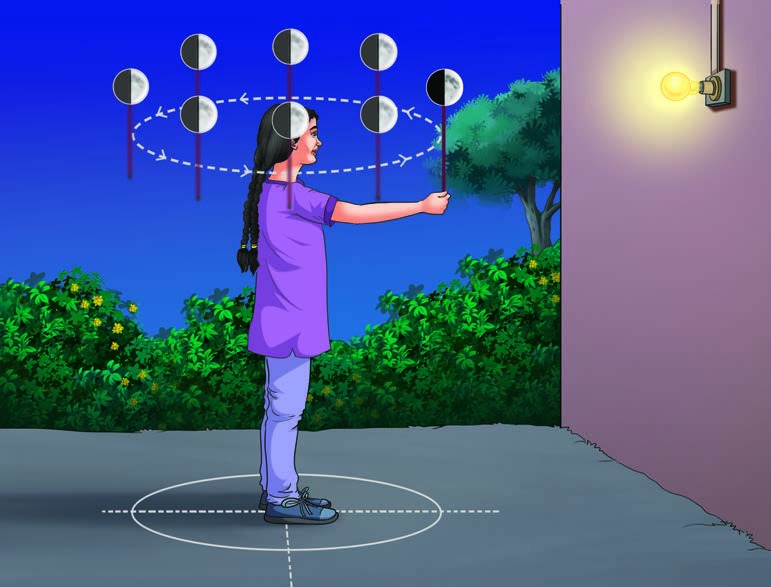
A simple activity makes this clear. Hold a small ball on a stick at arm's length and turn slowly in a dark room while a torch shines from one side. When the ball is opposite the torch, its whole lit side faces you, like a full Moon. When it is towards the torch, you see only its dark side, like a new Moon. The boundary between the lit and dark parts appears curved at other positions and produces the shapes of the phases.
1.6 Phases are not eclipses
The phases do not happen because the Earth's shadow falls on the Moon. They happen because the Moon orbits the Earth and we see different fractions of the illuminated half. The Earth's shadow causes a lunar eclipse, which can only occur on a full Moon day; a solar eclipse can only occur on a new Moon day. Eclipses do not happen every month because the Moon's orbital plane is tilted a little relative to the plane of the Earth's orbit around the Sun.