

Satellites and quick revision
Keeping Time with the Skies16 min readLesson 4 of 5
4.1 Artificial satellites
The Moon is the Earth's natural satellite. Besides it, many countries have placed man-made satellites in orbit around the Earth. They show up as small moving points of light at night. Most circle at around 800 km altitude and finish an orbit in about 100 minutes.
Satellites serve weather watching, communication, navigation, disaster response and scientific research. ISRO, the Indian Space Research Organisation, operates many of them.
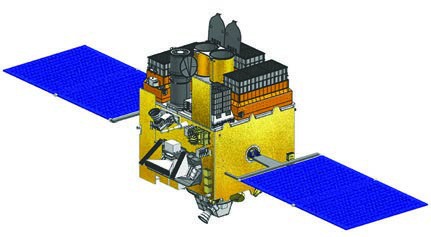
Cartosat sends back detailed Earth images used in mapping, urban planning and disaster response; the Bhuvan platform turns them into maps of terrain, soil, land use and vegetation. AstroSat studies stars and other celestial objects. Chandrayaan 1, 2 and 3 went to the Moon, Aditya L1 watches the Sun and Mangalyaan reached Mars. Students have also built and launched small satellites, including Jugnu, AzaadiSat and InspireSat-1, with ISRO's help.
4.2 Seeing a satellite
Spotting a satellite is a night-sky activity. Go to a place with a clear view of the sky, without tall trees or buildings, just before sunrise or after sunset, and take an adult along. Look for a point of light moving fast across the sky; its brightness may be steady or flickering. Satellites can be seen with the naked eye or with binoculars. Apps and websites list when satellites will pass over a given location.
4.3 Space debris
Satellites that stop working, and spent rocket stages, turn into space junk. Such debris clutters orbit and may hit functioning satellites. Small fragments burn up on entering the atmosphere, while larger ones can reach the ground. Nations are cooperating to clear this dangerous debris.
Vikram Ambalal Sarabhai earned the title Father of the Indian space programme by leading the push to put India's first satellites in orbit. The Vikram Sarabhai Space Centre in Thiruvananthapuram, which builds rockets and launch vehicles, carries his name.
4.4 The Moon and the tides
Near the sea, water levels rise and fall in a regular pattern called tides. A high tide returns roughly 50 minutes later on the following day. Tides track the Moon's position and phase; the lunar rise time shifts by about the same interval.
4.5 Common mistakes to avoid
- Thinking the Moon is visible only at night: it can be seen in daylight, especially near the new and quarter phases.
- Explaining phases by the Earth's shadow: phases come from seeing different portions of the Moon's sunlit half; eclipses need special alignment.
- Believing the Moon rises at the same time every day: it rises about 50 minutes later each day.
- Treating a lunar year as equal to a solar year: 12 lunar months add up to about 354 days, nearly 11 days short.
- Ignoring the extra quarter day: without leap years, the calendar would slowly drift out of step with the seasons.
- Calling an artificial satellite a star: satellites move fast across the sky, while stars appear fixed relative to one another during the night.
- Believing eclipses happen every month: the Moon's orbit is tilted, so the alignments needed for eclipses are not repeated monthly.
- Forgetting that solar calendars need correction: century leap-year rules keep the Gregorian calendar matched to the seasons.
Exam
For Moon questions, trace the chain: the Moon reflects sunlight, half of it is always lit, and the Earth sees different fractions of the lit half as the Moon orbits, giving the phases. For calendars, connect each unit to a cycle: day to Earth's rotation, month to the Moon's phases (about 29.5 days), year to Earth's revolution and seasons (about 365.25 days). Remember lunar year 354 days, luni-solar Adhika Maasa every two or three years, and the Gregorian leap year every four years with century exceptions.
- Explain why the Moon shows phases, using the idea of its sunlit half.
- Distinguish waning and waxing periods and the full and new Moon days.
- Explain why moonrise shifts by about 50 minutes daily and when to look for the Moon.
- Explain why phases are not caused by the Earth's shadow.
- Relate the day, month and year to the Sun's apparent motion, the Moon's phases and the seasons.
- Compare lunar, solar and luni-solar calendars and explain the leap year.
- Describe the Indian National Calendar and why festivals fall on changing dates.
- State the uses of artificial satellites and two facts about ISRO's missions.