

Festivals and the moving Sun
Keeping Time with the Skies15 min readLesson 3 of 5
3.1 Festivals tied to the Moon
Much of the Indian festival calendar follows the Moon, using lunar or luni-solar dates. Holi comes on Phalguna's full Moon, Diwali on Kartika's new Moon, Buddha Purnima at Vaisakha's full Moon, and Dussehra on Ashwina's tenth day. Eid-ul-Fitr begins once the crescent is sighted at the close of Ramazan.
Since the Moon sets the dates, they move in the Gregorian year. A luni-solar festival shifts by less than a month, because the extra intercalary month repairs the gap every few years. Purely lunar dates such as Eid-ul-Fitr lack that repair, so they slide through the Gregorian months and arrive about 11 days earlier each year.
3.2 Festivals tied to the Sun
Some festivals follow the solar sidereal calendar and stay close to one Gregorian date each year: Pongal and Bihu, Makar Sankranti and Vaisakhi, Puthandu and Poila Baisakh. Long ago these festivals were tied to a solstice or an equinox. Because the sidereal year and the tropical year differ slightly, the dates slowly drift away from those markers. The drift comes from the slow wobble of the Earth's axis, like the wobble of a spinning top, and it moves Makar Sankranti ahead by about one day every 71 years.
3.3 Uttarayan and Dakshinayan
Sunrise drifts away from due east through the year: northerly in summer, southerly in winter. The extremes arrive at the solstices, near 21 June and 21 December, while at the equinoxes sunrise is due east and sunset due west.
Uttarayan names the December-to-June half, when the Sun seems to climb north; Dakshinayan covers the June-to-December southward half. The pattern repeats yearly and follows the seasons.
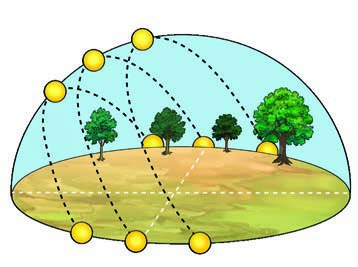
Verse 6.5.3 of the Taittiriya Samhita describes the halves: six months of southward travel followed by six months northward. The Surya Siddhanta adds that around the winter solstice, long ago, the Sun stood against the stars of Makar (Capricorn); entering Makar began the six-month northward phase, and entering Karka (Cancer) began the southward phase.
3.4 Panchang and festival dates
Many festival dates depend on the lunar phase at sunrise. Because sunrise arrives earlier in the east than in the west, the same festival can fall a day apart in different regions. For uniformity, the Government of India's Positional Astronomy Centre brings out the Rashtriya Panchang each year, listing the Sun's and Moon's positions for a central Indian location and supplying the festival dates used in official holiday announcements.
3.5 The Moon in Indian art
The Moon and moonlight have inspired Indian classical music and dance. Ragas such as Chandrakauns, Chandranandan and Shubhapantuvarali draw on Moon imagery in name and mood. Mudras such as Chandrakala and Ardhachandran in Bharatanatyam relate to the Moon, and other classical dance forms share this imagery. Traditional painting and craft, including Madhubani, Warli and Dhokra metalwork, often depict the Sun and the Moon.
3.6 The sky as a calendar
Before clocks and printed calendars, the sky itself was the calendar. Farmers watched the Sun's path to judge the seasons, travellers used the Moon's phase to estimate the date, and festivals were tied to the solstices and equinoxes. These events repeat predictably, which is what makes them useful for keeping time.
A single observation is not enough; the patterns appear only when the sky is watched over many months and years. That is why ancient sky watchers recorded the positions of the Sun, Moon and stars again and again, and why their calendars became more accurate over time.
3.7 Reading the crescent
On a day when the crescent Moon is visible, point towards the Sun and then move your finger slowly towards the Moon by the shortest path. The finger crosses the lit part of the Moon first, which shows that the Moon's light comes from the Sun and that the crescent faces the Sun's direction.
The line joining the two tips of the crescent corresponds to a diameter of the Moon. Looking at the crescent carefully helps connect the shape in the sky with the geometry of the illuminated half.
3.8 A long heritage of sky watching
For thousands of years, people in India and elsewhere observed the sky and built calendars. They did not know that the Earth goes around the Sun and they had no modern instruments. Yet by watching the patterns carefully, they worked out that a year is about 365 days long.
They noticed that the Sun does not rise exactly in the east all year, and marked the solstices and equinoxes. Ancient Indian texts such as the Surya Siddhanta describe these movements, and the same cycles still shape the calendars and festivals used across India today.