

Farming with nature and quick revision
How Nature Works in Harmony16 min readLesson 4 of 5
4.1 Feeding a growing nation
Farming has supported people for thousands of years, and as the population grew, so did dependence on agriculture. A food crisis hit India between 1950 and 1965 when harvests fell short. From the mid-20th century, tractors, machines, synthetic fertilisers and pesticides helped raise output. The period came to be called the Green Revolution.
Those methods are now considered unsustainable in some forms because of heavy chemical use, excessive extraction of groundwater and the repeated growing of a single crop for commercial gain.
4.2 What goes wrong
Overusing synthetic fertilisers can reduce soil fertility by lowering friendly microorganisms and humus, the organic matter that holds soil particles together. With too little humus, soil erodes easily. Heavy pesticide use also lowers the population of natural predators, which can let pests increase again. Some pests even develop resistance to the chemicals, making them harder to control.
Heavy irrigation and repeated ploughing disturb soil organisms such as earthworms and snails, which are important for ecological balance. Growing the same crop again and again, called monoculture, reduces biodiversity and can affect pollinators that food production depends on.
4.3 Farming with nature
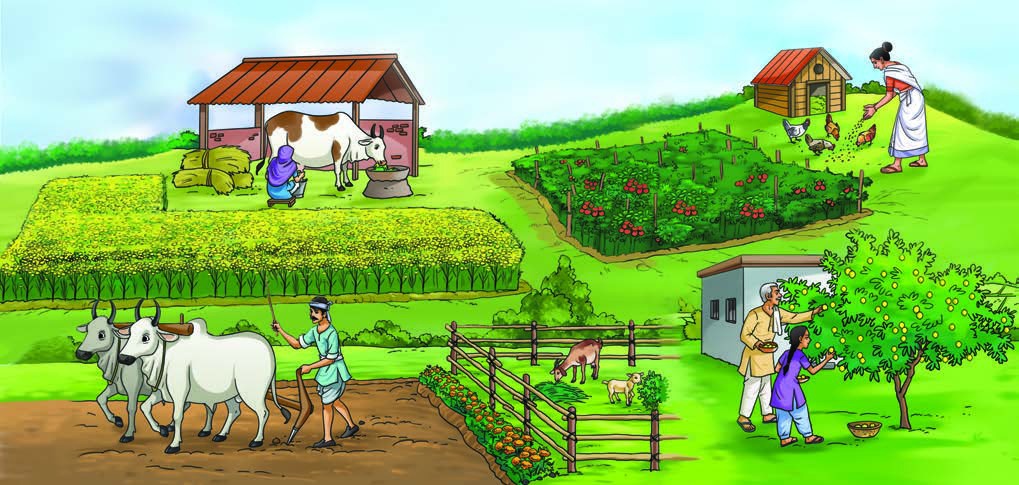
Some farmers are turning to organic and natural farming. These approaches reduce synthetic fertilisers and pesticides and support farming with minimal interference in natural ecosystems. The ancient text Vrikshayurveda stresses soil health and nourishment, recommending organic manure and Kunapa Jala, a liquid fertiliser made by fermenting animal and plant waste so that complex substances break into simpler ones.
Human-made ecosystems such as fish ponds, farms and parks need human care and management. When designed well, they can reduce pollution, support biodiversity and give people places for recreation.
4.4 Common mistakes to avoid
- Thinking plants need readymade food: producers make food by photosynthesis.
- Calling mushrooms plants: they are fungi that act as decomposers.
- Confusing population with community: a population is one kind, a community is several populations together.
- Treating a food chain as the whole story: food chains interlink into webs.
- Believing ecosystem balance is fixed: it is dynamic.
- Saying mutualism harms one partner: both benefit, while parasitism harms one.
- Dismissing decomposers as unimportant: they recycle the nutrients that soil and plants need.
- Assuming synthetic inputs alone can sustain farming: humus, predators, pollinators and water all matter.
Exam
For ecology answers, start from components: name the biotic and abiotic parts, then say how they interact. Classify organisms as producers, consumers or decomposers, and place them in a food chain by trophic level. When a question asks what happens if a species disappears, trace the effect through a food web and mention competition, predation and decomposition. For human impact questions, link the cause to the chain of effects and suggest a conservation step such as protected areas or organic farming.
- Define habitat, population, community and ecosystem with an example each.
- Distinguish biotic and abiotic components and give two interactions between them.
- Explain the roles of producers, consumers and decomposers.
- Draw a food chain and name the trophic levels in it.
- Explain how a food web differs from a food chain.
- Describe how decomposers recycle nutrients in an ecosystem.
- Explain mutualism, commensalism and parasitism with examples.
- List two ecosystem services and two threats to ecosystems.