Interactions that keep ecosystems balanced
How Nature Works in Harmony16 min readLesson 3 of 5
3.1 Competition
Besides feeding links, organisms compete for food, water, physical space and sunlight. Competition limits population size and helps keep the ecosystem balanced. Without rivals, a single species might grow without limit and upset the system.
3.2 What one change can do
Suppose many plants in a pond begin to die because of pollution. Less oxygen is produced in the water, so the fish population drops. With fewer fish, other consumers decline, and insects increase in number. The insects spread to nearby farmland, crops get damaged, farmers use more pesticides, and the environment suffers further. One small change can set off a long chain of consequences.
A study of two ponds shows a similar ripple. Pond A had fish and many flowering plants around it; Pond B had no fish and fewer flowers. Fish eat dragonfly larvae, so Pond A had fewer dragonflies. Dragonflies normally eat flies, bees and butterflies, so with fewer dragonflies there were more pollinators, and the plants near Pond A set more seed. The fish, dragonflies, pollinators and plants were all linked.
3.3 Relationships among organisms
Not every relationship is about eating. There are three common patterns.
- Mutualism: both organisms benefit, as when honeybees collect nectar and flowers get pollinated.
- Commensalism: one benefits and the other is unaffected, as when an orchid grows on a tree branch for support.
- Parasitism: one benefits and the other is harmed, as when a tick feeds on a dog's blood and irritates its skin.
3.4 A case from history
In the 1980s India exported frog legs on a large scale, especially from the Indian bullfrog. This harvest reduced frog populations. Frogs eat insects, so fewer frogs meant more agricultural pests. Farmers used more synthetic pesticides, which harmed soil, water and health. The export was banned to prevent more damage to the ecosystem.
3.5 Balance and benefits
An ecosystem remains in balance when its interactions keep populations and resources stable. That balance is dynamic, not fixed, and it can be disturbed by natural events or by human actions.
Humans benefit from ecosystems. Forests give fresh air, fertile soil, food, fibre, timber and medicine, and waters supply food and drinking water. Ecosystems also give beauty and recreation. These benefits connect human well-being closely with the health of nature.
3.6 The Sundarbans
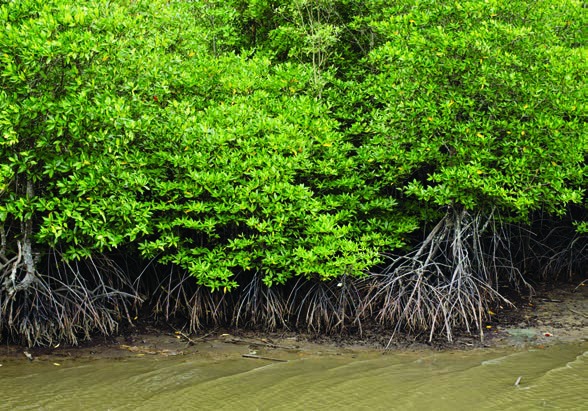
The Sundarbans hold the world's largest mangrove forests, where the Ganges and Brahmaputra meet between India and Bangladesh. The forests and rivers shelter many species, including endangered ones. Mangroves weaken storms and floods by slowing wind and waves, absorb carbon dioxide and release oxygen. In 1987 UNESCO listed the Sundarbans as a World Heritage Site.
The region faces serious threats. People fell mangroves for fuel and fields, hunt illegally and take too much from the forest, while industrial waste and untreated sewage pollute the water. These activities disrupt the way the ecosystem works. Across India, deforestation, overuse of resources, invasive species, unsustainable land use and pollution damage forests, rivers, scrublands, wetlands, grasslands and coasts.
A protected area is a stretch of land or water kept aside so that wildlife and habitats can be conserved. India's protected areas include biosphere reserves, wildlife sanctuaries, national parks and community conserved areas. Examples include Jim Corbett National Park in Uttarakhand, Manas National Park in Assam, the Nilgiri Biosphere Reserve in the Western Ghats, Chilika Lake in Odisha, Eaglenest Wildlife Sanctuary in Arunachal Pradesh, Hemis National Park in Leh, Keibul Lamjao National Park in Manipur and Pirotan Island Marine National Park in Gujarat.
3.7 A wildlife biologist's work
A.J.T. Johnsingh studied forest ecosystems by observing animals and was a pioneer in using modern tracking methods. Working in Bandipur National Park in Karnataka, he showed how tigers and leopards depend on animals such as deer and wild boar for food, and that predators need a healthy prey base to survive. He inspired many young people to study wildlife and protect India's forests and biodiversity.
3.8 Two ponds, one lesson
The two-pond study is a small example of a large idea. The fish did not eat the flowers or the bees; they changed the numbers of dragonflies, which changed the numbers of pollinators, which changed the seed production of nearby plants. The effect travelled through the food web in steps.
This is why ecologists study whole communities rather than single species. A change at one point can appear somewhere else, sometimes after several steps and with unexpected results.
3.9 What people can do
Understanding ecosystems points to practical actions. Reducing pollution keeps water and soil healthy. Protecting wetlands, grasslands, forests and mangroves preserves habitats and the services they provide. Using resources at a rate nature can renew them, controlling invasive species and avoiding unnecessary damage to soil and vegetation all help.
At a smaller scale, a school can keep a garden, avoid wasting water, reduce plastic and plant native species. At a larger scale, protected areas and wildlife corridors connect habitats and allow animals to move safely. The balance of an ecosystem is dynamic, and human choices form part of that balance.