

Who eats whom
How Nature Works in Harmony15 min readLesson 2 of 5
2.1 Feeding habits
Plants make their own food through photosynthesis, so they are producers, also called autotrophs (auto means self, troph means food). Animals are consumers, or heterotrophs (hetero means other): they rely on other organisms for food because they cannot make it themselves.
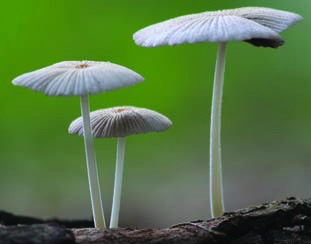
Herbivores eat only plants, such as deer and hare. Carnivores eat only animals, such as the leopard. Omnivores eat both, such as crows, foxes and mice. Vultures feed on dead animals. Mushrooms are fungi rather than plants, and they feed on dead matter.## Food chains and trophic levels
Feeding links form a food chain, a simple line showing who eats whom. Grass is eaten by a hare, and the hare by a leopard. Another chain in a grassland runs grass, grasshopper, frog, snake, eagle.
Each organism has a position in the chain called a trophic level. Producers sit at the first level, herbivores at the second, small carnivores at the third, and large carnivores at the next. The numbers in a food chain can be drawn as a pyramid: many millet plants support fewer mice, and the mice support fewer eagles.
2.2 Food webs
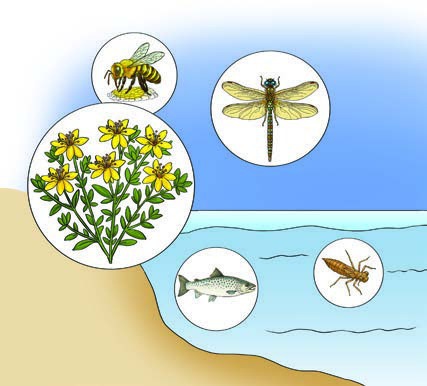
In a real ecosystem food chains do not stay separate. An organism may be eaten by two or more kinds of predators, and a predator may eat several kinds of prey. The linked chains form a food web, a network of feeding relationships. Removing one species can affect many others through this network.
2.3 Nature's recyclers
Organisms grow, reproduce, produce waste and die. Fungi and bacteria break down complex matter in dead plants and animals into simpler substances, returning nutrients to the soil. This is decomposition, and the organisms that do it are decomposers, also called saprotrophs (sapro means rotten, troph means food).
Mushrooms growing on fallen wood during the rainy season are visible fungi at work. Tiny beetles and flies gather on elephant dung and help break it down. Since many soil nutrients come from this recycling, decomposers keep the soil fertile. Nature wastes little: material is endlessly reused.
2.4 Travelling birds
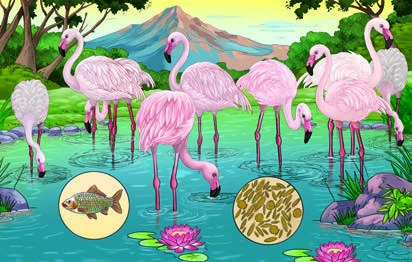
India has many habitats and seasons, and migratory birds travel thousands of kilometres to reach them in winter, escaping harsh weather and searching for food. Along the way they pollinate flowers and spread seeds, linking distant habitats. They also eat insect pests, which helps farmers keep pest populations in check. Demoiselle cranes visit Khichan in Jodhpur district during winter. Postal stamps of migratory birds are one way to spread awareness about them.
2.5 Reading a food chain
A food chain can be written for any ecosystem once the feeding habits are known. In a grassland, grass is eaten by a grasshopper, the grasshopper by a frog, the frog by a snake and the snake by an eagle. In the same grassland, grass may also be eaten by a hare and the hare by a leopard. In a crop field, millet may be eaten by a mouse and the mouse by an eagle or a hawk.
Each chain shows the direction in which food passes. The arrow points from the organism being eaten to the eater, because that is the direction in which matter and energy move. A chain usually has only a few links, because at every step some energy is used by the organism for its own life and is not passed on.
2.6 Why there are fewer top predators
The numbers in a food chain often form a pyramid. Many millet plants are needed to support a smaller number of mice, and those mice support an even smaller number of eagles. A top predator needs many prey over a large area, which is why large carnivores are fewer than the herbivores they hunt.
The pyramid shape is not a law about size. It describes how the numbers of organisms usually change from one trophic level to the next, and it helps explain why removing a top predator can have wide effects.
2.7 Decomposers at work
Decomposers are found wherever dead matter collects. Mushrooms push up through fallen leaves and dead wood, bacteria and fungi work in the soil, and beetles and flies gather on dung. Each group breaks down a different kind of material, and together they release nutrients that plants can take up again.
Without decomposers, dead plants and animals would pile up, and the nutrients locked inside them would not return to the soil. The soil would lose fertility, and the producers at the base of every food chain would suffer. This is why decomposers, though small and easily overlooked, are essential to the whole ecosystem.