

Interparticle spaces and compressibility
Particulate Nature of Matter14 min readLesson 3 of 5
3.1 There are gaps between particles
Even a piece of matter that looks completely full has empty spaces between its particles. The particles are not packed without any gaps. These gaps are the interparticle spaces that allow sugar to disappear into water, and they explain why some materials can be squeezed.
3.2 The syringe test
Use a syringe with the needle removed. Pull its plunger out, cover the open end with your thumb, then push the plunger in. The air inside can be compressed; the volume decreases because the gas particles are forced closer together. Release the plunger and the particles spread out again, pushing it back. Gas particles naturally have a large amount of space between them.
Repeat the test with water instead of air. Water is practically incompressible. Its particles are already close together, so there is very little space left to squeeze out. This is one of the clearest differences between the three states: the spaces are largest in gases, smaller in liquids, and smallest in solids.
3.3 Sugar and the water level
Fill a glass about halfway with water and mark the level A. Add two teaspoons of sugar and mark the new level B. Then stir until the sugar dissolves and mark the level again as C. The level rises when the sugar is added, because the solid occupies space. After dissolving, the level often falls somewhat below B.
The volume of the solution is smaller than the water and sugar volumes added together. The sugar particles have moved into the spaces between the water particles, so the total volume grows by less than the volume of the sugar added. This is direct evidence that interparticle spaces exist in liquids.
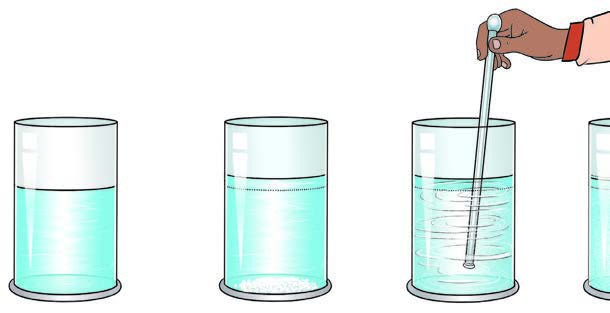
Something different happens with sand. Sand does not dissolve; its particles settle at the bottom and take up space there, so the total volume increases. Sand particles are held together too strongly for water particles to pull them apart.
3.4 Solids have spaces too
Solids are closely packed, but some empty space remains between their particles. This space is not filled with air; it contains nothing at all. The particles are held in place by strong attractions, which is why solids keep their shape.
3.5 The word particle in different contexts
The word particle is used in several ways. When we talk about air pollution and suspended particulate matter (SPM), we mean tiny dust particles floating in the air. These dust particles are much larger than the constituent particles of matter; each dust grain is itself made of an enormous number of atoms and molecules. The context tells us which meaning is intended.
3.6 Why gases compress so easily
A gas can be squeezed into a smaller volume because there is a lot of empty space between its particles. When the plunger of a syringe is pushed in, the particles are forced closer together and the gas occupies less volume. When the push stops, the particles spread out again and the plunger returns. The same principle is used in pumps, tyres and gas cylinders, where gas is compressed into a smaller space.
A liquid cannot be compressed much because its particles are already close together and there is very little empty space left. A solid is even less compressible. This order, gas most compressible, liquid next, solid least, matches the order of interparticle spacing.
3.7 Measuring the water-level change
The sugar experiment becomes clearer when it is repeated with different soluble solids. Common salt, glucose and sugar all dissolve and show a similar small change in level, because their particles enter the spaces between water particles. Sand and stone pieces do not dissolve; they settle and add their volume to the container, so the level rises by a larger amount.
The experiment is a good example of controlling one thing at a time. The same glass and the same amount of water are used, and only the added solid changes. Comparing the results shows that dissolving depends on whether the water particles can pull the solid apart, rather than on the amount of solid added.
3.8 The spaces inside a solid
Solids are described as closely packed, but that does not mean the particles are touching without any gaps. There is still some empty space between them. The spaces are simply small compared with the spaces in liquids and gases. They are not filled with air; they contain nothing at all. Strong attractions hold the particles around these spaces, which is why a solid keeps its shape.
3.9 A note on the word particle
The everyday word particle and the scientific idea of a constituent particle are not the same. A speck of dust, a grain of sand or a drop of smoke is a particle in ordinary language, but each of these is made of a huge number of constituent particles. Keeping the two meanings apart prevents confusion when reading about air pollution or about atoms and molecules.
3.10 Interparticle spaces around the house
The same spaces explain many household observations. A sponge holds water because the water enters the spaces between the fibres and within the material. Clothes absorb water and soil holds moisture in the gaps between particles. A compressed gas cylinder stores a large amount of gas in a small volume because the gas particles can be forced closer together.
A useful question to ask about any such observation is where the empty space is. In a sponge the spaces are large and visible, in a cloth they are fine, and in a solid they are tiny; in a gas the spaces between particles are large even though the gas itself looks empty.