

Particles in motion and quick revision
Particulate Nature of Matter16 min readLesson 4 of 5
4.1 Particles are always moving
Drop a few grains of potassium permanganate into a glass of water. Pink streaks spread out from the grains, and after some time the whole glass is evenly pink. The water particles are in constant motion. They pull particles away from the grain and carry them through the liquid, spreading them until the mixture is uniform. The same process explains why sugar dissolves and why a drop of ink colours a whole glass.
The motion of particles changes with temperature. In the chapter's test, a grain of potassium permanganate is dropped into hot water, room-temperature water and ice-cold water. The colour spreads fastest in the hot water, more slowly at room temperature, and slowest in the cold water. Heating gives the particles more energy, so they move faster.
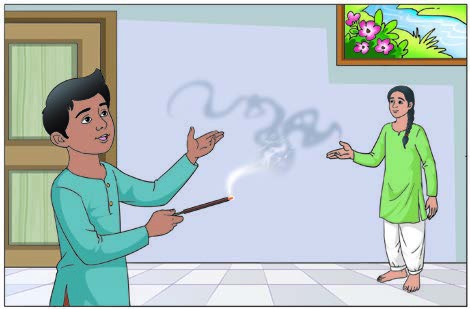
The same idea explains how a smell travels. Burn an incense stick in one corner of a room and the fragrance reaches every corner after a little while. The particles of the fragrance spread through the air, helped along by collisions with moving air particles. This spreading of particles from a region of higher concentration to a region of lower concentration is called diffusion.
4.2 Soap particles at work
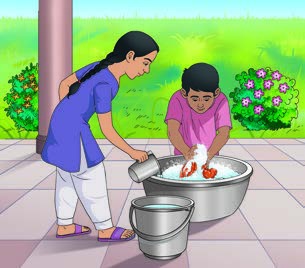
Particles explain everyday cleaning too. When clothes stained with oil are washed with soap, many soap particles surround each oil particle. The soap particle has one end that grabs the oil and another that mixes with water. The soap particles lift the oil away from the fabric and carry it into the water, so the cloth comes out clean.
4.3 Thermal energy and the state of matter
The state of a material depends on the energy its particles have. This internal energy of motion is called thermal energy. In a solid, the thermal energy is low, so the particles stay close together and only vibrate. At the melting point, the added energy is used to overcome the attractions, and particles break free of their fixed places and begin sliding past one another.
The table summarises the three states.
| Feature | Solid | Liquid | Gas |
|---|---|---|---|
| Interparticle spacing | Smallest | Larger than in solids | Largest |
| Interparticle attraction | Strongest | Weaker than in solids | Negligible |
| Particle movement | Only vibration | Within a limited space | Free in all directions |
| Shape | Fixed | Takes the shape of the container | Fills the container |
| Volume | Fixed | Fixed | Not fixed |
4.4 Common mistakes to avoid
- Thinking matter is continuous: even solid objects are built from particles with spaces between them.
- Believing that grinding changes a substance: breaking or grinding changes size and shape, not the substance.
- Saying solids have no spaces between particles: spaces exist, but they are small.
- Thinking gases have no mass: gases are matter, and they have particles and weight.
- Saying liquids have a fixed shape: liquids have a fixed volume but take the shape of their container.
- Believing evaporation happens only at the boiling point: it happens at all temperatures, just slowly below the boiling point.
- Thinking diffusion needs stirring: particles spread on their own because of their motion.
Exam
For a states-of-matter answer, link three ideas to each state: how closely the particles are packed, how strong the attractions are, and how the particles move. Then state the shape and volume each state has, and explain one test such as the syringe compressibility experiment or the smoke-spreading activity. For a change of state, name the melting point or boiling point and say that heat increases particle motion until the attractions can be overcome.
- Explain how chalk grinding shows that matter is made of particles without changing the substance.
- Describe constituent particles and interparticle spaces with the sugar-and-water example.
- Compare the arrangement, attraction and movement of particles in solids, liquids and gases.
- State the shape and volume of each state and explain the reason in particle terms.
- Explain melting and boiling points in terms of particle motion and interparticle attractions.
- Explain the syringe test and why gases are compressible while water is not.
- Describe diffusion using potassium permanganate and incense, including the effect of temperature.
- Explain how thermal energy decides the state of matter.