

Solids, liquids and gases
Particulate Nature of Matter15 min readLesson 2 of 5
2.1 The forces that hold particles together
Constituent particles are held together by attractive forces called interparticle attractions. How strong these attractions are depends on the material and on the separation between its particles. Even a small increase in the distance weakens these forces greatly. The strength of the attractions ultimately decides whether a substance is a solid, a liquid or a gas.
2.2 Solids
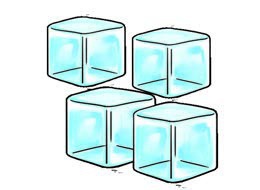
A solid has a definite shape and a definite volume. Its particles are packed closely and the attractions between them are very strong. They hold the particles in fixed positions, so the particles cannot move from one place to another; they can only vibrate about their positions.
When a solid is heated, the particles vibrate more vigorously. At a certain temperature the vibrations become strong enough to break the particles away from their fixed positions, and the solid melts into a liquid. This temperature is the melting point of the solid. Different solids melt at very different temperatures.
| Material | Melting point |
|---|---|
| Ice | 0 °C |
| Urea | 133 °C |
| Iron | 1538 °C |
Solids with weak interparticle attractions melt at low temperatures, while those with strong attractions melt at high temperatures.
2.3 Liquids
A liquid behaves differently. Pour the same 200 mL of water from one container to another of a different shape and the water takes the shape of the new container, while the level stays at 200 mL. Liquids therefore have a fixed volume but no fixed shape.
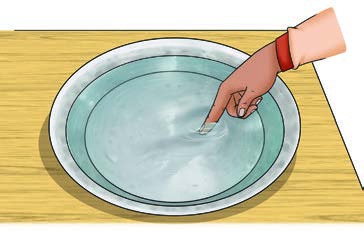
The particles of a liquid are not fixed in place; they can move freely, though only within a limited space. The attractions between them are weaker than in a solid, though the attractions are still enough to keep the particles near one another. You can feel this by moving a finger through water in a shallow dish. The finger pushes water aside, and the water returns to its place when the finger is removed, without a permanent hole.
When a liquid is heated, its particles move faster. At the boiling point, the particles gain enough energy to escape from the liquid and form vapour throughout the liquid, which is seen as bubbles. Vapour also forms slowly at the surface at temperatures below the boiling point, and this slower process is called evaporation. Spilled water drying up on a table is an example of evaporation.
2.4 Gases
Gases have neither a fixed shape nor a fixed volume. In one of the chapter's activities, smoke from an incense stick is trapped in a jar and then allowed to spread into a second jar. The smoke fills the second jar completely. Similarly, iodine vapour from a few crystals spreads through a closed jar. In each case the gas occupies all the space available to it.
The particles of a gas move freely in every direction, and the attractions between them are negligible. This is why a gas spreads out and fills its container. Liquids and gases both flow and do not keep a fixed shape; for this reason they are together called fluids.
2.5 Melting and boiling as changes of state
Melting and boiling are changes of state, not changes of substance. When ice melts, the water molecules are still water molecules; they have simply broken away from their fixed positions. When water boils, the molecules leave the liquid altogether and become vapour. The substance remains water throughout.
The melting point and the boiling point of a pure substance are fixed at a given atmospheric pressure. While a solid is melting, the heat supplied goes into loosening the attractions between particles rather than raising the temperature, which is why the temperature stays at the melting point until the change is complete. The same happens at the boiling point.
2.6 Evaporation and boiling compared
Boiling happens at a particular temperature, and it takes place throughout the liquid, producing bubbles of vapour. Evaporation happens at the surface at any temperature, even well below the boiling point. A puddle dries up on a warm day without ever boiling, and wet clothes dry in the shade because water evaporates from their surface all the time.
Evaporation is slower than boiling at low temperatures, but it never stops for an open container of water. The particles at the surface that have enough energy escape into the air, and the remaining liquid cools slightly as a result.
2.7 Why liquids and gases are fluids
Both liquids and gases flow and take the shape of their container, so both are classed as fluids. The difference is that a liquid keeps a definite volume while a gas does not. A gas will spread through the whole of a closed container, while a liquid settles at the bottom and leaves the rest of the container empty.
2.8 Ice is a special solid
Most substances are denser in their solid form than in their liquid form. Water is different. When water freezes, its particles arrange themselves so that the spacing between them is slightly larger than in liquid water. Ice is therefore less dense than water, which is why ice floats on a pond instead of sinking.
The floating ice forms a layer on the surface and slows the cooling of the water below, which allows aquatic life to survive in winter. The exception is a useful reminder that the particle model explains properties through arrangement and spacing, not through a rule that all solids must behave in the same way.