

Matter is made of tiny particles
Particulate Nature of Matter14 min readLesson 1 of 5
1.1 From mountains to sand
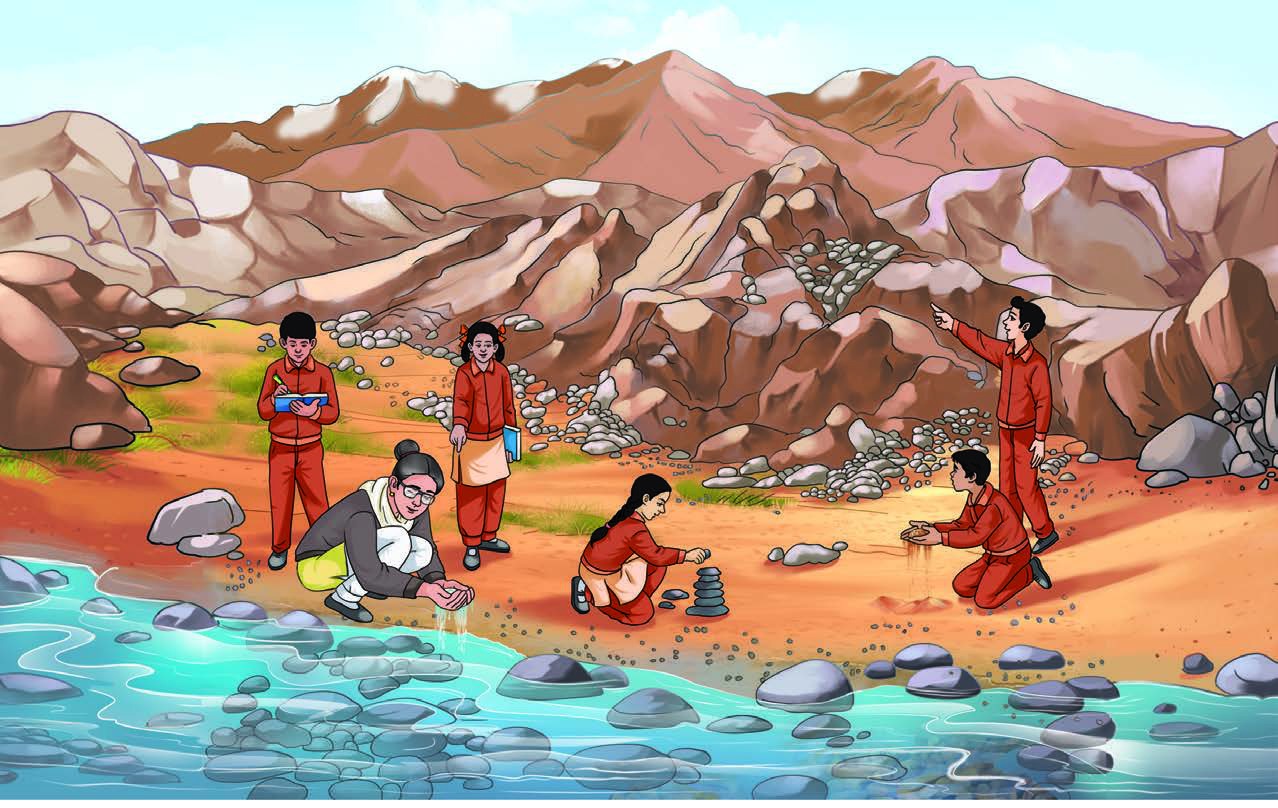
The chapter opens on a riverbank, where pebbles, stones and sand have collected. Where do they come from? In the mountains, rocks slowly break down through erosion. Rivers carry the broken pieces along, wear them smaller, and spread pebbles, sand and clay over the plains. Even the finest grain of sand is a piece of a larger rock, but is it the smallest piece possible? The chapter's first activity suggests an answer.
1.2 Breaking chalk
Take a stick of chalk and break it in two. Keep breaking the pieces until they are too small to break by hand. Then grind the pieces with a mortar and pestle and look at the powder through a magnifying glass. Each tiny speck is still chalk. Grinding has changed the size of the pieces, not the substance; it is a physical change.
Imagine the grinding continuing. Eventually a stage would come when the chalk cannot be broken into anything smaller. The units at that stage are the basic building blocks of chalk, called its constituent particles. A constituent particle is the smallest unit from which a larger piece of a substance is built. One stick of chalk is therefore built from a very large number of these units. The grains of sand and clay on the riverbank are built in the same way.
1.3 Where does the sugar go
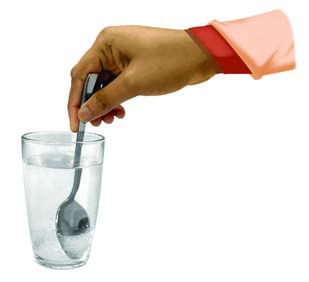
Stir two teaspoons of sugar into a glass of water and taste the water from the top. It is sweet, even though no sugar grains can be seen. The sugar is still there, so it must have broken into particles far too small for the eye. When sugar dissolves, its constituent particles separate and spread through the water.
The particles of sugar fit into the gaps between the particles of water. These gaps are called interparticle spaces. The sugar has not vanished and the water has not changed into a new substance; the particles of the two materials are simply mixed at a very small scale.
1.4 An old Indian idea
Long before modern science, the ancient Indian philosopher Acharya Kanad described matter as being made of tiny, indivisible and eternal particles called Parmanu. His idea appears in the Vaisheshika Sutras. The details of his model are different from modern atomic theory, but the central thought, that visible matter is built from extremely small units, is remarkably close to the modern picture.
Modern science calls the tiny units atoms and molecules. Iron is made of iron atoms, and gold of gold atoms. Atoms of some elements do not exist independently; a fixed number of them join to form a molecule. Two hydrogen atoms form a hydrogen molecule, and a water molecule contains two hydrogen atoms and one oxygen atom. These details are studied in higher classes.
1.5 Why the powder still behaves like chalk
The chalk powder is still chalk in every way that matters. It writes on a board, it fizzes if acid is dropped on it, and it settles in water just as chalk does. Breaking and grinding have changed the size and shape of the pieces, not the identity of the substance. If the substance had changed, the powder would have new properties; it does not.
The same is true of a stone that is chipped, a nail that is filed, or a lump of salt that is crushed. The pieces become smaller, but each piece is the same material. Physical changes of this kind are the everyday evidence that a material is built from smaller units of itself.
1.6 Particles too small to see
The particles of matter are far too small to be seen, even through an ordinary microscope. We know they exist because of their effects. Sugar disappears into water but the water tastes sweet. A grain of potassium permanganate colours a whole glass. A drop of perfume can be smelled across a room. In each case, something invisible has spread through the visible material.
Scientists use models to reason about these invisible units. A model does not show what a particle "looks like"; it shows how particles are arranged, how tightly they are packed and how they move. The pictures in the textbook are magnified schematic pictures, not photographs.
1.7 Mixtures and pure substances
When sugar dissolves in water, the result is a mixture of sugar particles and water particles, spread evenly through the same space. The particles themselves keep their identity; sugar particles are still sugar and water particles are still water. A mixture can usually be separated by physical means, while a pure substance contains only one kind of particle.
This particle view explains why a solution looks uniform even though it contains two materials. The particles are far too small to scatter light strongly, and they are distributed so evenly that the liquid appears clear.
1.8 Why breaking a solid changes its surface
Breaking chalk into powder does more than make the pieces smaller. It also exposes a much larger surface area for the same amount of chalk. A powder reacts or dissolves faster than a single lump because more of its particles are at the surface, where water or air can reach them.
The amount of chalk has not changed and the substance has not changed, but its behaviour in a mixture can change with particle size. This is one more reason the particle view is useful: it connects the size of the pieces with how quickly a material dissolves, mixes or reacts.