Concepts: Arthropoda, Mollusca and Echinodermata
Animal Kingdom18 min readLesson 4 of 8
4.1.1 Telling the three phyla apart
The quick tests run on three questions. Is the body flattened from top to bottom? A flatworm, and the coelom is absent. Is the cross-section round, with a complete gut and a pseudocoelom? A roundworm. Is the body ringed by visible segments and lined by a true coelom? An annelid. In a practical exam the external look alone may mislead, so the coelom type and the presence of flame cells, an excretory tube or nephridia settle the identity. The table below keeps the deciding characters together.
| Feature | Platyhelminthes | Aschelminthes | Annelida |
|---|---|---|---|
| Body form | flattened | circular in section | ringed segments |
| Coelom | absent | pseudocoelom | true coelom |
| Excretion | flame cells | excretory tube | nephridia |
| Digestion | incomplete or absent in some | complete canal | complete canal |
| Example | Taenia, Fasciola | Ascaris, Wuchereria | Nereis, Pheretima |
The special structures are what examiners attach marks to. Flame cells belong to the flatworms and are not found in the other two. The roundworms, on the other hand, are recognised by the pseudocoelom and the complete gut, and the annelids by the metameres and the nephridia. Each phylum therefore has a pair of characters that settle it even when the whole animal cannot be seen. The muscular pharynx and the separate sexes mark the roundworms. Parapodia, a closed circulatory system and a double ventral nerve cord mark the annelids. When a question asks for a difference, give one structural point and one functional point, because the two together show that the feature matters in the living animal. The coelom is the deep difference here: a flatworm has no cavity, a roundworm has one that is not lined by mesoderm, and an annelid has a cavity with a full mesodermal lining. That is why the three groups look alike at the surface of a pond but sit in different parts of the classification. Add the level of organisation and the excretory organ, and the separation is complete.
4.2 Phylum Arthropoda: the largest phylum
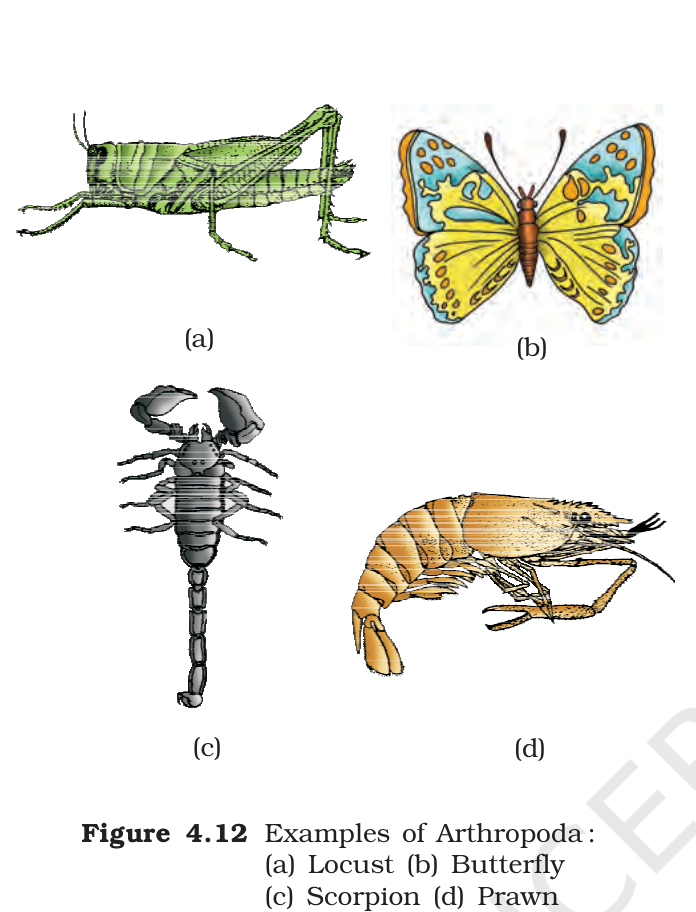
Arthropoda is the largest phylum of the animal kingdom, and the insects sit inside it. Over two-thirds of the species that have been named on earth are arthropods. Their body works at the organ system level. Symmetry is bilateral, the germ layers are three, the body is segmented, and a true coelom is present. A chitinous exoskeleton covers the body, which divides into head, thorax and abdomen. The appendages are jointed, which is what the name records. Respiration happens through gills, book gills, book lungs or a tracheal system. The circulatory system is of the open type. The sense organs include antennae, compound and simple eyes, and statocysts that work as balancing organs. Excretion is carried out by malpighian tubules. Arthropods are mostly dioecious, fertilisation is usually internal, most are oviparous, and development may be direct or indirect.
The examples come with their economic tags, which examiners like. Apis is the honey bee, Bombyx the silkworm and Laccifer the lac insect. Anopheles, Culex and Aedes are mosquito vectors. Locusta is the locust, a gregarious pest, and Limulus, the king crab, is called a living fossil.
4.3 Phylum Mollusca: the second largest
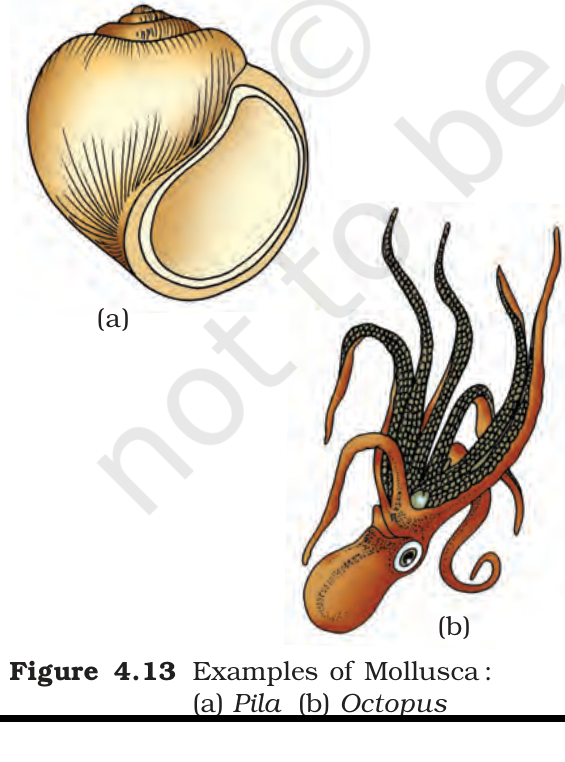
Mollusca is the second largest animal phylum. Its members are terrestrial or aquatic, and their organisation is at the organ system level. They are bilaterally symmetrical, triploblastic and coelomate. The body is unsegmented and covered by a calcareous shell, with a distinct head, a muscular foot and a visceral hump. A soft and spongy skin layer, the mantle, lies over the visceral hump, and the mantle cavity is the space that separates the hump from the mantle; feather-like gills sit in that cavity. The gills carry out respiration and excretion. The head region has sensory tentacles, and the mouth holds a file-like rasping organ called the radula. Molluscs are usually dioecious and oviparous, and development is indirect. Pila the apple snail, Pinctada the pearl oyster, Sepia the cuttlefish, Loligo the squid, Octopus the devil fish, Aplysia the sea hare, Dentalium the tusk shell and Chaetopleura the chiton are the printed examples.
4.4 Phylum Echinodermata: the spiny-bodied animals
The echinoderms have an endoskeleton of calcareous ossicles, which gives the phylum its name. All are marine and all show organ system organisation. The adult body is radially symmetrical, while the larva is bilaterally symmetrical. They are triploblastic and coelomate. The digestive system is complete, with the mouth on the lower side and the anus on the upper side. The most distinctive feature is the water vascular system, and it serves locomotion, the capture and transport of food, and respiration. There is no excretory system. The sexes are separate, reproduction is sexual, the egg is usually fertilised outside, and a free-swimming larva develops indirectly. Asterias the star fish, Echinus the sea urchin, Antedon the sea lily, Cucumaria the sea cucumber and Ophiura the brittle star are the examples.
4.4.1 Practice from the NCERT exercises, questions 7, 8 and 14
Exercise 7. Arthropods form the largest group because their body plan is adaptable. The jointed exoskeleton protects the body and lets the appendages take many forms, so the same basic design can walk, swim, dig, fly or feed in different species. Their small size lets them use habitats that larger animals cannot, their reproductive output is high, and their complete gut and open circulation work well on land and in water. The body is segmented into head, thorax and abdomen, and that division allows specialisation.
Exercise 8. The water vascular system is the characteristic of Echinodermata, so option (c) is correct.
Exercise 14, the remaining pairs. Operculum goes with Osteichthyes, parapodia with Annelida, scales with Reptilia, comb plates with Ctenophora, radula with Mollusca, hairs with Mammalia, choanocytes with Porifera, and gill slits with Cyclostomata and Chondrichthyes.
Exam
For arthropods, list the exoskeleton, jointed appendages, three body regions, open circulation and malpighian tubules, then give the tagged examples. For molluscs, the shell, mantle, mantle cavity, muscular foot and radula are the marks. For echinoderms, start with the water vascular system and the calcareous ossicles, then mention the radial adult and the bilateral larva.
Common mistake
Do not call the arthropod circulatory system closed, because it is open. Do not say the mollusc body is segmented, because it is unsegmented. Do not write that an echinoderm has no system, since it has a complete gut and a water vascular system and only the excretory system is absent. And do not confuse the radula of a mollusc with the chelicerae or mandibles of an arthropod.