Concepts: The basis of animal classification
Animal Kingdom20 min readLesson 1 of 8
1.1 Why animals need a framework
More than a million animal species have been described, and the number keeps rising, so a system is needed to place each one. Structure and form differ across the kingdom, yet a few fundamental features hold across groups: how cells are arranged, how the body is built in relation to a plane, whether a body cavity exists, and how the organ systems are laid out. These features are the basis of animal classification, and they are what examiners ask about first.
1.1.1 Levels of organisation
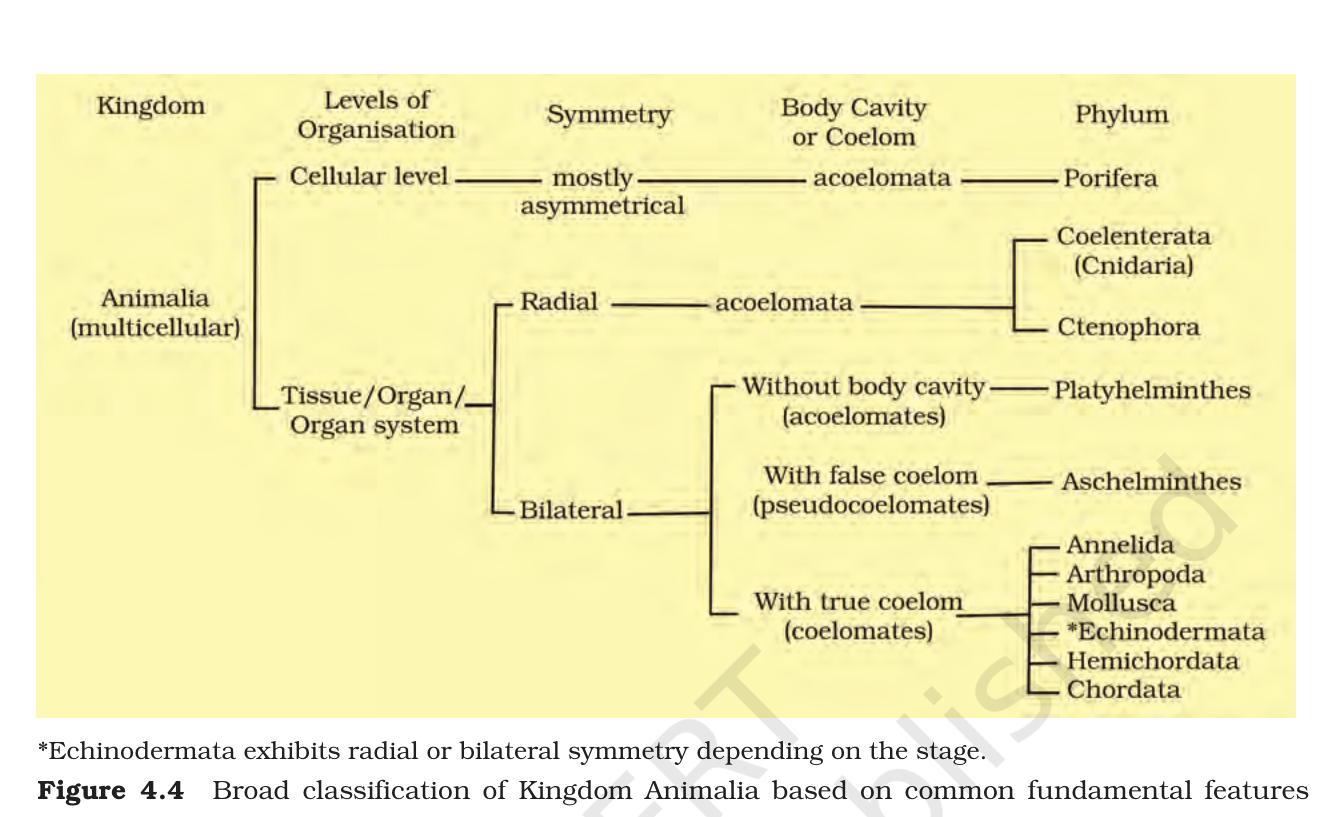
All animals are many-celled, but the arrangement of their cells is not the same. In a sponge, cells lie together as a loose aggregate, with some division of labour among them. That is the cellular level of organisation. In a coelenterate the arrangement is tighter: cells doing the same job are grouped into tissues, so the level is tissue. In Platyhelminthes and the higher phyla, tissues are grouped into organs that each do one specialised job, which is the organ level. In annelids, arthropods, molluscs, echinoderms and chordates the organs join into systems, each system handling one physiological function. That is the organ system level, and it allows more complex bodies.
The complexity can differ even within one system. The flatworm gut has one opening only, and that same opening works as mouth and anus, so the system is incomplete; a complete system has two separate openings. Circulation is open when the heart pushes blood into spaces where the cells sit directly in it, and closed when the blood is kept inside tubes of different widths, namely arteries, veins and capillaries.
1.1.2 Symmetry
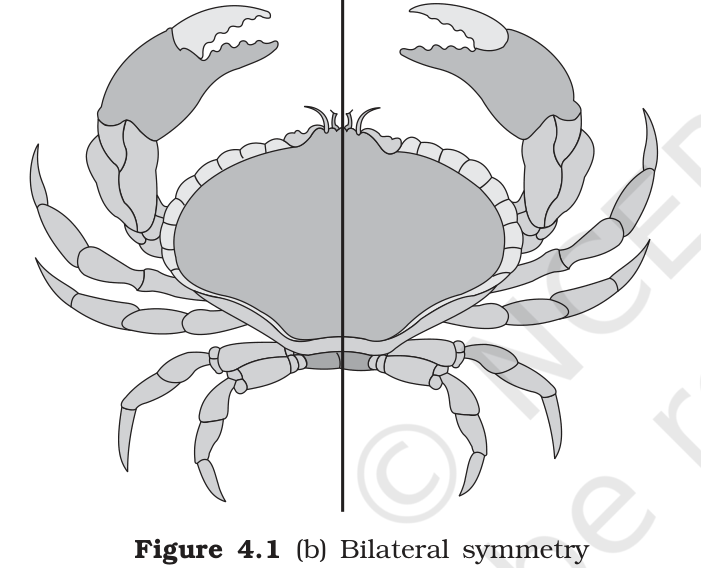
A sponge is mostly asymmetrical: no plane through its centre divides it into equal halves. When any plane through the central axis gives two identical halves, the body has radial symmetry, as in coelenterates, ctenophores and echinoderms. When only one plane can divide the body into matching left and right halves, the symmetry is bilateral, as in annelids and arthropods. Bilateral symmetry suits a body that moves in one direction, because the sense organs and the mouth can be collected at the front.
1.1.3 Germ layers and the coelom
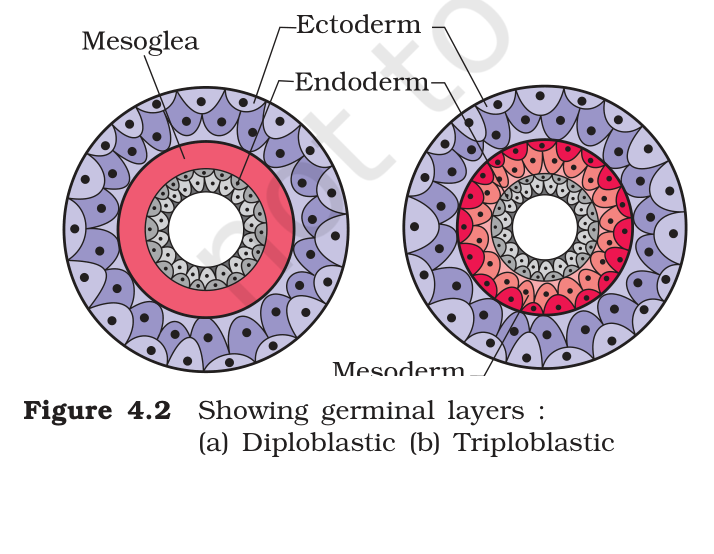
Animals whose cells form two embryonic layers, an outer ectoderm and an inner endoderm, are diploblastic, and the undifferentiated mesoglea lies between the two, as in coelenterates. When the embryo adds a third layer, the mesoderm, between the other two, the animal is triploblastic, which covers Platyhelminthes and everything above it.
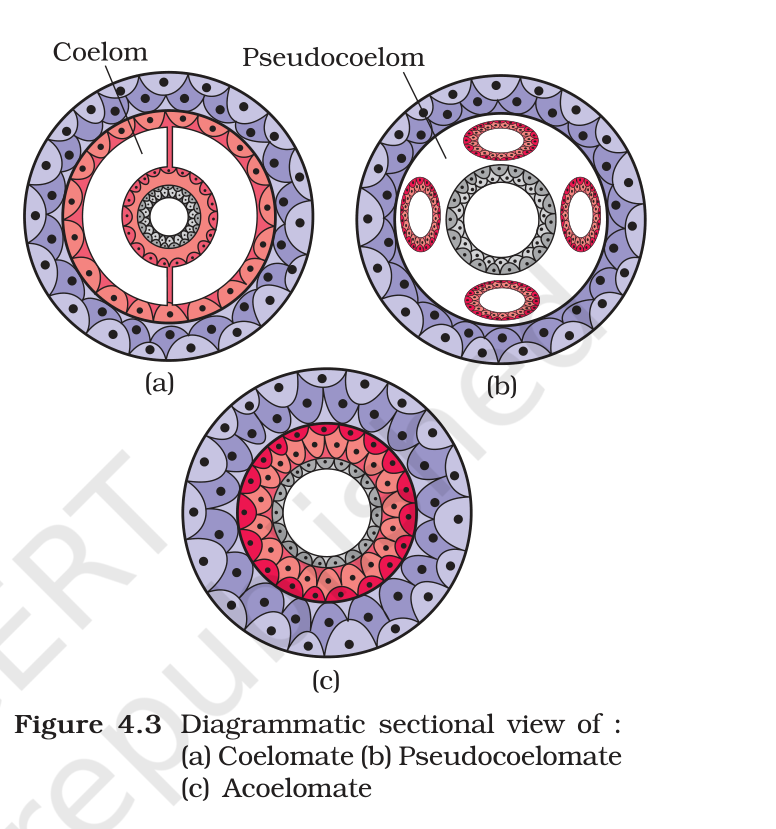
The coelom is the space found between the outer body wall and the gut wall, and the kind of tissue lining it decides the group. When mesoderm lines the cavity it is a true coelom, and the animal is a coelomate, as in annelids, molluscs, arthropods, echinoderms, hemichordates and chordates. When the cavity is not lined by mesoderm but the mesoderm sits as scattered pouches, the cavity is a pseudocoelom, and the animal is a pseudocoelomate, as in Aschelminthes. When no cavity exists, the animal is an acoelomate, as in Platyhelminthes.
1.1.4 Segmentation and notochord
In some animals the body is divided inside and outside into segments, with a serial repeat of at least some organs. The earthworm is the standard example, and the pattern is metameric segmentation. The notochord is a rod of mesodermal origin on the dorsal side, formed during the embryo stage. Animals that form it are chordates; animals that never form it are non-chordates, from sponges to echinoderms.
Slideshow, slide 1 of 3. Use the left and right arrow keys to change slides and the space bar to play or pause.
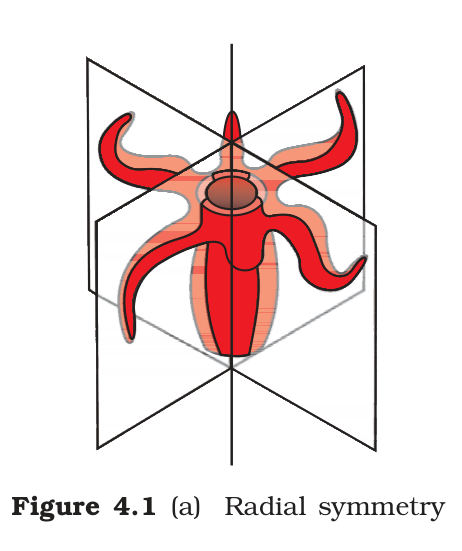
The NCERT diagram of radial symmetry, with several planes through the central axis dividing the body into matching halves.
1.1.5 Practice from the NCERT exercises, questions 1 and 3
Exercise 1. Without common fundamental features, an animal could be classified on one visible character such as colour or size, and two close relatives could land in distant groups. Species that look different at different stages of life would be split, and species that converge in one feature would be joined. The fundamental features, such as symmetry, coelom and level of organisation, give stable characters that stay with the animal through its life.
Exercise 3. The body cavity is a strong classifier because its lining is an embryological fact. A true coelom lined with mesoderm, a pseudocoelom with scattered mesodermal pouches and an acoelomate body with no cavity divide animals into three clear sets. The division agrees with other characters such as segmentation and organ complexity, and it separates groups that look alike from outside, so the study of the coelom is useful in animal classification.
Exercise 2 (also worked here). A specimen is first observed for its level of organisation, symmetry, germ layers, coelom, segmentation and notochord. Those characters place it in a phylum. Then the finer characters are read: the body covering, the appendages, the excretory organs, the heart and the reproductive pattern. The class, order and family follow the same way, until a key confirms the identity.
Exam
The basis of classification is the most repeated question of this chapter. Learn the six characters in order: level of organisation, symmetry, germ layers, coelom, segmentation and notochord. For each character, keep one animal example ready. Then use Figure 4.4 to show how the characters combine into phyla, because a ladder answer that follows the flow chart is easy for the examiner to mark.
Common mistake
Do not confuse radial symmetry with a round shape, because the test is whether more than one plane through the centre gives equal halves. Do not call a pseudocoelomate acoelomate, because the Aschelminthes do have a cavity, just not a mesoderm-lined one. And do not write that all triploblastic animals are coelomates, since Platyhelminthes are triploblastic and acoelomate.