Concepts: Vertebrate classes and exercise practice
Animal Kingdom24 min readLesson 6 of 8
6.1 The vertebrate classes
Vertebrata divides into two divisions. Agnatha lacks jaws and is represented by the single class Cyclostomata. Gnathostomata bears jaws and splits into the super class Pisces, which bears fins, and the super class Tetrapoda, which bears limbs. Pisces holds Chondrichthyes and Osteichthyes. Tetrapoda holds Amphibia, Reptilia, Aves and Mammalia.
Cyclostomes are ectoparasites on fishes. The body is elongated, with 6 to 15 pairs of gill slits. The mouth is round and sucking and has no jaws. The body has no scales and no paired fins, and the cranium and vertebral column are cartilaginous. Cyclostomes are marine but migrate to fresh water to spawn, and the adults die a few days after spawning while the larvae return to the sea after metamorphosis. Petromyzon the lamprey and Myxine the hagfish are the examples.
Chondrichthyes are the cartilaginous fishes. They are marine, with a streamlined body and a ventral mouth. The notochord persists for life, and the gill slits are separate without an operculum. The skin has minute placoid scales, and the teeth are modified placoid scales directed backwards. These fishes are predaceous. The air bladder is absent, so they must swim constantly to avoid sinking. The heart has two chambers. Some have electric organs, as in Torpedo, and some have a poison sting, as in Trygon. They are cold-blooded, the sexes are separate, the pelvic fins of males carry claspers, fertilisation is internal, and many are viviparous. Scoliodon, Pristis, Carcharodon and Trygon are the examples.
Osteichthyes are the bony fishes, marine and fresh water. The body is streamlined and the mouth is mostly terminal. There are four pairs of gills covered by an operculum on each side. The skin carries cycloid or ctenoid scales. An air bladder sits inside and keeps buoyancy under control. Two chambers make up the heart. These fish are cold-blooded, the egg is usually fertilised outside, most of them lay eggs, and development is direct. Marine examples are Exocoetus and Hippocampus, fresh water ones are Labeo, Catla and Clarias, and Betta with Pterophyllum are kept in aquaria.
Amphibians can live in water and on land. Most have two pairs of limbs, and the body is divided into head and trunk, with a tail in some. The skin is moist and has no scales, the eyes have eyelids, and the tympanum represents the ear. The gut, the urinary tract and the reproductive tract all end in one common chamber, called the cloaca. Gills, lungs and skin all take part in respiration. Three chambers form the heart, and the blood is cold. The egg is fertilised outside the body, the female lays eggs, and development is indirect. Bufo, Rana, Hyla, Salamandra and Ichthyophis are the examples.
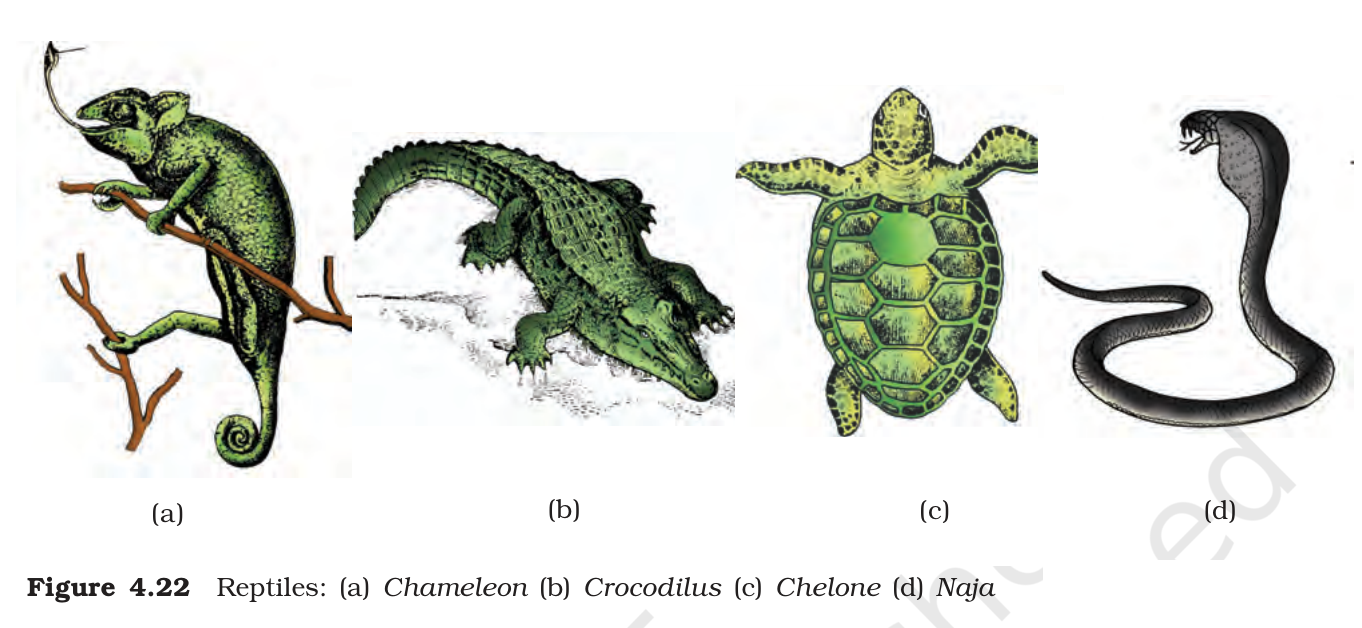
Reptiles creep or crawl, which is what the name means. Most live on land, and dry cornified skin with epidermal scales or scutes covers the body. Ear openings are absent on the outside, and the tympanum stands for the ear. Three chambers usually make the heart, though the crocodile has four, and the blood is poikilothermous. Snakes and lizards shed their scales as a skin cast. The egg is fertilised internally, the female lays eggs, and development is direct. Chelone, Testudo, Chameleon, Calotes, Crocodilus, Alligator and Hemidactylus are the examples, with Naja, Bangarus and Vipera as the poisonous snakes.
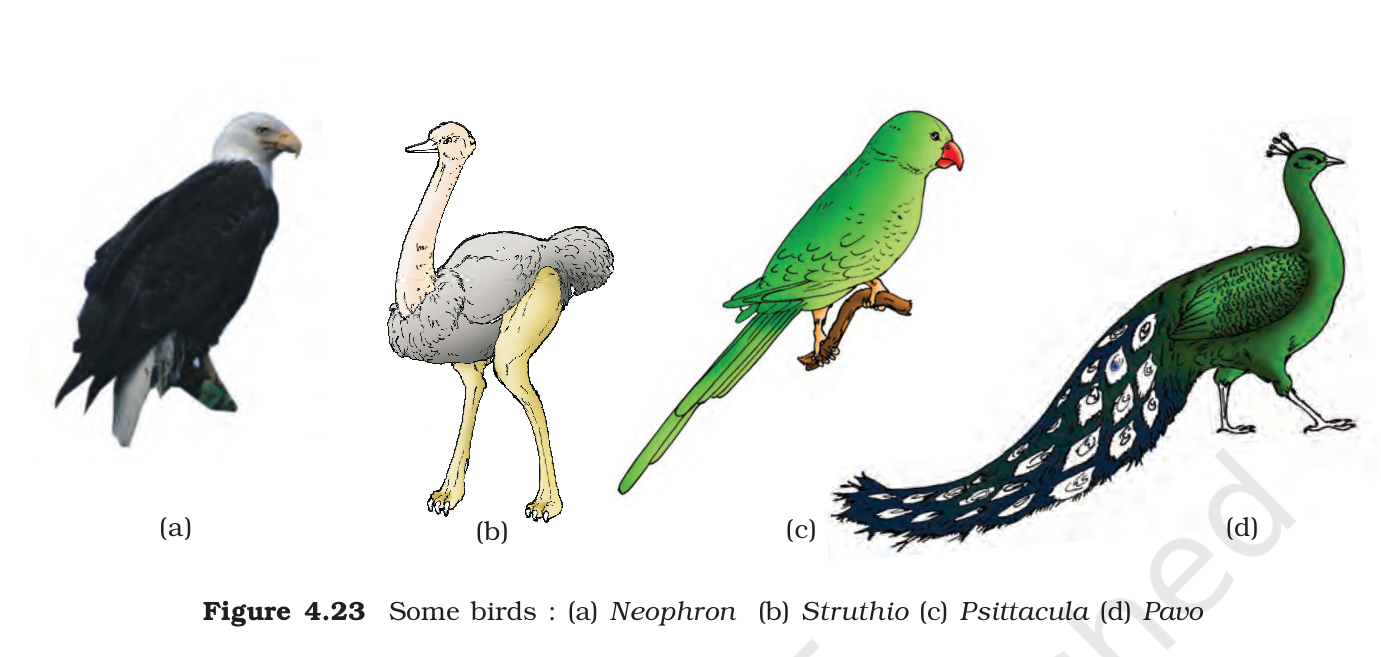
Birds carry feathers, and most fly, with flightless birds such as the ostrich as exceptions. They have a beak, the forelimbs are modified into wings, and the hind limbs have scales and are used for walking, swimming or clasping branches. Glands on the skin are missing except the oil gland near the tail base. Every bone is ossified, and the long bones carry air cavities that make them pneumatic. A crop and a gizzard are extra chambers in the digestive tract. The heart has four chambers and birds are warm-blooded. Air is breathed through lungs helped by air sacs. The egg is fertilised inside the body, the female lays eggs, and development is direct. The examples printed in the chapter are Corvus, Columba, Pavo, Struthio, Psittacula, Neophron and Aptenodytes.
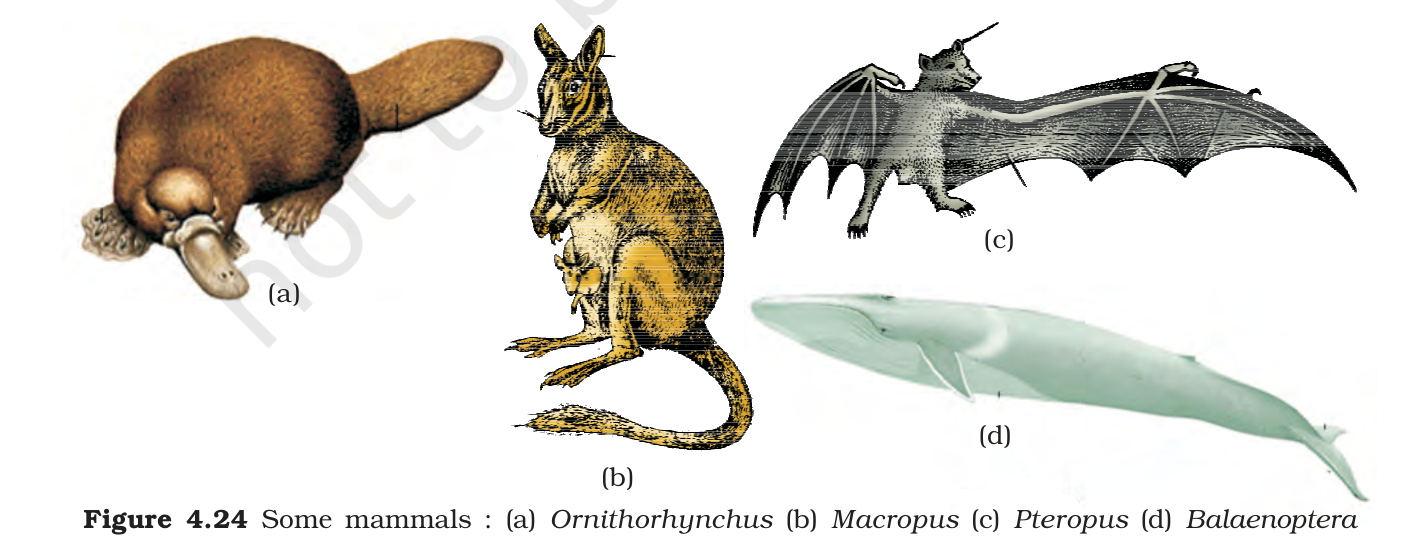
Mammals live in a wide range of habitats, from polar ice to deserts, forests and caves, and some fly or swim. The unique character is the mammary gland, which feeds the young with milk. They have two pairs of limbs and a skin with hair. External ears or pinnae are present, the jaw carries teeth of different kinds, the heart has four chambers, and mammals are homoiothermous. Respiration is by lungs. Fertilisation is internal, most are viviparous, and development is direct. Ornithorhynchus, the platypus, is oviparous, while Macropus, Pteropus, Camelus, Macaca, Rattus, Canis, Felis, Elephas, Equus, Delphinus, Balaenoptera, Panthera tigris and Panthera leo are viviparous examples.
6.1.1 Practice from the NCERT exercises, questions 2, 5, 10, 11 and 12
Exercise 5. In direct development the young one resembles the adult, and no larval stage appears. In indirect development a larva is born that looks different from the adult, and metamorphosis turns it into the adult form. Amphibians and many insects show indirect development, while reptiles, birds and mammals show direct development.
Exercise 10. The air bladder matters because it regulates buoyancy. A bony fish can stay at a chosen depth without swimming, while a cartilaginous fish that lacks the bladder must keep swimming or sink. The bladder therefore saves energy and lets the fish hold its position in the water column.
Exercise 11. Bird flight is helped by feathers, wings made from forelimbs, hollow pneumatic long bones, a fully ossified skeleton, strong flight muscles, a four-chambered heart and air sacs that keep the lungs supplied with air. The streamlined body and the beak without teeth also cut weight and air resistance.
Exercise 12. The numbers are not equal. An oviparous mother lays many eggs, because each egg is a small package with food for the embryo and many eggs are lost to predators and to bad conditions. A viviparous mother carries the embryo inside her, feeds it from her body and protects it, so she can invest in fewer young ones and still keep the line going.
Exam
The vertebrate table is the highest-yield revision in this chapter. Keep the columns skin, respiration, heart chambers, warmth, fertilisation and development. Two heart facts settle most marks: three chambers in amphibians and most reptiles, four in birds, mammals and crocodiles. Two skin facts settle the rest: dry cornified skin with scales in reptiles, and hair with mammary glands in mammals.
Common mistake
Do not say all reptiles have a three-chambered heart, because crocodiles have four. Do not call birds cold-blooded, since they are homoiothermous. Do not say mammals are all viviparous, because the platypus lays eggs. And do not write that amphibians have a dry scaly skin, because their skin is moist and without scales.