Concepts: Hemichordata and Chordata
Animal Kingdom18 min readLesson 5 of 8
5.1.1 A comparison table for the three phyla
| Feature | Arthropoda | Mollusca | Echinodermata |
|---|---|---|---|
| Body covering | chitinous exoskeleton | calcareous shell | calcareous ossicles |
| Body parts | head, thorax, abdomen | head, muscular foot, visceral hump | radial adult body |
| Special organ | jointed appendages | radula in the mouth | water vascular system |
| Circulation | open | open in most forms | open in the body plan of the group |
| Example | Locusta, Limulus | Pila, Octopus | Asterias, Echinus |
Some entries need care. The molluscan shell is a covering, not a skeleton of plates, and the mantle that secretes it is a soft skin fold. The echinoderm skeleton lies under the skin, which is why the animal feels spiny rather than hard and smooth. The arthropod exoskeleton also carries the sense organs and the appendages, and because it cannot stretch, the animal has to shed it as it grows. That single structural choice explains most of the other arthropod features in this chapter.
5.2 Phylum Hemichordata
Hemichordata once sat as a sub-phylum inside Chordata; it is now a separate phylum placed with the non-chordates. In the collar region the group carries a rudimentary structure, the stomochord, which looks like a notochord but is not one. The phylum holds a small set of worm-like animals of the sea, built at the organ system level. Symmetry is bilateral, the germ layers are three, and a true coelom is present. The body is a cylinder with three parts, an anterior proboscis, then a collar, then a long trunk. Blood flows in an open system, gills handle respiration, and the proboscis gland carries out excretion. The sexes are separate, the egg is fertilised outside, and development is indirect. Balanoglossus and Saccoglossus are the examples.
5.3 Phylum Chordata
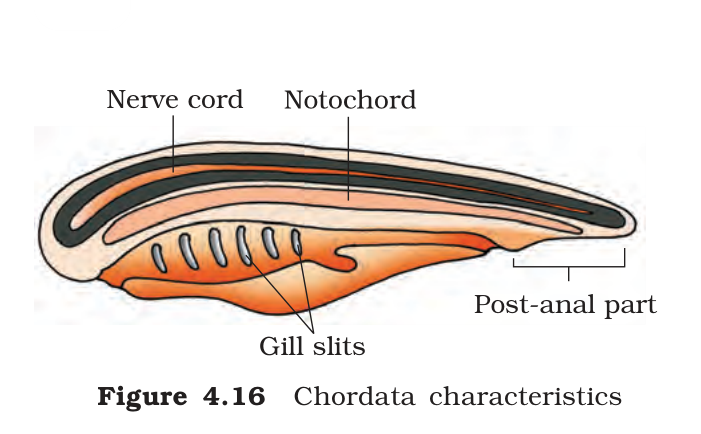
Three fundamental characters, found together, identify a chordate: a notochord, a dorsal nerve cord that is hollow, and paired gill slits in the pharynx. The body is bilateral, triploblastic and coelomate, with organ system organisation. A post-anal tail is present, and so is a closed circulatory system.
The comparison with non-chordates turns on five pairs of features. Chordates have a notochord, and non-chordates do not. The chordate central nervous system is dorsal, hollow and single, while the non-chordate central nervous system is ventral, solid and doubled. The chordate pharynx is perforated by gill slits, and gill slits are absent in non-chordates. The chordate heart is ventral, while the non-chordate heart, where present, is dorsal. Chordates have a post-anal tail, and non-chordates do not.
5.3.1 The three subphyla
Chordata is divided into Urochordata or Tunicata, Cephalochordata and Vertebrata. Urochordata and Cephalochordata are together called the protochordates, and both are exclusively marine. In Urochordata the notochord appears only in the larval tail, while in Cephalochordata it runs from head to tail and stays for life. The examples are Ascidia, Salpa and Doliolum for Urochordata, and Branchiostoma, also called Amphioxus or the lancelet, for Cephalochordata.
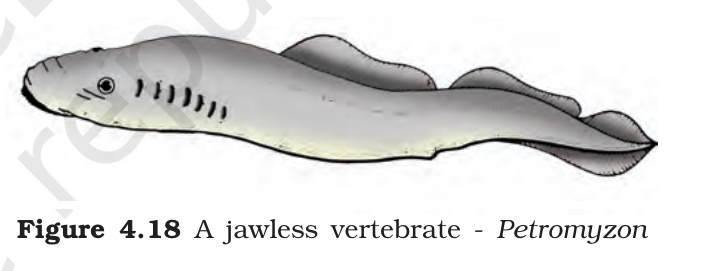
Vertebrates have a notochord during the embryo stage, and in the adult a cartilaginous or bony vertebral column replaces it. That gives the standard exam line about vertebrates and chordates, and the two sets are not equal. Beyond the chordate characters, a vertebrate carries a muscular heart on the ventral side with two, three or four chambers, kidneys that handle excretion and osmoregulation, and appendages in pairs that may be fins or limbs.
5.3.2 Chordates and non-chordates side by side
| Character | Chordata | Non-chordata |
|---|---|---|
| Notochord | present at some stage | never formed |
| Central nervous system | dorsal, hollow and single | ventral, solid and doubled |
| Pharynx | perforated by gill slits | gill slits absent |
| Heart | ventral in position | dorsal where a heart exists |
| Tail | a post-anal part is present | post-anal part absent |
The comparison matters because it shows that chordate characters come as a package. A single feature taken alone, such as a tail or a gill, can be found outside the phylum, but the package of notochord, dorsal hollow nerve cord and pharyngeal gill slits is unique. The protochordates keep two of these characters for life while the vertebrate replaces the notochord with a column of bone or cartilage, and that is the whole difference between the two halves of the phylum.
5.3.3 Practice from the NCERT exercises, questions 9 and 15
Exercise 9. All vertebrates are chordates because each one passes through an embryo that carries a notochord, a nerve cord that is dorsal and hollow, and gill slits in pairs along the pharynx. The reverse is not true, because Urochordata and Cephalochordata are chordates that never build a vertebral column. The first group keeps the notochord in the larval tail only, and the second keeps it from head to tail for life, so both remain non-vertebrate chordates.
Exercise 15. Animals that are parasitic on human beings include the tapeworm Taenia, the liver fluke Fasciola, the roundworm Ascaris, the filarial worm Wuchereria, the hookworm Ancylostoma and the malarial parasite Plasmodium. Leeches also feed on human blood, and the roundworm and hookworm are common intestinal parasites.
Exam
The chordate answer is the four characters: notochord, dorsal hollow nerve cord, paired pharyngeal gill slits and post-anal tail. Then give the five-point comparison with non-chordates in a table, and finish with the three subphyla and the line about vertebrates being chordates but not the reverse. The hemichordate point is the stomochord: similar to a notochord, but the animal is not a chordate.
Common mistake
Do not call the hemichordate stomochord a true notochord, because the group is placed with the non-chordates. Do not say every chordate has a vertebral column, since the protochordates do not. Do not write that the chordate nerve cord is ventral, because it is dorsal and hollow. And do not forget the opposite heart position: ventral in chordates, dorsal in non-chordates.