Concepts: Porifera, Coelenterata and Ctenophora
Animal Kingdom18 min readLesson 2 of 8
2.1 Phylum Porifera: the sponges
Members of Porifera are the sponges. Most are marine, and most are asymmetrical. They are primitive many-celled animals with a cellular level of organisation. Water enters the body through minute pores called ostia and passes into a central cavity, the spongocoel, then leaves through a larger opening called the osculum. That pathway is the water transport or canal system, and it does the work of food gathering, gas exchange and waste removal in one flow. The inner lining of the spongocoel and the canals carries choanocytes, the collar cells. Digestion takes place inside the cells. The body is held up by a skeleton of spicules or of spongin fibres.
Sponges are hermaphrodite, which means one individual makes both eggs and sperms. Fragmentation gives asexual offspring, while sexual reproduction goes through gametes. The egg is fertilised inside the body, and the young pass through a larva that looks nothing like the adult. Sycon, Euspongia and Spongilla are the examples printed in the chapter, and Spongilla is the fresh water form.
2.2 Phylum Coelenterata (Cnidaria)
Coelenterates are aquatic and mostly marine. They may be sessile or free-swimming, and they are radially symmetrical. The name cnidaria comes from the cnidoblasts, also called cnidocytes, which sit on the tentacles and the body and hold stinging capsules called nematocysts. The cnidoblast is used to anchor the animal, to defend it and to capture prey. Coelenterates show the tissue level of organisation and are diploblastic. Their central gastrovascular cavity has one opening, the mouth, placed on a raised part called the hypostome. Digestion is partly outside the cells and partly inside them. Some members, such as corals, build a skeleton of calcium carbonate.
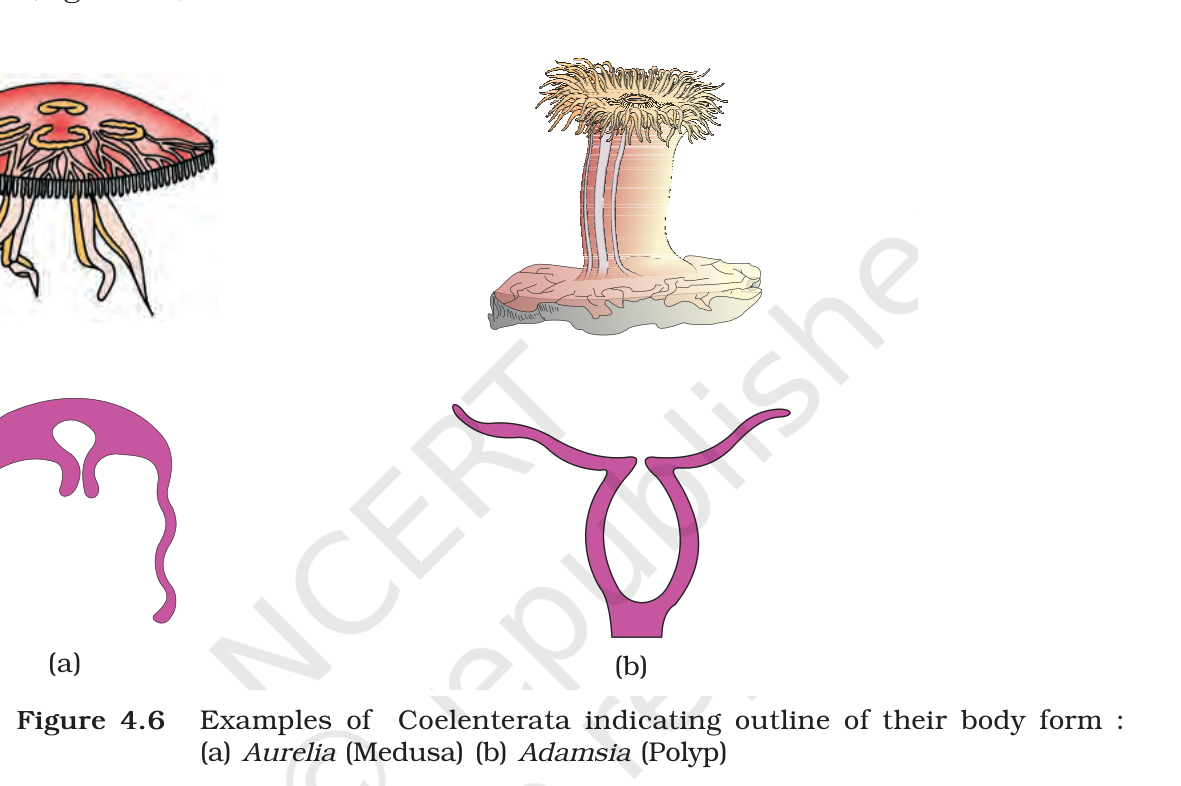
Two body forms appear in the phylum. A polyp is fixed and cylindrical, as in Hydra and Adamsia, while a medusa is shaped like an open umbrella and swims freely, as in Aurelia the jelly fish. Some cnidarians show both forms, and the cycle between them carries the name alternation of generations, or metagenesis: the polyps produce medusae asexually, and the medusae produce polyps sexually. Obelia is the standard example. Physalia, Pennatula, Gorgonia and Meandrina are the other examples printed in the chapter.
2.3 Phylum Ctenophora
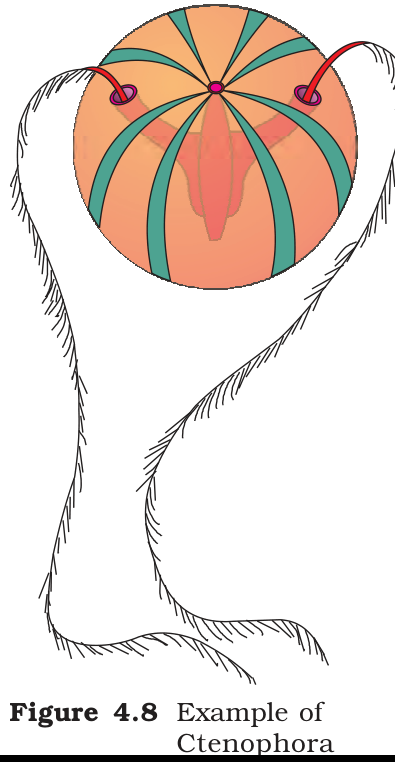
Ctenophores are the sea walnuts or comb jellies. They are exclusively marine, radially symmetrical and diploblastic, with tissue level organisation. Eight rows of ciliated comb plates run on the outside of the body and drive locomotion. Food is digested both outside and inside the cells. The group also glows: the ability of a living organism to emit light, called bioluminescence, is well marked here. Sexes are not separate, reproduction is sexual, fertilisation is external, and development is indirect. Pleurobrachia and Ctenoplana are the examples.
2.3.1 Practice from the NCERT exercise, question 4
Exercise 4. Intracellular digestion happens inside a cell, where food is taken into a food vacuole and broken down by enzymes there. Extracellular digestion happens outside the cell, in a cavity or a gut, where enzymes are released and the broken products are then absorbed. Sponges digest inside their cells, while coelenterates do both, breaking food down in the gastrovascular cavity and completing the work inside cells.
2.3.2 The lower phyla side by side
| Feature | Porifera | Coelenterata | Ctenophora |
|---|---|---|---|
| Level of organisation | cellular | tissue | tissue |
| Symmetry | mostly asymmetrical | radial | radial |
| Special structure | choanocytes and spicules | cnidoblasts with nematocysts | eight rows of comb plates |
| Body forms | one form, the sponge | polyp and medusa in some | one form, the comb jelly |
| Example | Sycon, Spongilla | Hydra, Aurelia, Obelia | Pleurobrachia, Ctenoplana |
Every entry in the table repeats a fact printed in the phylum sections above. The three phyla sit at the base of the animal scheme in this chapter. Sponges are the only ones at the cellular level, and their body does not build tissues. Coelenterates and ctenophores both use water currents and tentacles, but their tools differ: stinging capsules in one group and sticky comb plates in the other. That is why the two are kept in separate phyla even though both show radial symmetry.
The canal system of a sponge deserves one more line, because the same water current serves three systems at once. Food particles are trapped as the water passes, oxygen is taken from the water and wastes are carried out with it. The animal therefore needs no gut, no blood vessels and no lungs in the usual sense. Its larva swims freely, which lets the group spread even though the adult stays fixed to a surface.
In a coelenterate the gastrovascular cavity does two jobs with one opening. It digests the captured prey, and it also distributes the digested food through the body, because there are no blood vessels to carry it. That is one reason the body plan stays simple and the animal stays thin. The tentacles and the stinging cells around the mouth do the hunting, and the cavity does the rest.
2.3.3 Three body plans, one paragraph each
The three phyla can also be told apart by what each one does with water. A sponge pushes water through its body and lives on what the current brings. A coelenterate sits in the water and reaches into it with tentacles. A ctenophore swims through the water and rows itself along with comb plates. That single question about water separates the three groups faster than a list of names.
The skeleton of a sponge is made of spicules or spongin fibres, and that frame keeps the canal system open while the current passes. Corals among the coelenterates build a skeleton of calcium carbonate, which is why the group can leave a hard structure behind on the sea floor. In a ctenophore the two sexes are not separate, the egg is fertilised outside the body, and development is indirect. The comb plates give the group its common name, and the same plates make the animal one of the most active swimmers among the three phyla.
The three groups also differ in the structures that name them. In a cnidarian the cnidoblasts carry the stinging capsules that give the phylum its name, and those cells sit on the tentacles and the body. In a ctenophore the eight comb plates are external and ciliated, and they supply both the locomotion and the common name. In a sponge the choanocytes line the internal spaces and keep the water moving.
Exam
For a Porifera question, the water path is the answer: ostium, spongocoel, osculum, with choanocytes lining the way. Add that the same current serves feeding, respiration and waste removal. For a coelenterate question, give cnidoblasts with nematocysts, the two body forms polyp and medusa, and metagenesis with Obelia. These three points cover almost every question set on the phylum.
Common mistake
Do not say sponges have tissues or organs, because their organisation stops at the cellular level. Do not write that the osculum is the mouth, because a sponge has no true mouth; the osculum is the exit of the water current. Do not confuse a polyp with a medusa: the polyp is fixed and cylindrical, the medusa is free-swimming and umbrella-shaped. And do not call comb jellies cnidarians, because the comb plates belong to Ctenophora.