

Concepts: Platyhelminthes, Aschelminthes and Annelida
Animal Kingdom18 min readLesson 3 of 8
3.1 Phylum Platyhelminthes: the flatworms
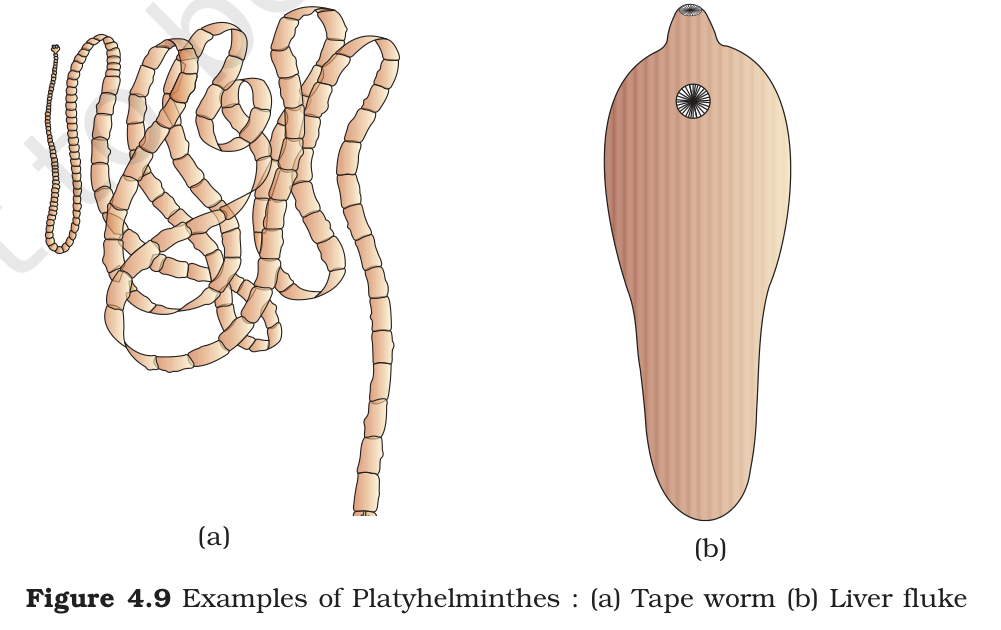
Platyhelminthes have a body flattened from top to bottom, which gives them the name flatworms. Most are endoparasites inside animals, including human beings. They are bilaterally symmetrical, triploblastic and acoelomate, and their organisation reaches the organ level. The parasitic forms carry hooks and suckers that grip host tissue, and some absorb nutrients straight through the body surface from the host. The flattened body helps the worm lie close against that tissue. Specialised cells called flame cells look after osmoregulation and excretion. There are no separate sexes. The egg is fertilised inside the body, and the young pass through several larval stages. Planaria is a member of the group with a high capacity to regenerate lost parts. Taenia, the tapeworm, and Fasciola, the liver fluke, are the examples printed in the chapter.
3.2 Phylum Aschelminthes: the roundworms
The body of an aschelminthe is circular in cross-section, which is why the group is called roundworms. They may live free in water or soil, or as parasites of plants and animals. Their body is built at the organ system level. Symmetry is bilateral, the germ layers are three, and the cavity is a pseudocoelom. The gut is complete, with a muscular pharynx that is well developed. Waste leaves the body cavity through a tube that opens at an excretory pore. The sexes are separate, and the female is often longer than her mate. The egg is fertilised internally, and development may be direct, with young that resemble the adult, or indirect. Ascaris, the roundworm, Wuchereria, the filarial worm, and Ancylostoma, the hookworm, are the examples.
3.3 Phylum Annelida: the segmented worms
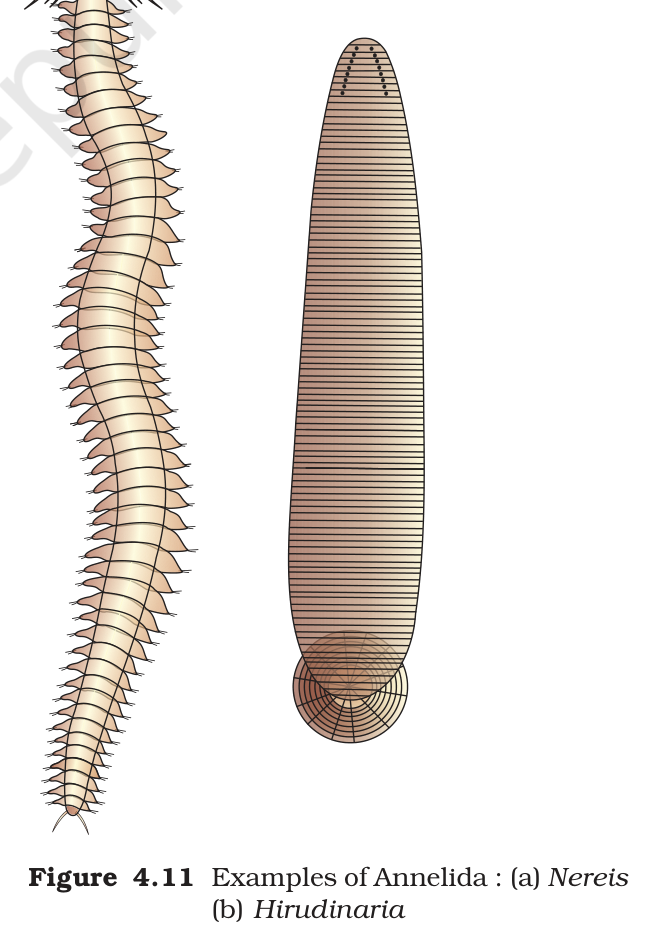
Annelids may be aquatic, in sea water or fresh water, or terrestrial. Some are free-living and some are parasitic. They show organ system organisation and bilateral symmetry, and they are triploblastic, metamerically segmented and coelomate. The body surface is marked out into segments called metameres, and the phylum name itself comes from the Latin word for a little ring. Longitudinal and circular muscles in the body wall drive locomotion. Aquatic annelids such as Nereis carry lateral appendages called parapodia, which help in swimming. The circulatory system is closed. Nephridia take care of osmoregulation and excretion. The nervous system carries paired ganglia, and lateral nerves link them to a ventral nerve cord that is double. Nereis has separate sexes, while the earthworm and the leech carry both sexes in one body. Reproduction is sexual. Nereis, Pheretima the earthworm and Hirudinaria the blood-sucking leech are the examples.
3.3.1 Practice from the NCERT exercises, questions 6, 13 and 14
Exercise 6. The parasitic platyhelminths carry hooks and suckers for attachment to the host, they have a flattened body that fits inside host tissues, and some of them absorb nutrients directly through the body surface instead of feeding through a gut. Their tegument and their high reproductive output also help them survive inside a host.
Exercise 13. Segmentation first appears in Annelida, so option (c) is correct. The other listed phyla do not build a body of repeated metameres.
Exercise 14, the annelid and flatworm pairs. Operculum goes with Osteichthyes, parapodia with Annelida, radula with Mollusca, choanocytes with Porifera, and flame cells belong with the platyhelminth excretory system. The pairs are worth memorising as a set, because the same list reappears in chapter tests and in the exemplar.
Exam
Three phyla answers repeat the same skeleton: symmetry, germ layers, coelom, level of organisation, then the special structures. For flatworms the special structures are hooks, suckers and flame cells. For roundworms they are the complete gut with a muscular pharynx and the pseudocoelom. For annelids they are metameric segmentation, parapodia, closed circulation and nephridia. Name the examples with each.
Common mistake
Do not call Fasciola a pseudocoelomate, because Platyhelminthes are acoelomate; that is one of the common wrong options in the exemplar. Do not say the roundworm gut is incomplete, since Aschelminthes have a complete alimentary canal. Do not mix up Nereis and earthworm sexuality: Nereis is dioecious, while the earthworm and the leech are monoecious.
3.3.2 The three worm phyla compared
| Feature | Platyhelminthes | Aschelminthes | Annelida |
|---|---|---|---|
| Body form | flattened | circular in section | ringed segments |
| Coelom | absent | pseudocoelom | true coelom |
| Excretory organ | flame cells | excretory tube | nephridia |
| Digestion | incomplete or absent in some | complete canal | complete canal |
| Example | Taenia, Fasciola | Ascaris, Wuchereria | Nereis, Pheretima |
The table shows why the worm phyla are separated even though all three can live as parasites or in damp places. A flatworm has no cavity around its gut, so the body stays thin and exchange happens close to the surface. A roundworm has a cavity that is not lined by mesoderm, and its complete canal and muscular pharynx handle a steady food supply. An annelid has a true coelom, a segmented body and a closed circulation, so its organs can be packed more efficiently and the segments can move one by one. For an exam answer, begin with the coelom type, then add the excretory organ and the digestive plan, because those three characters separate the phyla without any risk of confusion.
The special structures also tell a story about habitat. Flame cells and a flattened body suit a parasite that lives pressed against host tissue. A muscular pharynx and a complete gut suit a worm that feeds on fluids and particles in the soil or in a host. Parapodia and a closed circulatory system suit an active animal that swims or crawls through sediment. Each structure is a working response to the way the animal lives, which is why the features are remembered together with the examples.