

Concepts: Factors affecting photosynthesis and exercise practice
Photosynthesis in Higher Plants24 min readLesson 6 of 8
6.1 What sets the rate
The rate of photosynthesis is not fixed. It changes with the environment and with the plant itself. The external factors are light, carbon dioxide concentration, temperature and water. The plant factors include the number and size of leaves, their age, the number of stomata, the amount of chlorophyll and the internal CO2 level. A measuring question often gives one factor at a time and asks for the shape of the curve.
6.1.1 Light
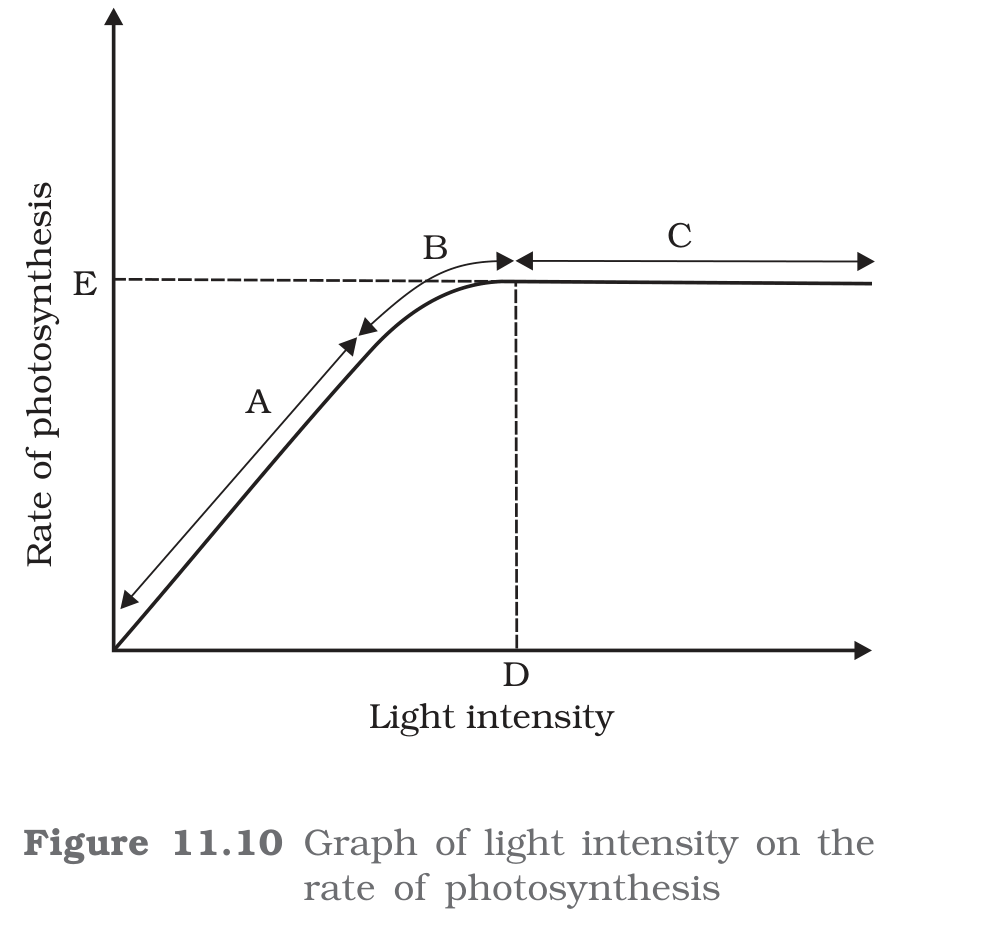
Light acts through intensity, quality and duration. The rate rises with intensity up to a point, then levels off because the dark reaction can no longer keep pace with the products of the light reaction. This plateau is called light saturation. Most full sunlight is well above the saturation point for a normal leaf, so on a bright day light is rarely the limiting factor. The quality of light matters too: red and blue are efficient, while green is poorly absorbed.
6.1.2 Carbon dioxide
CO2 is a small fraction of the air, about 0.04 per cent. It is the usual limiting factor in a normal field on a bright day, and increasing it to about 0.05 per cent can raise the rate, as greenhouse growers do. Pushing CO2 much higher becomes harmful. The reason CO2 limits so often is that it is far below the concentration the Calvin cycle could use.
6.1.3 Temperature
Photosynthetic enzymes have an optimum. The rate rises with temperature up to roughly 25 to 35 degrees Celsius for many plants and then falls, because the enzymes lose shape and because photorespiration increases faster than photosynthesis at high temperature. C4 plants often have a higher temperature optimum than C3 plants.
6.1.4 Water
Water is a raw material, but the effect of drought on photosynthesis is mostly indirect. When water is short, stomata close, CO2 entry falls and the rate drops. Water also affects the leaves through wilting, which reduces the surface receiving light.
6.1.5 Blackman law of limiting factors
A. F. Blackman put the idea simply: when a process is affected by several factors, its rate is set by the factor that is nearest to its minimum value. That factor is the limiting factor. If CO2 is plentiful and light is low, adding more CO2 does nothing; giving more light raises the rate. Once light is sufficient, CO2 becomes limiting. Figure 11.10 shows this on a graph of rate against light intensity, with A as the light-limited region, B where light stops limiting, C the plateau and D the region where another factor limits.
6.1.6 Exercise practice
The exercise questions that remain after the earlier pages are 8 and 9. Question 8 is answered with the graph above. Question 9 asks for three comparisons, and those are collected here:
C3 and C4 pathways. C3 uses RuBP and RuBisCO in the mesophyll and gives 3-phosphoglycerate as the first product. C4 uses PEP and PEP carboxylase in the mesophyll, gives oxaloacetate, and runs the Calvin cycle in the bundle sheath cells.
Cyclic and non-cyclic photophosphorylation. Cyclic uses only PS I, has a closed electron path and makes ATP but no NADPH or oxygen. Non-cyclic uses PS II and PS I, splits water, makes ATP, NADPH and oxygen.
Leaf anatomy of C3 and C4 plants. C3 leaves have ordinary mesophyll and no special sheath. C4 leaves show Kranz anatomy, with a ring of large bundle sheath cells around the vascular bundles and chloroplast-rich sheath cells.
A final control point: photosynthesis responds to several factors at once, and a single-factor graph is only valid while the other factors are held at a level where they are not limiting.
6.1.7 How the rate is measured and improved
The rate of photosynthesis is measured in several ways: the volume of oxygen released by a leaf in a sealed chamber, the amount of carbon dioxide taken up, or the dry mass added over a period. Each method measures a different part of the process, so values from different methods do not always agree exactly. In field experiments a leaf chamber records the rate under changing light or CO2, and the curve that results is the one drawn in the textbook.
Growers use these ideas directly. Because carbon dioxide in air is low, greenhouses are often enriched to a slightly higher CO2 level, which raises the rate until another factor limits it. Because high temperature favours photorespiration in C3 plants, the choice of crop for a hot region often falls on a C4 plant such as maize or sorghum. And because light saturation is reached well below full sunlight in many C3 leaves, shading crops during the hottest part of the day rarely helps the rate, though it may save water.
Exam
For a graph question, read the plateau as the point where the factor on the x axis stops being limiting, not as the maximum possible rate of the plant. For the law of limiting factors, write the factor nearest its minimum and add that raising any other factor does nothing until the limiting factor is relieved.
Common mistake
Do not say that the rate of photosynthesis keeps rising forever with light. The curve saturates because the Calvin cycle becomes the bottleneck. Do not claim that CO2 above 0.05 per cent always helps, because beyond a small increase it becomes harmful. Also do not use the saturation point from one experiment as a universal constant, since it depends on the species, the temperature and the leaf age.