

Concepts: The discovery of photosynthesis, the chloroplast and the pigments
Photosynthesis in Higher Plants24 min readLesson 1 of 8
1.1 What a green leaf actually does
Photosynthesis is the process that builds food from two simple raw materials, carbon dioxide and water, using light as the source of energy. Oxygen is released as a by-product. The overall account for a green plant is written as 6CO2 + 12H2O gives C6H12O6 + 6O2 + 6H2O in the presence of light and chlorophyll. The extra water on the right side is there because the oxygen released comes from water, not from carbon dioxide.
1.1.1 The experiments that built the idea
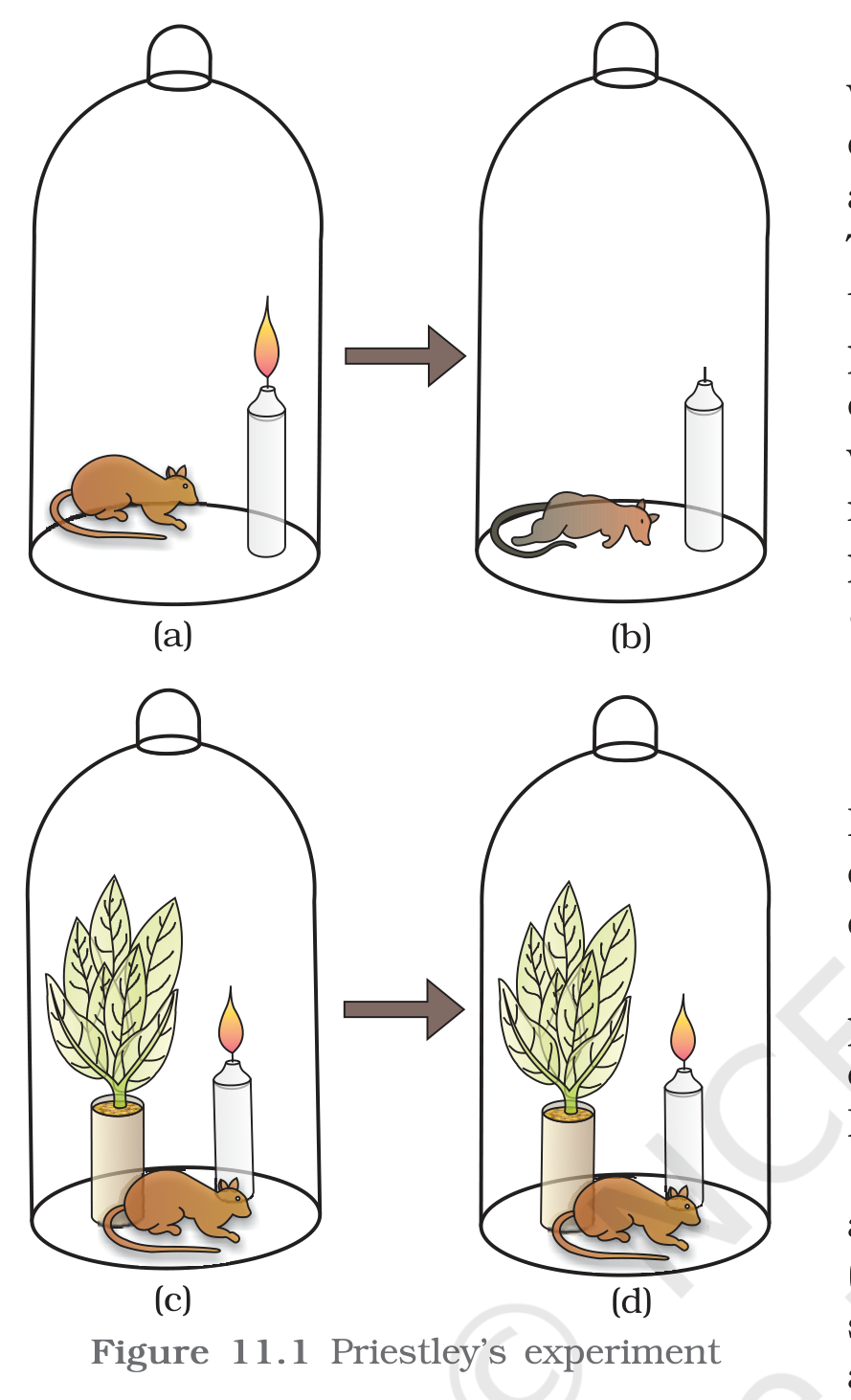
Joseph Priestley showed in 1770 that a burning candle or a mouse placed in a closed bell jar soon used up the air, but a mint plant kept in the same air restored it. Jan Ingenhousz followed in 1779 and showed that the restoration happened only in sunlight, so light was essential. Julius von Sachs found in 1854 that starch appears in the green parts of a plant kept in light, and that chlorophyll sits inside chloroplasts. T. W. Engelmann used a filamentous alga and a prism in 1883 and mapped the rate of photosynthesis across the spectrum, which gave the first action spectrum. Cornelius van Niel worked with purple and green bacteria in 1931 and concluded that water is the hydrogen donor, a conclusion later confirmed for green plants. Melvin Calvin used radioactive carbon in the 1950s to follow the path of carbon through the cycle that now carries his name.
1.1.2 Where it happens
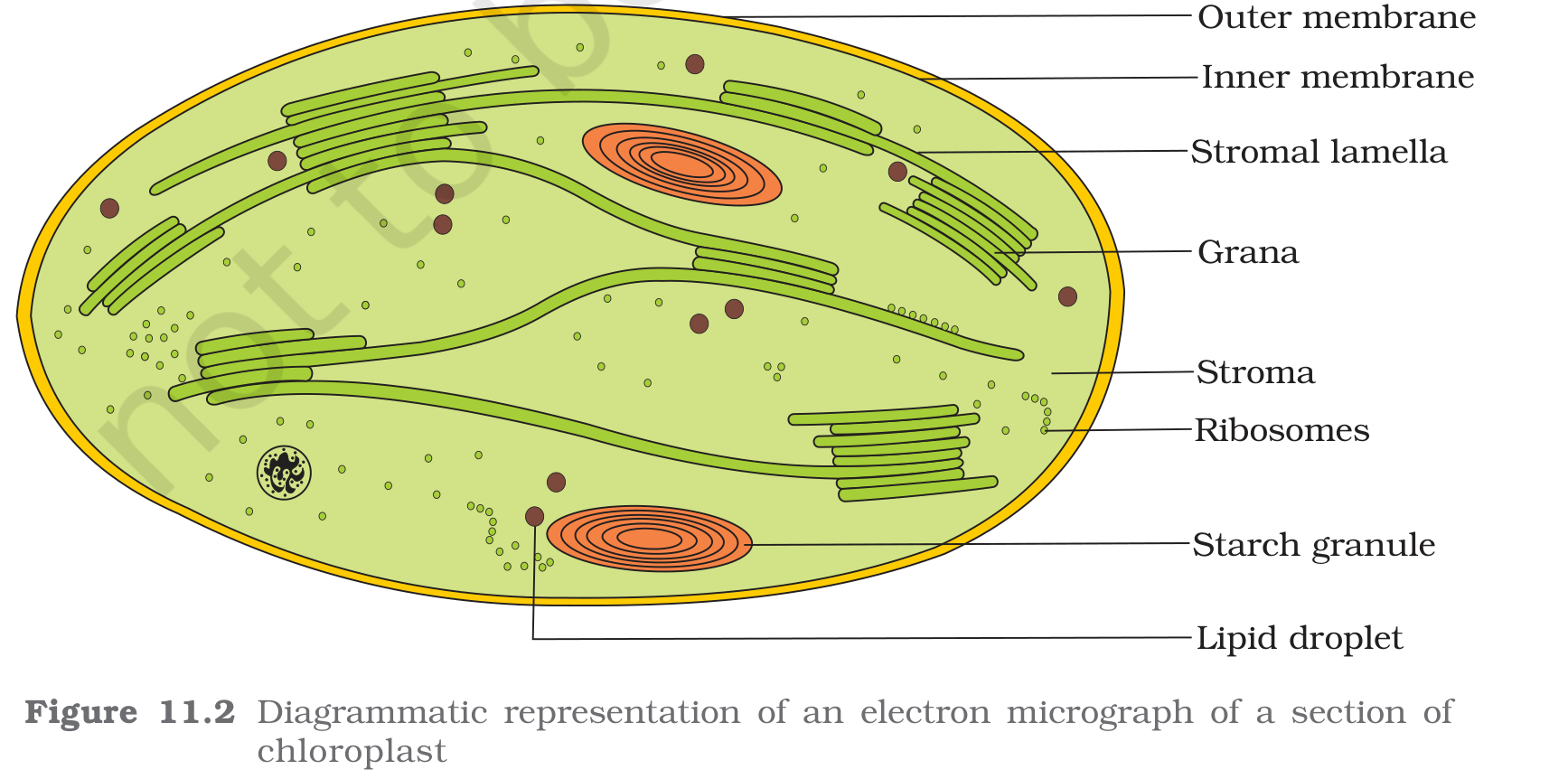
The site is the chloroplast, present mainly in the mesophyll cells of a leaf. A chloroplast has a double membrane envelope. Inside, a stack of flattened sacs called thylakoids forms a granum, and several grana are joined by stroma lamellae. The fluid around the grana is the stroma. The thylakoid membranes hold the pigments and the electron carriers of the light reaction, and the stroma holds the enzymes of carbon fixation. Ribosomes and small circular DNA also sit in the stroma. The figure of a chloroplast section shows the granum, stroma lamellae, stroma, starch grains and lipid droplets.
| Part of the chloroplast | What it contains | What happens there |
|---|---|---|
| Thylakoid membrane | Photosystems, pigments, electron carriers, ATP synthase | Light reaction |
| Thylakoid lumen | Proton pool | Proton gradient builds up |
| Stroma | RuBisCO and Calvin cycle enzymes | Carbon fixation |
1.1.3 The pigments
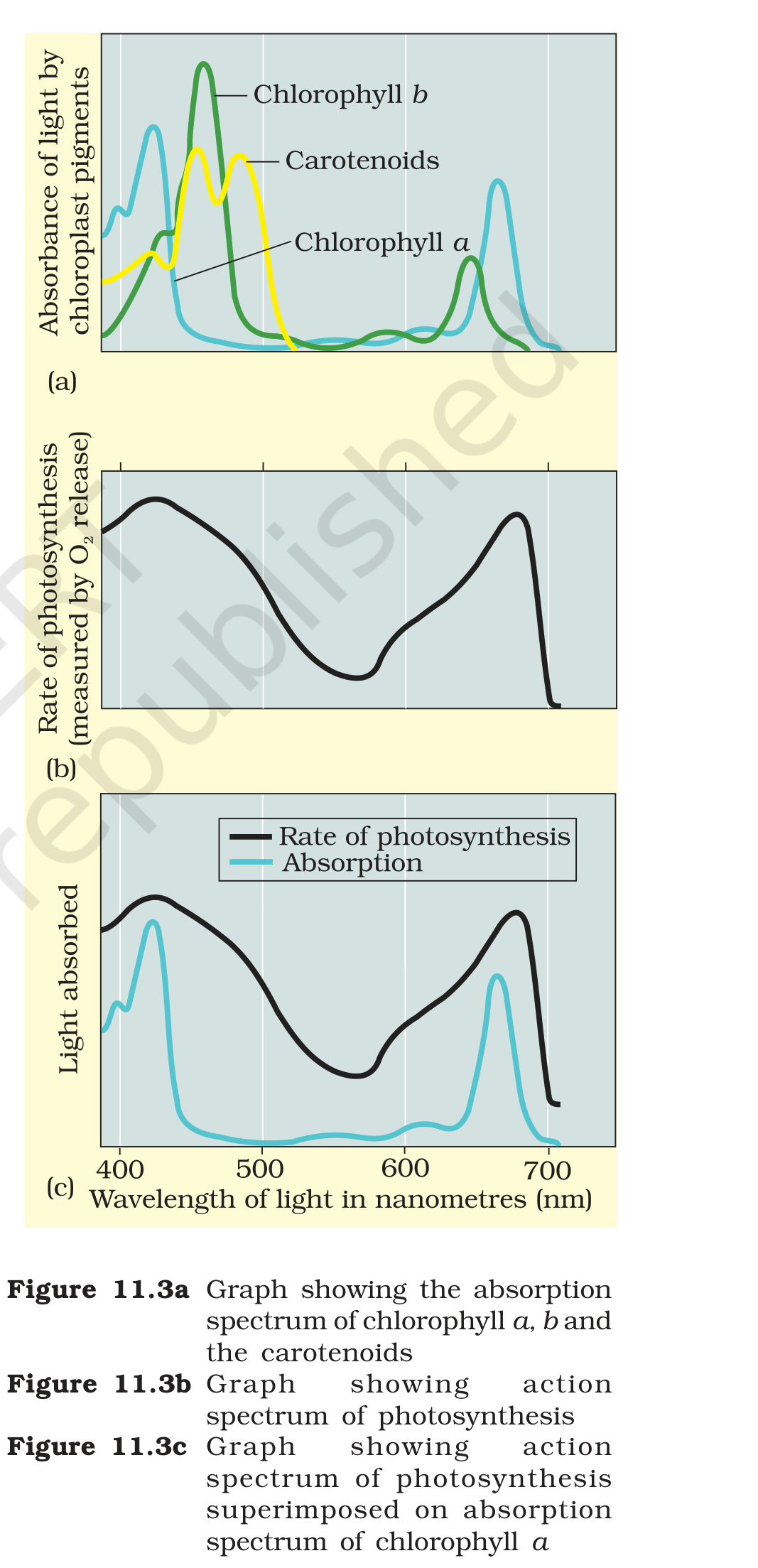
A leaf has several pigments, and together they cover more of the visible spectrum than any one pigment could. Chlorophyll a is blue-green and is the primary pigment that converts light energy into chemical energy at the reaction centre. Chlorophyll b is yellow-green and passes energy to chlorophyll a. Carotenoids, which include the orange carotenes and the yellow xanthophylls, are accessory pigments and also protect the pigment system from damage by excess light. Chlorophyll contains a magnesium ion at the centre of its porphyrin ring, and this is why magnesium deficiency shows up as yellowing between leaf veins.
The absorption spectrum of a pigment is a plot of how much light it absorbs at each wavelength. Chlorophyll a absorbs strongly in the blue-violet and red regions and hardly at all in the green, which is why leaves look green. The action spectrum of photosynthesis plots the rate of photosynthesis at each wavelength. When the two spectra are placed together, the peaks line up: photosynthesis is fastest in red and blue light. Engelmann's early experiment, the absorption curves of chlorophyll a and b, and the overlap of action and absorption spectra are the three panels of figure 11.3.
1.1.4 Practice from the NCERT exercises, questions 5, 6 and 7
Exercise 5. Plants that lack chlorophyll a could not carry out normal photosynthesis, because chlorophyll a is the primary pigment at the reaction centre that actually converts light energy. Chlorophyll b and the other accessory pigments widen the range of wavelengths that are absorbed and hand the energy to chlorophyll a, so they add efficiency and protection rather than replacing the primary pigment.
Exercise 6. A leaf kept in the dark turns yellow or pale green because chlorophyll is broken down and new pigment is not made in the dark. Carotenoids are more stable and stay longer, so their yellow and orange colours show through.
Exercise 7. Leaves on the sunny side are usually darker green than leaves in the shade, because leaves that receive more light build more chlorophyll and pack more chloroplasts into their mesophyll. The upper side of a leaf is deeper green than the lower side for the same reason, because the palisade layer faces the sun.
1.1.5 Who can photosynthesise
Leaves are the usual organs, but they are not the only ones. Green stems, petioles, sepals and even the green parts of some fruits contain chloroplasts and can fix carbon. Unicellular algae and cyanobacteria do the whole job inside a single cell. In higher plants the mesophyll cells hold most chloroplasts, and the stomata on the leaf surface control how much carbon dioxide enters the leaf.
The oxygen that leaves the plant comes from the water that the plant takes up, not from carbon dioxide. This was shown long ago by comparing green plants with purple bacteria and later confirmed with heavy oxygen. The water is split on the inner side of the thylakoid membrane, and the released oxygen diffuses out of the leaf.
Exam
For a question on the pigments, name chlorophyll a as the primary pigment and the carotenoids with chlorophyll b as accessory pigments, then give the two jobs of accessory pigments: absorbing wavelengths the primary pigment misses and protecting it from photo-damage. For the spectra, write that the action spectrum follows the absorption spectrum, with peaks in the red and blue regions and a trough in the green.
Common mistake
Do not say that the oxygen released during photosynthesis comes from carbon dioxide. The classic heavy isotope and bacterial experiments showed that water is the hydrogen donor and the source of the released oxygen. Do not put the whole light reaction in the stroma either, because the photosystems sit in the thylakoid membrane while the Calvin cycle runs in the stroma. The names of the magnesium ion in chlorophyll and the iron ion in the electron carriers are also commonly swapped.