

Concepts: The C4 pathway and photorespiration
Photosynthesis in Higher Plants24 min readLesson 5 of 8
5.1 When RuBisCO chooses oxygen
RuBisCO can accept either carbon dioxide or oxygen at its active site. When oxygen wins, the RuBP is split into one molecule of 3-phosphoglycerate and one molecule of phosphoglycolate, a two-carbon compound. The phosphoglycolate cannot be used in the Calvin cycle, so the plant has to send it through a long recovery route that releases CO2 and consumes ATP. Nothing useful is made and energy is spent. This wasteful process is photorespiration.
Photorespiration happens mostly in C3 plants on hot, bright, dry days. Stomata close to save water, the CO2 level inside the leaf falls and oxygen from the light reaction rises, so RuBisCO meets more oxygen than carbon dioxide. Oxygen itself competes with CO2 at the active site, and the balance decides which reaction is faster. The process uses O2 and releases CO2, but it produces no sugar, no ATP and no NADPH. It is not the same as respiration, because it does not harvest energy from food.
5.1.1 The C4 solution
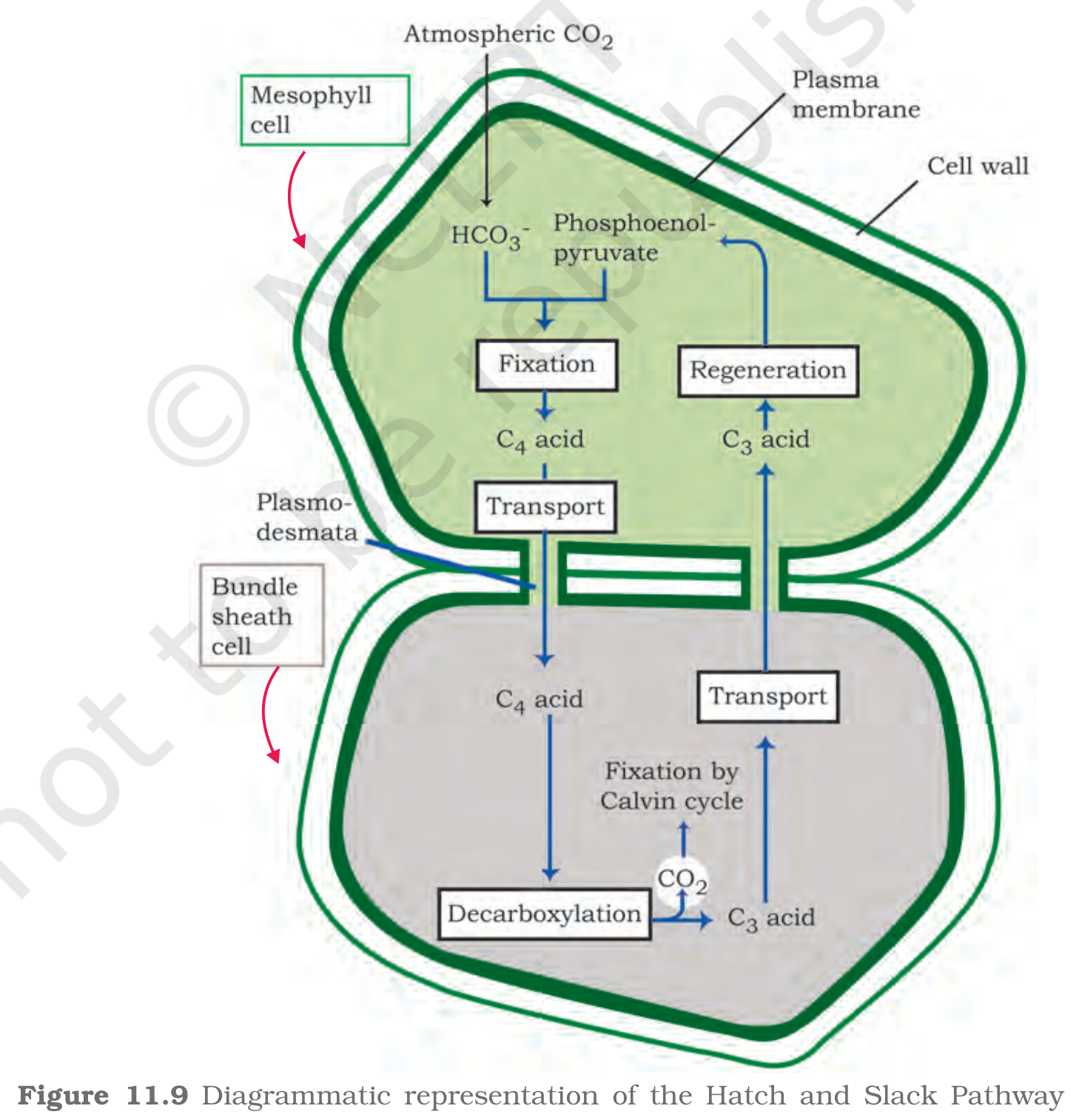
C4 plants separate the first fixation from the Calvin cycle in space. In the mesophyll cells the enzyme phosphoenolpyruvate carboxylase, or PEP carboxylase, joins CO2 to phosphoenolpyruvate, or PEP, and the first product is oxaloacetate, a four-carbon acid. This enzyme has a very high affinity for CO2 and no affinity for oxygen, so it fixes carbon efficiently even when CO2 is low inside the leaf. The oxaloacetate is reduced to malate or converted to aspartate and moved into the bundle sheath cells through plasmodesmata.
Inside the bundle sheath the four-carbon acid is decarboxylated, which releases CO2. The CO2 is now concentrated around RuBisCO, so the enzyme works almost entirely as a carboxylase and photorespiration is suppressed. The three-carbon acid left after decarboxylation, pyruvate or alanine, returns to the mesophyll and is used to remake PEP at the cost of ATP. The Calvin cycle itself runs in the bundle sheath cells, not in the mesophyll.
5.1.2 Kranz anatomy
C4 leaves show Kranz anatomy. The bundle sheath cells around the vascular bundles are large, thick walled and packed with chloroplasts, and the mesophyll cells form a thin layer around them. There are no intercellular spaces between the bundle sheath cells, which helps keep the CO2 from leaking out. This arrangement makes the division of labour possible. C4 plants include maize, sugarcane, sorghum and pearl millet, and they grow better than C3 plants in high temperature and high light.
The cost of the C4 route is extra ATP for rebuilding PEP. The benefit is a much lower loss of carbon through photorespiration, and a higher rate of net photosynthesis in hot, bright conditions. That is why the same leaf area of a C4 plant can add more biomass on a hot day than a C3 plant can.
5.1.3 Following the waste products
The two-carbon phosphoglycolate made by the oxygenase reaction is not usable directly. It loses its phosphate and becomes glycolate, which moves to the peroxisome and then to the mitochondrion, where carbon is released as CO2 and a serine molecule is formed. Recovering the rest costs ATP and NADPH. The net effect is a measurable loss: on a hot day a C3 leaf can send a large share of the carbon it fixes straight back out as CO2 through this route. C4 plants avoid the loss because the sheath raises the CO2 concentration before RuBisCO meets the substrate.
C4 photosynthesis is more expensive in ATP because each CO2 delivered to the sheath needs regeneration of PEP. In hot, bright, dry places this extra cost is worth paying, since the C3 plant loses far more energy through photorespiration. That is why maize and sugarcane dominate in the tropics while wheat and rice do well in cooler regions.
5.1.4 Practice from the NCERT exercises, questions 1 to 4 and 8
Exercise 1. External appearance alone cannot separate C3 from C4 plants reliably, but C4 plants often show faster growth and a higher temperature optimum. The certain answer needs the internal anatomy.
Exercise 2. Kranz anatomy gives the answer: a ring of large, chloroplast-rich bundle sheath cells with thick walls around the vascular bundles, and a thin mesophyll layer outside.
Exercise 3. Only the bundle sheath cells run the Calvin cycle, but the mesophyll pumps CO2 into them first, so RuBisCO faces a high CO2 concentration and loses little carbon to photorespiration.
Exercise 4. RuBisCO works as a carboxylase in the C4 bundle sheath because the sheath has a high CO2 level and a low oxygen level, which favours the carboxylation reaction.
Exercise 8. The graph in figure 11.10 plots the rate of photosynthesis against light intensity. In region A light is the limiting factor, at B the curve begins to level and light stops being limiting, and C to D shows the plateau where another factor such as CO2 or temperature holds the rate.
Exam
For a C4 answer, write the two cells, the two enzymes and the carbon compounds in order: mesophyll PEP carboxylase, PEP plus CO2 to oxaloacetate, then malate to the bundle sheath, decarboxylation, Calvin cycle with RuBisCO in the sheath, and pyruvate back to the mesophyll. For photorespiration, state the oxygenase action of RuBisCO, the two products, and the fact that no sugar and no useful energy are produced.
Common mistake
Do not call photorespiration a kind of respiration. Respiration breakdowns fuel and captures energy, while photorespiration wastes fixed carbon and spends ATP without making sugar. Do not place the Calvin cycle in the mesophyll of a C4 plant, because there it runs in the bundle sheath. Also do not write that C4 plants have no RuBisCO; they have it, but it is restricted to the bundle sheath cells.